



 Chat with AI
Exam 2: Financial Statements and Cash Flow

Exam 1: Introduction to Corporate Finance67 Questions
Exam 2: Financial Statements and Cash Flow94 Questions
Exam 3: Financial Statements Analysis and Financial Models120 Questions
Exam 4: Discounted Cash Flow Valuation134 Questions
Exam 5: Net Present Value and Other Investment Rules105 Questions
Exam 6: Making Capital Investment Decisions101 Questions
Exam 7: Risk Analysis, Real Options, and Capital Budgeting99 Questions
Exam 8: Interest Rates and Bond Valuation69 Questions
Exam 9: Stock Valuation77 Questions
Exam 10: Risk and Return: Lessons From Market History84 Questions
Exam 11: Return and Risk: the Capital Asset Pricing Model Capm136 Questions
Exam 12: An Alternative View of Risk and Return: The Arbitrage Pricing Theory51 Questions
Exam 13: Risk, Cost of Capital, and Valuation59 Questions
Exam 14: Efficient Capital Markets and Behavioral Challenges65 Questions
Exam 15: Long-Term Financing46 Questions
Exam 16: Capital Structure: Basic Concepts91 Questions
Exam 17: Capital Structure: Limits to the Use of Debt74 Questions
Exam 18: Valuation and Capital Budgeting for the Levered Firm57 Questions
Exam 19: Dividends and Other Payouts90 Questions
Exam 20: Raising Capital73 Questions
Exam 21: Leasing55 Questions
Exam 22: Options and Corporate Finance95 Questions
Exam 23: Options and Corporate Finance: Extensions and Applications46 Questions
Exam 24: Warrants and Convertibles58 Questions
Exam 25: Derivatives and Hedging Risk66 Questions
Exam 26: Short-Term Finance and Planning124 Questions
Exam 27: Cash Management59 Questions
Exam 28: Credit and Inventory Management61 Questions
Exam 29: Mergers, Acquisitions, and Divestitures83 Questions
Exam 30: Financial Distress52 Questions
Exam 31: International Corporate Finance95 Questions
Select questions type


 What is the amount of net new borrowing for 2011?

Your firm has net income of $198 on total sales of $1,200. Costs are $715 and depreciation is $145. The tax rate is 34%. The firm does not have interest expenses. What is the operating cash flow?
(Multiple Choice)
4.7/5  (82)
(82) Total assets are $1000,fixed assets are $700,long-term debt is $250,and short-term debt is $300. What is the amount of net working capital?
(Multiple Choice)
4.7/5 (94)
(94) Which of the following are all components of the statement of cash flows?
(Multiple Choice)
4.8/5 (73)
(73)  What is the operating cash flow for 2011?
When you are making a financial decision,the most relevant tax rate is the __________ rate.
(Multiple Choice)
5.0/5 (80)
(80) 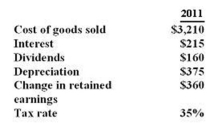 What are the sales for 2011?
Sometimes when businesses are critically delinquent on their tax liabilities,the tax authority comes in and literally seizes the business by chasing all of the employees out of the building and changing the locks. What does this tell you about the importance of taxes relative to our discussion of cash flow?
Why might a business owner want to avoid such an occurrence?
(Essay)
4.7/5 (82)
(82) _____ is calculated by adding back noncash expenses to net income and adjusting for changes in current assets and liabilities.
(Multiple Choice)
4.7/5 (74)
(74) 
Filters
- Essay(0)
- Multiple Choice(0)
- Short Answer(0)
- True False(0)
- Matching(0)