



 Chat with AI
Exam 2: Financial Statements and Cash Flow

Exam 1: Introduction to Corporate Finance67 Questions
Exam 2: Financial Statements and Cash Flow94 Questions
Exam 3: Financial Statements Analysis and Financial Models120 Questions
Exam 4: Discounted Cash Flow Valuation134 Questions
Exam 5: Net Present Value and Other Investment Rules105 Questions
Exam 6: Making Capital Investment Decisions101 Questions
Exam 7: Risk Analysis, Real Options, and Capital Budgeting99 Questions
Exam 8: Interest Rates and Bond Valuation69 Questions
Exam 9: Stock Valuation77 Questions
Exam 10: Risk and Return: Lessons From Market History84 Questions
Exam 11: Return and Risk: the Capital Asset Pricing Model Capm136 Questions
Exam 12: An Alternative View of Risk and Return: The Arbitrage Pricing Theory51 Questions
Exam 13: Risk, Cost of Capital, and Valuation59 Questions
Exam 14: Efficient Capital Markets and Behavioral Challenges65 Questions
Exam 15: Long-Term Financing46 Questions
Exam 16: Capital Structure: Basic Concepts91 Questions
Exam 17: Capital Structure: Limits to the Use of Debt74 Questions
Exam 18: Valuation and Capital Budgeting for the Levered Firm57 Questions
Exam 19: Dividends and Other Payouts90 Questions
Exam 20: Raising Capital73 Questions
Exam 21: Leasing55 Questions
Exam 22: Options and Corporate Finance95 Questions
Exam 23: Options and Corporate Finance: Extensions and Applications46 Questions
Exam 24: Warrants and Convertibles58 Questions
Exam 25: Derivatives and Hedging Risk66 Questions
Exam 26: Short-Term Finance and Planning124 Questions
Exam 27: Cash Management59 Questions
Exam 28: Credit and Inventory Management61 Questions
Exam 29: Mergers, Acquisitions, and Divestitures83 Questions
Exam 30: Financial Distress52 Questions
Exam 31: International Corporate Finance95 Questions
Select questions type


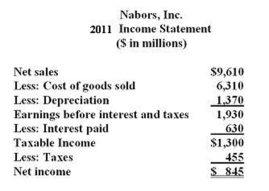
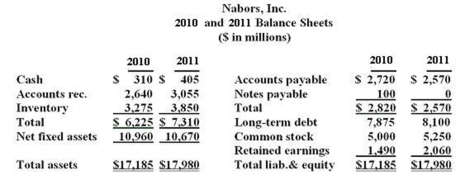 What is the operating cash flow for 2011?

At the beginning of the year,long-term debt of a firm is $310 and total debt is $350. At the end of the year,long-term debt is $280 and total debt is $370. The interest paid is $50. What is the amount of the cash flow to creditors?
(Multiple Choice)
4.9/5  (78)
(78) _____ refers to the cash flow that results from the firm's ongoing,normal business activities.
(Multiple Choice)
4.8/5 (75)
(75) Which of the following are included in current assets?
I. equipment
II. Inventory
III. accounts payable
IV. cash
(Multiple Choice)
4.9/5 (73)
(73) 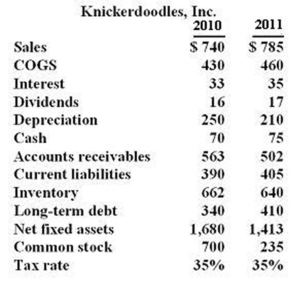 What is the net working capital for 2011?
Interpret,in words,what cash flow of the firm represents by discussing operating cash flow,changes in net working capital,and additions to fixed assets.
(Essay)
4.8/5 (69)
(69) The financial statement summarizing a firm's accounting performance over a period of time is the:
(Multiple Choice)
4.9/5 (68)
(68) Pete's Boats has beginning long-term debt of $180 and ending long-term debt of $210. The beginning and ending total debt balances are $340 and $360,respectively. The interest paid is $20. What is the amount of the cash flow to creditors?
(Multiple Choice)
4.8/5 (81)
(81) What is operating cash flow and how does it different from the total cash flow to the firm?
(Essay)
4.9/5 (81)
(81) _____ refers to the difference between a firm's current assets and its current liabilities.
(Multiple Choice)
4.8/5 (78)
(78) 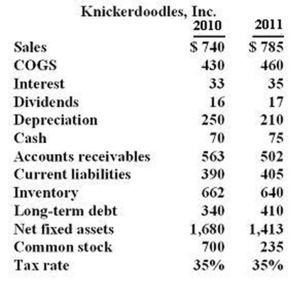 What is the cash flow to stockholders for 2011?
Which of the following is not included in the computation of operating cash flow?
(Multiple Choice)
4.9/5 (81)
(81) Peggy Grey's Cookies has net income of $360. The firm pays out 40% of the net income to its shareholders as dividends. During the year,the company sold $80 worth of common stock. What is the cash flow to stockholders?
(Multiple Choice)
4.7/5 (80)
(80) Your _____ tax rate is the amount of tax payable on the next taxable dollar you earn.
(Multiple Choice)
4.8/5 (67)
(67) According to Generally Accepted Accounting Principles,costs are:
(Multiple Choice)
4.9/5 (81)
(81) 
Filters
- Essay(0)
- Multiple Choice(0)
- Short Answer(0)
- True False(0)
- Matching(0)