



 Chat with AI
Exam 2: Financial Statements and Cash Flow

Exam 1: Introduction to Corporate Finance67 Questions
Exam 2: Financial Statements and Cash Flow94 Questions
Exam 3: Financial Statements Analysis and Financial Models120 Questions
Exam 4: Discounted Cash Flow Valuation134 Questions
Exam 5: Net Present Value and Other Investment Rules105 Questions
Exam 6: Making Capital Investment Decisions101 Questions
Exam 7: Risk Analysis, Real Options, and Capital Budgeting99 Questions
Exam 8: Interest Rates and Bond Valuation69 Questions
Exam 9: Stock Valuation77 Questions
Exam 10: Risk and Return: Lessons From Market History84 Questions
Exam 11: Return and Risk: the Capital Asset Pricing Model Capm136 Questions
Exam 12: An Alternative View of Risk and Return: The Arbitrage Pricing Theory51 Questions
Exam 13: Risk, Cost of Capital, and Valuation59 Questions
Exam 14: Efficient Capital Markets and Behavioral Challenges65 Questions
Exam 15: Long-Term Financing46 Questions
Exam 16: Capital Structure: Basic Concepts91 Questions
Exam 17: Capital Structure: Limits to the Use of Debt74 Questions
Exam 18: Valuation and Capital Budgeting for the Levered Firm57 Questions
Exam 19: Dividends and Other Payouts90 Questions
Exam 20: Raising Capital73 Questions
Exam 21: Leasing55 Questions
Exam 22: Options and Corporate Finance95 Questions
Exam 23: Options and Corporate Finance: Extensions and Applications46 Questions
Exam 24: Warrants and Convertibles58 Questions
Exam 25: Derivatives and Hedging Risk66 Questions
Exam 26: Short-Term Finance and Planning124 Questions
Exam 27: Cash Management59 Questions
Exam 28: Credit and Inventory Management61 Questions
Exam 29: Mergers, Acquisitions, and Divestitures83 Questions
Exam 30: Financial Distress52 Questions
Exam 31: International Corporate Finance95 Questions
Select questions type


Discuss the difference between book values and market values on the balance sheet and explain which is more important to the financial manager and why.
(Essay)
4.9/5  (75)
(75) When making financial decisions related to assets,you should:
(Multiple Choice)
4.7/5 (87)
(87) One of the reasons why cash flow analysis is popular is because:
(Multiple Choice)
4.8/5 (76)
(76) _____ refers to the firm's interest payments less any net new borrowing.
(Multiple Choice)
4.7/5 (89)
(89) A firm has $450 in inventory,$700 in fixed assets,$210 in accounts receivable,$50 in accounts payable,and $60 in cash. What is the amount of the current assets?
(Multiple Choice)
4.7/5 (86)
(86) Which one of the following assets is generally the most liquid?
(Multiple Choice)
4.9/5 (75)
(75) 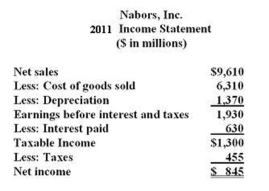
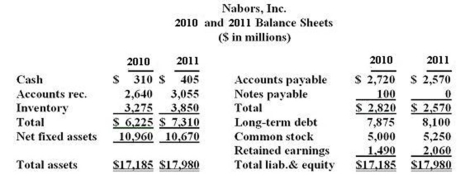 What is the amount of the net capital spending for 2011?
Note that in all of our cash flow computations to determine cash flow of the firm,we never include the addition to retained earnings. Why not?
Is this an oversight?
(Essay)
4.9/5 (70)
(70) 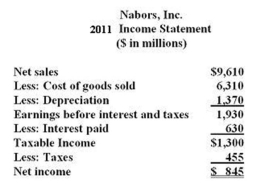
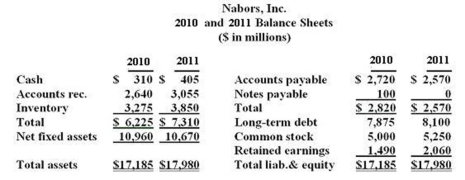 What is the cash flow to creditors for 2011?
Thompson's Jet Skis has operating cash flow of $218. Depreciation is $45 and interest paid is $35. A net total of $69 was paid on long-term debt. The firm spent $180 on fixed assets and increased net working capital by $38. What is the amount of the cash flow to stockholders?
(Multiple Choice)
4.7/5 (82)
(82) Note that we added depreciation back to operating cash flow and to additions to fixed assets. Why add it back twice?
Isn't this double-counting?
(Essay)
4.8/5 (79)
(79) Which of the following statements concerning the income statement is true?
(Multiple Choice)
4.9/5 (79)
(79) Explain why the income statement is not a good representation of cash flow.
(Essay)
4.9/5 (59)
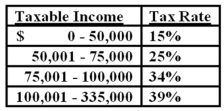
(59) The tax rates are as shown. Your firm currently has taxable income of $79,400. How much additional tax will you owe if you increase your taxable income by $21,000?
(Multiple Choice)
4.9/5 (79)
(79) Mart's Boutique has sales of $670,000 and costs of $460,000. Interest expense is $50,000 and depreciation is $55,000. The tax rate is 34%. What is the net income?
(Multiple Choice)
4.9/5 (72)
(72) 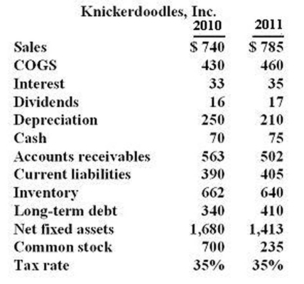 What is net new borrowing for 2011?
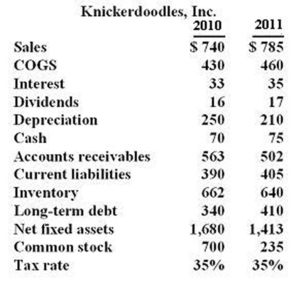 What is net capital spending for 2011?
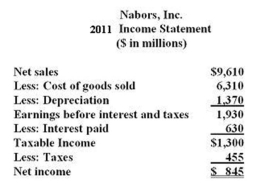
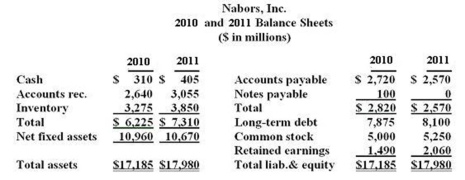 What is the cash flow of the firm for 2011?

Filters
- Essay(0)
- Multiple Choice(0)
- Short Answer(0)
- True False(0)
- Matching(0)