



 Chat with AI
Exam 2: Financial Statements and Cash Flow

Exam 1: Introduction to Corporate Finance67 Questions
Exam 2: Financial Statements and Cash Flow94 Questions
Exam 3: Financial Statements Analysis and Financial Models120 Questions
Exam 4: Discounted Cash Flow Valuation134 Questions
Exam 5: Net Present Value and Other Investment Rules105 Questions
Exam 6: Making Capital Investment Decisions101 Questions
Exam 7: Risk Analysis, Real Options, and Capital Budgeting99 Questions
Exam 8: Interest Rates and Bond Valuation69 Questions
Exam 9: Stock Valuation77 Questions
Exam 10: Risk and Return: Lessons From Market History84 Questions
Exam 11: Return and Risk: the Capital Asset Pricing Model Capm136 Questions
Exam 12: An Alternative View of Risk and Return: The Arbitrage Pricing Theory51 Questions
Exam 13: Risk, Cost of Capital, and Valuation59 Questions
Exam 14: Efficient Capital Markets and Behavioral Challenges65 Questions
Exam 15: Long-Term Financing46 Questions
Exam 16: Capital Structure: Basic Concepts91 Questions
Exam 17: Capital Structure: Limits to the Use of Debt74 Questions
Exam 18: Valuation and Capital Budgeting for the Levered Firm57 Questions
Exam 19: Dividends and Other Payouts90 Questions
Exam 20: Raising Capital73 Questions
Exam 21: Leasing55 Questions
Exam 22: Options and Corporate Finance95 Questions
Exam 23: Options and Corporate Finance: Extensions and Applications46 Questions
Exam 24: Warrants and Convertibles58 Questions
Exam 25: Derivatives and Hedging Risk66 Questions
Exam 26: Short-Term Finance and Planning124 Questions
Exam 27: Cash Management59 Questions
Exam 28: Credit and Inventory Management61 Questions
Exam 29: Mergers, Acquisitions, and Divestitures83 Questions
Exam 30: Financial Distress52 Questions
Exam 31: International Corporate Finance95 Questions
Select questions type


Calculate net income based on the following information. Sales are $250,cost of goods sold is $160,depreciation expense is $35,interest paid is $20,and the tax rate is 34%.
(Multiple Choice)
4.8/5  (67)
(67) A firm starts its year with a positive net working capital. During the year,the firm acquires more short-term debt than it does short-term assets. This means that:
(Multiple Choice)
4.9/5 (55)
(55) The financial statement showing a firm's accounting value on a particular date is the:
(Multiple Choice)
4.9/5 (83)
(83)  What is the cash flow of the firm for 2011?
What is a liquid asset and why is it necessary for a firm to maintain a reasonable level of liquid assets?
(Essay)
4.7/5 (84)
(84) Given the tax rates as shown,what is the average tax rate for a firm with taxable income of $126,500?

(Multiple Choice)
4.8/5 (88)
(88) A(n) ____ asset is one which can be quickly converted into cash without significant loss in value.
(Multiple Choice)
4.8/5 (82)
(82) 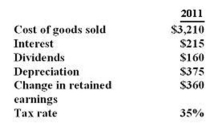 What is the operating cash flow for 2011?
Your _____ tax rate is the total taxes you pay divided by your taxable income.
(Multiple Choice)
4.8/5 (86)
(86) Which of the following accounts are included in shareholders' equity?
I. interest paid
II. retained earnings
III. capital surplus
IV. long-term debt
(Multiple Choice)
4.8/5 (71)
(71)  What is the change in net working capital from 2010 to 2011?
 (Multiple Choice)
4.8/5 (80)
(80) Brad's Company has equipment with a book value of $500 that could be sold today at a 50% discount. Its inventory is valued at $450 and could be sold to a competitor for that amount. The firm has $100 in cash and customers owe it $250. What is the accounting value of its liquid assets?
(Multiple Choice)
4.9/5 (95)
(95) 
Filters
- Essay(0)
- Multiple Choice(0)
- Short Answer(0)
- True False(0)
- Matching(0)