



 Chat with AI
Exam 9: Application: International Trade

Exam 1: Ten Principles of Economics347 Questions
Exam 2: Thinking Like an Economist535 Questions
Exam 3: Interdependence and the Gains From Trade442 Questions
Exam 4: The Market Forces of Supply and Demand569 Questions
Exam 5: Elasticity and Its Application503 Questions
Exam 6: Supply, Demand, and Government Policies556 Questions
Exam 7: Consumers, Producers, and the Efficiency of Markets460 Questions
Exam 8: Application: The Costs of Taxation422 Questions
Exam 9: Application: International Trade409 Questions
Exam 10: Measuring a Nations Income428 Questions
Exam 11: Measuring the Cost of Living436 Questions
Exam 12: Production and Growth417 Questions
Exam 13: Saving, Investment, and the Financial System473 Questions
Exam 14: The Basic Tools of Finance419 Questions
Exam 15: Unemployment571 Questions
Exam 16: The Monetary System423 Questions
Exam 17: Money Growth and Inflation388 Questions
Exam 18: Open-Economy Macroeconomic Models448 Questions
Exam 19: A Macroeconomic Theory of the Open Economy374 Questions
Exam 20: Aggregate Demand and Aggregate Supply471 Questions
Exam 21: The Influence of Monetary and Fiscal Policy on Aggregate Demand416 Questions
Exam 22: The Short-Run Trade-Off Between Inflation and Unemployment400 Questions
Exam 23: Six Debates Over Macroeconomic Policy235 Questions
Select questions type


The nation of Aquilonia has decided to end its policy of not trading with the rest of the world. When it ends its trade restrictions, it discovers that it is importing rice, exporting steel, and neither importing nor exporting TVs. We can conclude that producer surplus in Aquilonia is now
(Multiple Choice)
4.9/5  (84)
(84) The world price of a ton of steel is $1,000. Before Russia allowed trade in steel, the price of a ton of steel there was $650. Once Russia allowed trade in steel with other countries, Russia began
(Multiple Choice)
5.0/5 (78)
(78) Figure 9-16. The figure below illustrates a tariff. On the graph, Q represents quantity and P represents price. 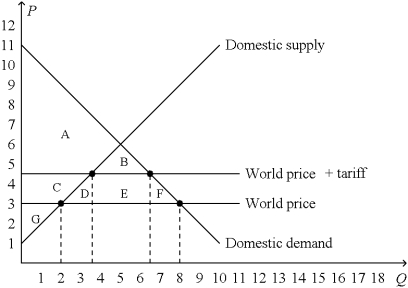 -Refer to Figure 9-16. The tariff
 (Multiple Choice)
4.9/5 (82)
(82) Figure 9-3. The domestic country is China.  -Refer to Figure 9-3. With trade, producer surplus in China is
 (Multiple Choice)
4.9/5 (74)
(74) At present, the United States uses a system of quotas to limit the amount of sugar imported into the country. Which of the following statements is most likely true?
(Multiple Choice)
4.8/5 (74)
(74) When a country takes a unilateral approach to free trade, it
(Multiple Choice)
4.8/5 (75)
(75) Figure 9-2  -Refer to Figure 9-2. As a result of trade, total surplus increases by
 (Multiple Choice)
5.0/5 (73)
(73) Figure 9-11  -Refer to Figure 9-11. Producer surplus plus consumer surplus in this market before trade is
 (Multiple Choice)
4.8/5 (69)
(69) When a country abandons no-trade policies in favor of free-trade policies and becomes an importer of steel, then the domestic price of steel will increase as a result.
(True/False)
4.9/5 (77)
(77) Characterize the two different approaches a nation can take to achieve free trade. Does one approach have an advantage over the other?
(Essay)
4.7/5 (64)
(64) Figure 9-11
-Refer to Figure 9-11. Consumer surplus in this market before trade is
-Refer to Figure 9-11. Consumer surplus in this market before trade is (Multiple Choice)
4.9/5 (87)
(87) Figure 9-20
The figure illustrates the market for rice in Vietnam. 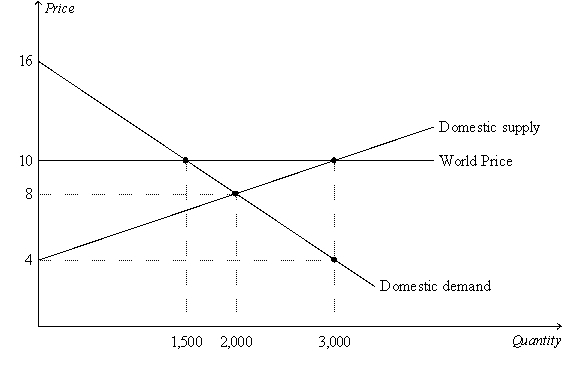 -Refer to Figure 9-20. Given that Vietnam is a small country, it is apparent from the figure that
 (Multiple Choice)
5.0/5 (88)
(88) Figure 9-17  -Refer to Figure 9-17. The amount of revenue collected by the government from the tariff is
 (Multiple Choice)
4.8/5 (97)
(97) Figure 9-1
The figure illustrates the market for wool in Scotland. 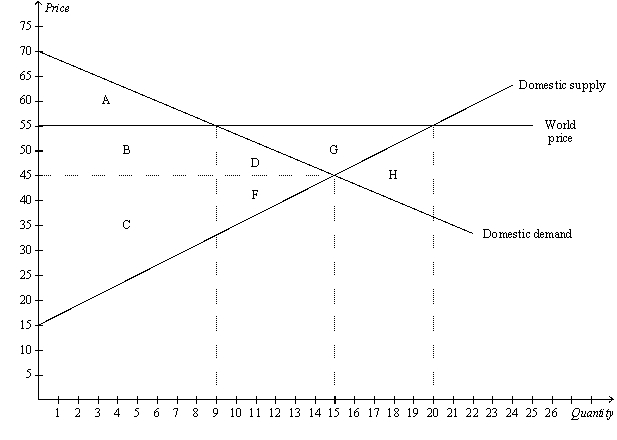 -Refer to Figure 9-1. With trade, Scotland will
 (Multiple Choice)
4.8/5 (78)
(78) When a country that imports a particular good imposes an import quota on that good,
(Multiple Choice)
4.8/5 (75)
(75) If Belgium exports chocolate to the rest of the world, then Belgian chocolate producers benefit from higher producer surplus, Belgian chocolate consumers are worse off because of lower consumer surplus, and total surplus in Belgium increases because of the exports of chocolate.
(True/False)
4.9/5 (68)
(68) The price of sugar that prevails in international markets is called the
(Multiple Choice)
4.8/5 (71)
(71) Chile is an importer of computer chips, taking the world price of $12 per chip as given. Suppose Chile imposes a $7 tariff on chips. Which of the following outcomes is possible?
(Multiple Choice)
4.8/5 (72)
(72) 
Filters
- Essay(0)
- Multiple Choice(0)
- Short Answer(0)
- True False(0)
- Matching(0)