



 Chat with AI
Exam 9: Application: International Trade

Exam 1: Ten Principles of Economics347 Questions
Exam 2: Thinking Like an Economist535 Questions
Exam 3: Interdependence and the Gains From Trade442 Questions
Exam 4: The Market Forces of Supply and Demand569 Questions
Exam 5: Elasticity and Its Application503 Questions
Exam 6: Supply, Demand, and Government Policies556 Questions
Exam 7: Consumers, Producers, and the Efficiency of Markets460 Questions
Exam 8: Application: The Costs of Taxation422 Questions
Exam 9: Application: International Trade409 Questions
Exam 10: Measuring a Nations Income428 Questions
Exam 11: Measuring the Cost of Living436 Questions
Exam 12: Production and Growth417 Questions
Exam 13: Saving, Investment, and the Financial System473 Questions
Exam 14: The Basic Tools of Finance419 Questions
Exam 15: Unemployment571 Questions
Exam 16: The Monetary System423 Questions
Exam 17: Money Growth and Inflation388 Questions
Exam 18: Open-Economy Macroeconomic Models448 Questions
Exam 19: A Macroeconomic Theory of the Open Economy374 Questions
Exam 20: Aggregate Demand and Aggregate Supply471 Questions
Exam 21: The Influence of Monetary and Fiscal Policy on Aggregate Demand416 Questions
Exam 22: The Short-Run Trade-Off Between Inflation and Unemployment400 Questions
Exam 23: Six Debates Over Macroeconomic Policy235 Questions
Select questions type


Figure 9-5  -Refer to Figure 9-5. Without trade, producer surplus amounts to
 (Multiple Choice)
4.9/5  (71)
(71) Figure 9-2  -Refer to Figure 9-2. With free trade, producer surplus is
 (Multiple Choice)
4.9/5 (92)
(92) Scenario 9-1
The before-trade domestic price of peaches in the United States is $40 per bushel. The world price of peaches is $52 per bushel. The U.S. is a price-taker in the market for peaches.
-Refer to Scenario 9-1. If trade in peaches is allowed, the
(Multiple Choice)
4.9/5 (68)
(68) Figure 9-15  -Refer to Figure 9-15. For the saddle market, area B represents
 (Multiple Choice)
4.9/5 (85)
(85) Figure 9-6  -Refer to Figure 9-6. When a tariff is imposed in the market, domestic producers
 (Multiple Choice)
5.0/5 (78)
(78) For Country A, the world price of soybeans exceeds the domestic equilibrium price of soybeans. As a result, international trade allows buyers of soybeans in Country A to experience greater consumer surplus than they otherwise would experience.
(True/False)
4.8/5 (80)
(80) The before-trade price of fish in Denmark is $10.00 per pound. The world price of fish is $6.00 per pound. Denmark is a price-taker in the fish market. If Denmark begins to allow trade in fish, its consumers of fish will become
(Multiple Choice)
4.9/5 (71)
(71) In a December 2007 New York Times column Paul Krugman argued in favor of
(Multiple Choice)
4.8/5 (78)
(78) Which of the following tools and concepts is useful in the analysis of international trade?
(Multiple Choice)
4.8/5 (69)
(69) Figure 9-10. The figure applies to Mexico and the good is rifles. 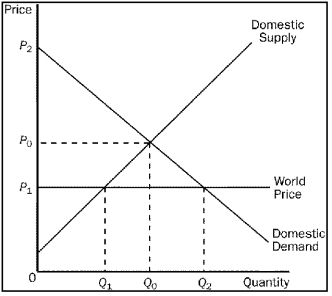 -Refer to Figure 9-10. The price and quantity of rifles in Mexico before trade is
 (Multiple Choice)
4.8/5 (73)
(73) Figure 9-18. On the diagram below, Q represents the quantity of peaches and P represents the price of peaches. The domestic country is Isoland. 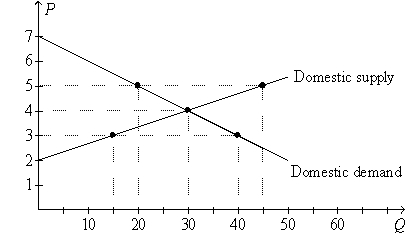 -Refer to Figure 9-18. Suppose Isoland changes from a no-trade policy to a policy that allows international trade. If the world price of peaches is $5, then the policy change results in a
 (Multiple Choice)
4.9/5 (76)
(76) Assume, for the U.S., that the domestic price of pineapples without international trade is lower than the world price of pineapples. This suggests that, in the production of pineapples,
(Multiple Choice)
4.8/5 (93)
(93) Figure 9-11  -Refer to Figure 9-11. Producer surplus plus consumer surplus in this market after trade is
 (Multiple Choice)
5.0/5 (82)
(82) Patterns of trade among nations are primarily determined by
(Multiple Choice)
4.8/5 (80)
(80) If Freedonia changes its laws to allow international trade in software and the world price is lower than its domestic price, then it must be the case that
(Multiple Choice)
4.9/5 (89)
(89) The results of a 2008 Los Angeles Times poll suggest that a significant majority of Americans believe that free international trade helps the American economy.
(True/False)
4.9/5 (85)
(85) Domestic producers of a good become better off, and domestic consumers of a good become worse off, when a country begins allowing international trade in that good and
(Multiple Choice)
4.8/5 (77)
(77) Scenario 9-2
For a small country called Boxland, the equation of the domestic demand curve for cardboard is
,
where represents the domestic quantity of cardboard demanded, in tons, and represents the price of a ton of cardboard.For Boxland, the equation of the domestic supply curve for cardboard is
,
where represents the domestic quantity of cardboard supplied, in tons, and again represents the price of a ton of cardboard.
-Refer to Scenario 9-2. If Boxland prohibits international trade in cardboard, then the equilibrium price of a ton of cardboard is
(Multiple Choice)
4.8/5 (88)
(88) Figure 9-14. On the diagram below, Q represents the quantity of crude oil and P represents the price of crude oil.  -Refer to Figure 9-14. A result of this country allowing international trade in crude oil is as follows:
 (Multiple Choice)
4.7/5 (82)
(82) When a country allows trade and becomes an importer of coal,
(Multiple Choice)
4.9/5 (72)
(72) 
Filters
- Essay(0)
- Multiple Choice(0)
- Short Answer(0)
- True False(0)
- Matching(0)