



 Chat with AI
Exam 9: Application: International Trade

Exam 1: Ten Principles of Economics347 Questions
Exam 2: Thinking Like an Economist535 Questions
Exam 3: Interdependence and the Gains From Trade442 Questions
Exam 4: The Market Forces of Supply and Demand569 Questions
Exam 5: Elasticity and Its Application503 Questions
Exam 6: Supply, Demand, and Government Policies556 Questions
Exam 7: Consumers, Producers, and the Efficiency of Markets460 Questions
Exam 8: Application: The Costs of Taxation422 Questions
Exam 9: Application: International Trade409 Questions
Exam 10: Measuring a Nations Income428 Questions
Exam 11: Measuring the Cost of Living436 Questions
Exam 12: Production and Growth417 Questions
Exam 13: Saving, Investment, and the Financial System473 Questions
Exam 14: The Basic Tools of Finance419 Questions
Exam 15: Unemployment571 Questions
Exam 16: The Monetary System423 Questions
Exam 17: Money Growth and Inflation388 Questions
Exam 18: Open-Economy Macroeconomic Models448 Questions
Exam 19: A Macroeconomic Theory of the Open Economy374 Questions
Exam 20: Aggregate Demand and Aggregate Supply471 Questions
Exam 21: The Influence of Monetary and Fiscal Policy on Aggregate Demand416 Questions
Exam 22: The Short-Run Trade-Off Between Inflation and Unemployment400 Questions
Exam 23: Six Debates Over Macroeconomic Policy235 Questions
Select questions type


Figure 9-5  -Refer to Figure 9-5. Bearing in mind that this country is "small," what would happen if there were a decrease in the price of horses within this country, given that wagons and horses are complements?
 (Multiple Choice)
4.7/5  (70)
(70) Use the graph to answer the following questions about CDs. 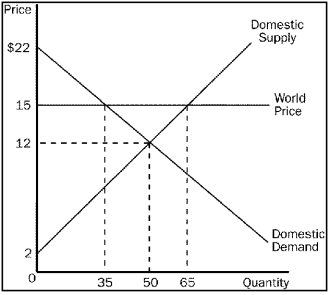 a. What is the equilibrium price of CDs before trade?
b. What is the equilibrium quantity of CDs before trade?
c. What is the price of CDs after trade is allowed?
d. What is the quantity of CDs exported after trade is allowed?
e. What is the amount of consumer surplus before trade?
f. What is the amount of consumer surplus after trade?
g. What is the amount of producer surplus before trade?
h. What is the amount of producer surplus after trade?
i. What is the amount of total surplus before trade?
j. What is the amount of total surplus after trade?
k. What is the change in total surplus because of trade?
a. What is the equilibrium price of CDs before trade?
b. What is the equilibrium quantity of CDs before trade?
c. What is the price of CDs after trade is allowed?
d. What is the quantity of CDs exported after trade is allowed?
e. What is the amount of consumer surplus before trade?
f. What is the amount of consumer surplus after trade?
g. What is the amount of producer surplus before trade?
h. What is the amount of producer surplus after trade?
i. What is the amount of total surplus before trade?
j. What is the amount of total surplus after trade?
k. What is the change in total surplus because of trade? (Essay)
4.8/5 (75)
(75) Figure 9-12  -Refer to Figure 9-12. Consumer surplus before trade is
 (Multiple Choice)
4.9/5 (72)
(72) If Argentina exports oranges to the rest of the world, Argentina's producers of oranges are worse off, and Argentina's consumers of oranges are better off, as a result of trade.
(True/False)
4.8/5 (77)
(77) Figure 9-1
The figure illustrates the market for wool in Scotland.  -Refer to Figure 9-1. In the absence of trade, total surplus in Scotland is represented by the area
 (Multiple Choice)
4.9/5 (88)
(88) When the nation of Brownland first permitted trade with other nations, domestic producers of wheat experienced an increase in producer surplus of $4 million and total surplus in Brownland's wheat market increased by $1 million. We can conclude that
(Multiple Choice)
4.9/5 (91)
(91) Figure 9-2  -Refer to Figure 9-2. If this country chooses to trade, the price of baskets in this country will be
 (Multiple Choice)
4.7/5 (67)
(67) When a country allows trade and becomes an exporter of a good, which of the following is not a consequence?
(Multiple Choice)
5.0/5 (89)
(89) Which of the following is not a commonly-advanced argument for trade restrictions?
(Multiple Choice)
4.9/5 (73)
(73) 
Filters
- Essay(0)
- Multiple Choice(0)
- Short Answer(0)
- True False(0)
- Matching(0)