



 Chat with AI
Exam 9: Application: International Trade

Exam 1: Ten Principles of Economics347 Questions
Exam 2: Thinking Like an Economist535 Questions
Exam 3: Interdependence and the Gains From Trade442 Questions
Exam 4: The Market Forces of Supply and Demand569 Questions
Exam 5: Elasticity and Its Application503 Questions
Exam 6: Supply, Demand, and Government Policies556 Questions
Exam 7: Consumers, Producers, and the Efficiency of Markets460 Questions
Exam 8: Application: The Costs of Taxation422 Questions
Exam 9: Application: International Trade409 Questions
Exam 10: Measuring a Nations Income428 Questions
Exam 11: Measuring the Cost of Living436 Questions
Exam 12: Production and Growth417 Questions
Exam 13: Saving, Investment, and the Financial System473 Questions
Exam 14: The Basic Tools of Finance419 Questions
Exam 15: Unemployment571 Questions
Exam 16: The Monetary System423 Questions
Exam 17: Money Growth and Inflation388 Questions
Exam 18: Open-Economy Macroeconomic Models448 Questions
Exam 19: A Macroeconomic Theory of the Open Economy374 Questions
Exam 20: Aggregate Demand and Aggregate Supply471 Questions
Exam 21: The Influence of Monetary and Fiscal Policy on Aggregate Demand416 Questions
Exam 22: The Short-Run Trade-Off Between Inflation and Unemployment400 Questions
Exam 23: Six Debates Over Macroeconomic Policy235 Questions
Select questions type


Figure 9-6  -Refer to Figure 9-6. The size of the tariff on carnations is
 (Multiple Choice)
4.8/5  (81)
(81) Economists feel that national security concerns never provide a legitimate rationale for trade restrictions.
(True/False)
4.9/5 (98)
(98) Scenario 9-2
For a small country called Boxland, the equation of the domestic demand curve for cardboard is
,
where represents the domestic quantity of cardboard demanded, in tons, and represents the price of a ton of cardboard.For Boxland, the equation of the domestic supply curve for cardboard is
,
where represents the domestic quantity of cardboard supplied, in tons, and again represents the price of a ton of cardboard.
-Refer to Scenario 9-2. Suppose the world price of cardboard is $45. Then, relative to the no-trade situation, international trade in cardboard produces which of the following results for Boxland?
(Multiple Choice)
4.9/5 (79)
(79) Some time ago, the nation of Republica opened up its paper market to international trade. Which of the following results of this policy change is consistent with the notion that Republica has a comparative advantage over other countries in producing paper?
(Multiple Choice)
4.9/5 (78)
(78) In recent years, which countries have taken a unilateral approach to the removal of trade restrictions?
(Multiple Choice)
4.8/5 (72)
(72) Scenario 9-2
For a small country called Boxland, the equation of the domestic demand curve for cardboard is
,
where represents the domestic quantity of cardboard demanded, in tons, and represents the price of a ton of cardboard.For Boxland, the equation of the domestic supply curve for cardboard is
,
where represents the domestic quantity of cardboard supplied, in tons, and again represents the price of a ton of cardboard.
-Refer to Scenario 9-2. Suppose the world price of cardboard is $45 and international trade is allowed. Then Boxland's consumers demand
(Multiple Choice)
4.8/5 (80)
(80) Figure 9-13  -Refer to Figure 9-13. With trade, the country
 (Multiple Choice)
4.8/5 (76)
(76) When a country that imports a particular good imposes a tariff on that good,
(Multiple Choice)
4.9/5 (82)
(82) Figure 9-5  -Refer to Figure 9-5. If this country allows free trade in wagons,
 (Multiple Choice)
4.8/5 (61)
(61) Figure 9-5
-Refer to Figure 9-5. Total surplus with trade exceeds total surplus without trade by
-Refer to Figure 9-5. Total surplus with trade exceeds total surplus without trade by (Multiple Choice)
4.9/5 (89)
(89) Figure 9-15  -Refer to Figure 9-15. Producer surplus with trade and without a tariff is
 (Multiple Choice)
4.9/5 (79)
(79) Figure 9-2  -Refer to Figure 9-2. The world price for baskets represents
 (Multiple Choice)
4.9/5 (79)
(79) Honduras is an importer of goose-down pillows. The world price of these pillows is $50. Honduras imposes a $7 tariff on pillows. Honduras is a price-taker in the pillow market. As a result of the tariff, the price of goose-down pillows in Honduras
(Multiple Choice)
4.9/5 (78)
(78) Figure 9-17  -Refer to Figure 9-17. When comparing no trade to free trade, the gains from trade amount to
 (Multiple Choice)
4.9/5 (79)
(79) Assume, for Singapore, that the domestic price of soybeans without international trade is higher than the world price of soybeans. This suggests that, in the production of soybeans,
(Multiple Choice)
4.9/5 (71)
(71) Figure 9-1
The figure illustrates the market for wool in Scotland. 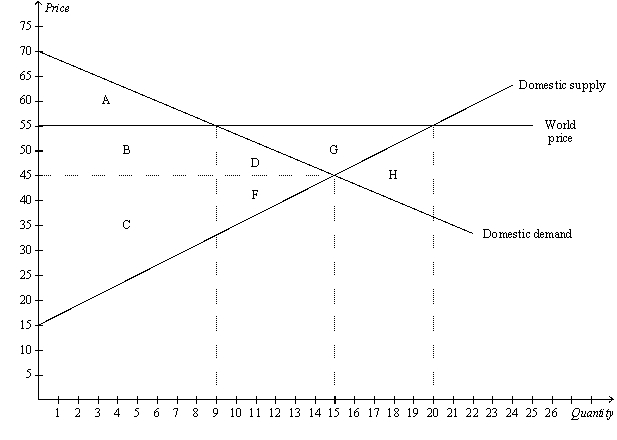 -Refer to Figure 9-1. In the absence of trade, total surplus in the Scotland wool market amounts to
 (Multiple Choice)
4.8/5 (93)
(93) "Owners of firms in young industries should be willing to incur temporary losses if they believe that those firms will be profitable in the long run." This observation helps to explain why many economists are skeptical about the
(Multiple Choice)
4.8/5 (75)
(75) In 2001, the U.S. agreed to support China's entry into the World Trade Organization. Under a special "safeguard provision" of that agreement, American companies or workers harmed by imports from China can ask the government for protection by demonstrating that
(Multiple Choice)
4.8/5 (71)
(71) When a country that imports shoes imposes a tariff on shoes, buyers of shoes in that country become worse off.
(True/False)
4.9/5 (82)
(82) Figure 9-15
-Refer to Figure 9-15. With the tariff, the domestic price and domestic quantity demanded are
-Refer to Figure 9-15. With the tariff, the domestic price and domestic quantity demanded are (Multiple Choice)
4.8/5 (68)
(68) 
Filters
- Essay(0)
- Multiple Choice(0)
- Short Answer(0)
- True False(0)
- Matching(0)