



 Chat with AI
Exam 9: Application: International Trade

Exam 1: Ten Principles of Economics347 Questions
Exam 2: Thinking Like an Economist535 Questions
Exam 3: Interdependence and the Gains From Trade442 Questions
Exam 4: The Market Forces of Supply and Demand569 Questions
Exam 5: Elasticity and Its Application503 Questions
Exam 6: Supply, Demand, and Government Policies556 Questions
Exam 7: Consumers, Producers, and the Efficiency of Markets460 Questions
Exam 8: Application: The Costs of Taxation422 Questions
Exam 9: Application: International Trade409 Questions
Exam 10: Measuring a Nations Income428 Questions
Exam 11: Measuring the Cost of Living436 Questions
Exam 12: Production and Growth417 Questions
Exam 13: Saving, Investment, and the Financial System473 Questions
Exam 14: The Basic Tools of Finance419 Questions
Exam 15: Unemployment571 Questions
Exam 16: The Monetary System423 Questions
Exam 17: Money Growth and Inflation388 Questions
Exam 18: Open-Economy Macroeconomic Models448 Questions
Exam 19: A Macroeconomic Theory of the Open Economy374 Questions
Exam 20: Aggregate Demand and Aggregate Supply471 Questions
Exam 21: The Influence of Monetary and Fiscal Policy on Aggregate Demand416 Questions
Exam 22: The Short-Run Trade-Off Between Inflation and Unemployment400 Questions
Exam 23: Six Debates Over Macroeconomic Policy235 Questions
Select questions type


Using the graph below, answer the following questions about hammers. 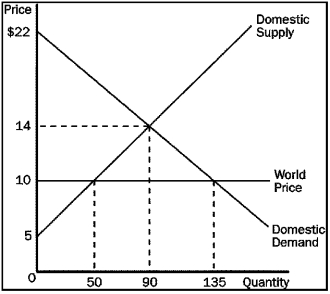 a. What is the equilibrium price of hammers before trade?
b. What is the equilibrium quantity of hammers before trade?
c. What is the price of hammers after trade is allowed?
d. What is the quantity of hammers imported after trade is allowed?
e. What is the amount of consumer surplus before trade?
f. What is the amount of consumer surplus after trade?
g. What is the amount of producer surplus before trade?
h. What is the amount of producer surplus after trade?
i. What is the amount of total surplus before trade?
j. What is the amount of total surplus after trade?
k. What is the change in total surplus because of trade?
a. What is the equilibrium price of hammers before trade?
b. What is the equilibrium quantity of hammers before trade?
c. What is the price of hammers after trade is allowed?
d. What is the quantity of hammers imported after trade is allowed?
e. What is the amount of consumer surplus before trade?
f. What is the amount of consumer surplus after trade?
g. What is the amount of producer surplus before trade?
h. What is the amount of producer surplus after trade?
i. What is the amount of total surplus before trade?
j. What is the amount of total surplus after trade?
k. What is the change in total surplus because of trade? (Essay)
4.8/5  (87)
(87) Tariffs cause deadweight loss because they move the price of an imported product closer to the equilibrium without trade, thus reducing the gains from trade.
(True/False)
4.8/5 (95)
(95) "Trade raises the economic well-being of a nation in the sense that the gains of the winners exceed the losses of the losers." This statement is correct for a nation that exports manufactured goods, but it is not correct for a nation that imports manufactured goods.
(True/False)
4.9/5 (72)
(72) Figure 9-9  -Refer to Figure 9-9. Producer surplus in this market before trade is
 (Multiple Choice)
4.8/5 (70)
(70) Figure 9-15  -Refer to Figure 9-15. Consumer surplus with trade and without a tariff is
 (Multiple Choice)
4.8/5 (85)
(85) Figure 9-9
-Refer to Figure 9-9. The change in total surplus in this market because of trade is
-Refer to Figure 9-9. The change in total surplus in this market because of trade is (Multiple Choice)
4.9/5 (74)
(74) Figure 9-8. On the diagram below, Q represents the quantity of cars and P represents the price of cars.  -Refer to Figure 9-8. When the country for which the figure is drawn allows international trade in cars,
 (Multiple Choice)
4.9/5 (75)
(75) Figure 9-20
The figure illustrates the market for rice in Vietnam.  -Refer to Figure 9-20. In the absence of trade, total surplus in the Vietnamese rice market amounts to
 (Multiple Choice)
4.8/5 (61)
(61) Figure 9-5  -Refer to Figure 9-5. With trade, producer surplus is
 (Multiple Choice)
4.9/5 (63)
(63) Figure 9-8. On the diagram below, Q represents the quantity of cars and P represents the price of cars.
-Refer to Figure 9-8. The country for which the figure is drawn
-Refer to Figure 9-8. The country for which the figure is drawn (Multiple Choice)
5.0/5 (74)
(74) Figure 9-10. The figure applies to Mexico and the good is rifles.  -Refer to Figure 9-10. The area bounded by the points (Q0, P0), (Q2, P1), and (Q1, P1) represents
 (Multiple Choice)
4.9/5 (91)
(91) The problem with the protection-as-a-bargaining-chip argument for trade restrictions is
(Multiple Choice)
4.8/5 (80)
(80) Suppose Iran imposes a tariff on lumber. For the tariff to have any effect, it must be the case that
(Multiple Choice)
5.0/5 (94)
(94) Figure 9-5
-Refer to Figure 9-5. Bearing in mind that this country is "small," which of the following events conceivably could cause the country to switch from being an importer of wagons to an exporter of wagons?
-Refer to Figure 9-5. Bearing in mind that this country is "small," which of the following events conceivably could cause the country to switch from being an importer of wagons to an exporter of wagons? (Multiple Choice)
4.8/5 (77)
(77) Suppose a country abandons a no-trade policy in favor of a free-trade policy. If, as a result, the domestic price of beans increases to equal the world price of beans, then
(Multiple Choice)
4.8/5 (88)
(88) The nation of Falconia forbids international trade. In Falconia, you can obtain a computer by trading 3 bicycles. In other countries, you can obtain a computer by trading 5 bicycles. These facts indicate that
(Multiple Choice)
4.9/5 (79)
(79) Figure 9-15
-Refer to Figure 9-15. Producer surplus with the tariff is
-Refer to Figure 9-15. Producer surplus with the tariff is (Multiple Choice)
4.8/5 (86)
(86) Figure 9-10. The figure applies to Mexico and the good is rifles.
-Refer to Figure 9-10. When trade takes place, the quantity Q2 - Q1 is
-Refer to Figure 9-10. When trade takes place, the quantity Q2 - Q1 is (Multiple Choice)
4.8/5 (73)
(73) Economists agree that trade ought to be restricted if free trade means that domestic jobs might be lost because of foreign competition.
(True/False)
4.9/5 (80)
(80) 
Filters
- Essay(0)
- Multiple Choice(0)
- Short Answer(0)
- True False(0)
- Matching(0)