



 Chat with AI
Exam 11: Viruses

Exam 1: Scope and History of Microbiology49 Questions
Exam 2: The Microbiome46 Questions
Exam 3: Fundamentals of Chemistry44 Questions
Exam 4: Microscopy and Staining53 Questions
Exam 5: Characteristics of Prokaryotic and Eukaryotic Cells56 Questions
Exam 6: Essential Concepts of Metabolism53 Questions
Exam 7: Growth and Culturing of Bacteria55 Questions
Exam 8: Microbial Genetics52 Questions
Exam 9: Gene Transfer and Genetic Engineering54 Questions
Exam 10: An Introduction to Taxonomy: The Bacteria55 Questions
Exam 11: Viruses51 Questions
Exam 12: Eukaryotic Microorganisms and Parasites50 Questions
Exam 13: Sterilization and Disinfection50 Questions
Exam 14: Antimicrobial Therapy50 Questions
Exam 15: Host-Microbe Relationships and Disease Processes49 Questions
Exam 16: Epidemiology and Nosocomial Infections50 Questions
Exam 17: Innate Host Defenses50 Questions
Exam 18: Basic Principles of Adaptive Immunity and Immunization50 Questions
Exam 19: Immune Disorders50 Questions
Exam 20: Diseases of the Skin and Eyes; Wounds and Bites50 Questions
Exam 21: Urogenital and Sexually Transmitted Diseases50 Questions
Exam 22: Diseases of the Respiratory System50 Questions
Exam 23: Oral and Gastrointestinal Diseases50 Questions
Exam 24: Cardiovascular, Lymphatic, and Systemic Diseases50 Questions
Exam 25: Diseases of the Nervous System50 Questions
Exam 26: Environmental Microbiology50 Questions
Exam 27: Applied Microbiology50 Questions
Select questions type


Growth of a bacterium which contains a prophage represents a:
(Multiple Choice)
4.9/5  (82)
(82) Much of the information about how viruses work has been gleaned from studying T-even phages that infect:
(Multiple Choice)
4.9/5 (86)
(86) Identify the portion of the growth curve that represents the time after penetration through the release of mature phages. 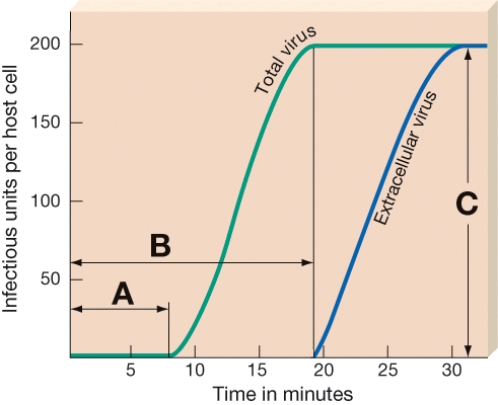
(Multiple Choice)
4.9/5 (76)
(76) Viruses that have plus strand RNA chromosomes that acts as a template for DNA synthesis are known as:
(Multiple Choice)
4.8/5 (94)
(94) Diseases such as Creutzfeld-Jacob disease (variant),kuru,and mad cow disease are caused by:
(Multiple Choice)
4.7/5 (64)
(64) Cells taken directly from an animal and cultured in vitro represent:
(Multiple Choice)
4.8/5 (73)
(73) Viruses are referred to as obligate intracellular parasites because:
(Multiple Choice)
4.8/5 (91)
(91) In the early 1990s,this emerging virus was of concern to the United States.It is transmitted from rodent feces and urine to human beings.This emerging virus is the:
(Multiple Choice)
4.8/5 (83)
(83) The scientist who discovered that some viruses may cause cancer is:
(Multiple Choice)
4.9/5 (78)
(78) Which of the following would be the best host system to study influenza A viruses
(Multiple Choice)
4.9/5 (89)
(89) Which is the best scientific explanation for the increasing concern over the recent outbreaks of avian influenza in Hong Kong and other Asian locations
(Multiple Choice)
4.9/5 (61)
(61) Viruses have some of the properties of cellular life forms.Which of the following is a characteristic of all organisms except viruses
(Multiple Choice)
4.8/5 (78)
(78) Viral DNA lying within a bacterial chromosome is called a ________ while the combination of a bacterial cell and its temperate phage is called a ________.
(Multiple Choice)
5.0/5 (73)
(73) The reason that retroviruses can direct the formation of DNA from RNA is because most retroviruses contain the following enzyme
(Multiple Choice)
4.8/5 (88)
(88) Prophages are responsible for production of the toxins found in:
(Multiple Choice)
4.9/5 (83)
(83) 
Filters
- Essay(0)
- Multiple Choice(0)
- Short Answer(0)
- True False(0)
- Matching(0)