



 Chat with AI
Exam 18: Populations

Exam 1: The Scientific Study of Life41 Questions
Exam 2: The Chemistry of Life58 Questions
Exam 3: Cells56 Questions
Exam 4: The Energy of Life62 Questions
Exam 5: Photosynthesis59 Questions
Exam 6: Respiration and Fermentation51 Questions
Exam 7: DNA Structure and Gene Function95 Questions
Exam 8: DNA Replication,Binary Fission,and Mitosis66 Questions
Exam 9: Sexual Reproduction and Meiosis58 Questions
Exam 10: Patterns of Inheritance94 Questions
Exam 11: DNA Technology53 Questions
Exam 12: Forces of Evolutionary Change50 Questions
Exam 13: Evidence of Evolution50 Questions
Exam 14: Speciation and Extinction50 Questions
Exam 15: Evolution and Diversity of Microbial Life91 Questions
Exam 16: Evolution and Diversity of Plants50 Questions
Exam 17: Evolution and Diversity of Animals87 Questions
Exam 18: Populations50 Questions
Exam 19: Communities and Ecosystems100 Questions
Exam 20: Preserving Biodiversity50 Questions
Exam 21: Plant Form and Function85 Questions
Exam 22: Reproduction and Development of Flowering Plants61 Questions
Exam 23: Animal Tissues and Organ Systems55 Questions
Exam 24: The Nervous System and the Senses92 Questions
Exam 25: The Endocrine System57 Questions
Exam 26: The Skeletal and Muscular Systems66 Questions
Exam 27: The Circulatory and Respiratory Systems103 Questions
Exam 28: The Digestive and Urinary Systems93 Questions
Exam 29: The Immune System64 Questions
Exam 30: Animal Reproduction and Development70 Questions
Select questions type


In a survivorship curve,a type I species,like a human or elephant,is a species that has
(Multiple Choice)
4.8/5  (91)
(91) All of the organisms in a given location or area are termed a
(Multiple Choice)
4.7/5 (72)
(72) 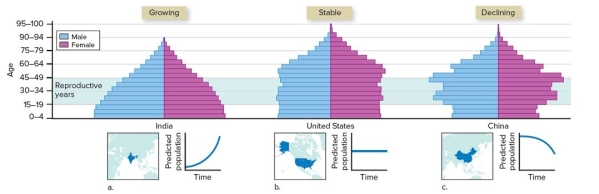 Source: Data from U.S. Census Bureau, International Data Base
-Based upon the age structure diagram,you expect the Chinese population to
Source: Data from U.S. Census Bureau, International Data Base
-Based upon the age structure diagram,you expect the Chinese population to (Multiple Choice)
4.7/5 (64)
(64) The physical location where an organism lives is termed its
(Multiple Choice)
4.9/5 (75)
(75) If a scientist sees 20 finches in 3 trees where they nest at 5 p.m.,the population density is 4.
(True/False)
4.9/5 (83)
(83) In 2010,India had a population of 1,170,000,000,a birth rate of 0.027,and a death rate of 0.013.Approximately how much did the Indian population grow in 2010?
(Multiple Choice)
4.8/5 (89)
(89) The number of individuals that die in a population per unit time is its
(Multiple Choice)
4.9/5 (89)
(89) Which of the following is not a characteristic for an organism with an opportunistic life history?
(Multiple Choice)
4.9/5 (67)
(67) Hydra,a type of cnidarian,have equal survival rates through life because they are equally fit at all stages.Hydra are an example of an organism with a type ________ survivorship curve.
(Multiple Choice)
4.8/5 (87)
(87) The overall human population growth rate is steadily increasing each year.
(True/False)
5.0/5 (102)
(102) If a species of guppy lives in a stream where there is more food than they need,they are at carrying capacity.
(True/False)
4.7/5 (67)
(67) Which of the following is an example of an aquatic community?
(Multiple Choice)
4.9/5 (76)
(76) The ________ measures the amount of land needed to support a country's overall lifestyle.
(Multiple Choice)
4.9/5 (81)
(81) The number of individuals of a species per unit area or volume of habitat is
(Multiple Choice)
4.9/5 (81)
(81) Source: Data from U.S. Census Bureau, International Data Base
-Based upon the age structure diagram,you expect the American population to
Source: Data from U.S. Census Bureau, International Data Base
-Based upon the age structure diagram,you expect the American population to (Multiple Choice)
4.8/5 (86)
(86) In regards to a species' life history,opportunistic species
(Multiple Choice)
4.8/5 (73)
(73) A human population with a large percentage of pre-reproductive individuals is common in
(Multiple Choice)
4.7/5 (87)
(87) 
Filters
- Essay(0)
- Multiple Choice(0)
- Short Answer(0)
- True False(0)
- Matching(0)