



 Chat with AI
Exam 13: Evidence of Evolution

Exam 1: The Scientific Study of Life41 Questions
Exam 2: The Chemistry of Life58 Questions
Exam 3: Cells56 Questions
Exam 4: The Energy of Life62 Questions
Exam 5: Photosynthesis59 Questions
Exam 6: Respiration and Fermentation51 Questions
Exam 7: DNA Structure and Gene Function95 Questions
Exam 8: DNA Replication,Binary Fission,and Mitosis66 Questions
Exam 9: Sexual Reproduction and Meiosis58 Questions
Exam 10: Patterns of Inheritance94 Questions
Exam 11: DNA Technology53 Questions
Exam 12: Forces of Evolutionary Change50 Questions
Exam 13: Evidence of Evolution50 Questions
Exam 14: Speciation and Extinction50 Questions
Exam 15: Evolution and Diversity of Microbial Life91 Questions
Exam 16: Evolution and Diversity of Plants50 Questions
Exam 17: Evolution and Diversity of Animals87 Questions
Exam 18: Populations50 Questions
Exam 19: Communities and Ecosystems100 Questions
Exam 20: Preserving Biodiversity50 Questions
Exam 21: Plant Form and Function85 Questions
Exam 22: Reproduction and Development of Flowering Plants61 Questions
Exam 23: Animal Tissues and Organ Systems55 Questions
Exam 24: The Nervous System and the Senses92 Questions
Exam 25: The Endocrine System57 Questions
Exam 26: The Skeletal and Muscular Systems66 Questions
Exam 27: The Circulatory and Respiratory Systems103 Questions
Exam 28: The Digestive and Urinary Systems93 Questions
Exam 29: The Immune System64 Questions
Exam 30: Animal Reproduction and Development70 Questions
Select questions type


If many human genes differ in about 10% of their bases from another species' same genes and substitutions occur at an estimated rate of 2% per one million years,approximately how many years have passed since the two species diverged?
(Multiple Choice)
4.9/5  (80)
(80) The abundant remains of ammonites in Oklahoma indicate that Oklahoma was
(Multiple Choice)
4.8/5 (75)
(75) Any gene,when mutated,that leads to an organism with structures in abnormal or unusual places,is referred to as a(n)________ gene.
(Multiple Choice)
4.8/5 (84)
(84) Relative dating uses ________ to estimate how old a fossil is.
(Multiple Choice)
4.7/5 (68)
(68) When a land bridge formed about 70 million years ago,marsupial mammals moved into South America and displaced many of the placental mammal species.
(True/False)
4.9/5 (89)
(89) The fossil record is often incomplete,in part because scientists will never be able to discover some of the fossils that are buried deep in the earth and in part because some living things fossilize more readily than others.
(True/False)
4.9/5 (76)
(76) The fossil record indicates that at one time marsupials were common to both Australia and South America,but today most South American marsupials have become extinct.The most probable explanation for marsupials being common to Australia yet not very common to South America today is that
(Multiple Choice)
4.9/5 (96)
(96) In a fruit fly embryo,the end that becomes the head contains high amounts of the protein bicoid.What may happen if you injected high levels of bicoid in the other end of the embryo?
(Multiple Choice)
4.8/5 (87)
(87) Which of the following pairs radioactive isotopes is used in radioactive fossil dating?
(Multiple Choice)
4.9/5 (74)
(74) Placental mammals give birth to more fully developed offspring than marsupial mammals and therefore have a greater chance of survival.
(True/False)
4.8/5 (63)
(63) During which period of the Paleozoic era did the first winged insects evolve?
(Multiple Choice)
4.9/5 (72)
(72) The techniques used to study molecular evolution are based on the comparison of nucleotide and amino acid sequences among species.
(True/False)
4.8/5 (75)
(75) Which of the following is most likely to be preserved as a fossil?
(Multiple Choice)
4.8/5 (85)
(85) 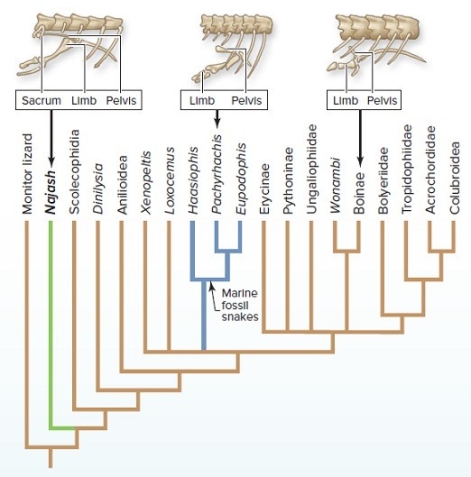 -In the section "Investigating Life: Evolving Backwards," what was hypothesized about the loss of legs in modern-day snakes?
 (Multiple Choice)
4.8/5 (92)
(92) The half life of ¹⁴C is 5,730 years.11,460 years after an organism dies what percent of the initial ¹⁴C will still be present in the organism bones?
(Multiple Choice)
4.8/5 (72)
(72) 
Filters
- Essay(0)
- Multiple Choice(0)
- Short Answer(0)
- True False(0)
- Matching(0)