



 Chat with AI
Exam 4: Psychopharmacology

Exam 1: What Is Behavioral Neuroscience?146 Questions
Exam 2: Functional Neuroanatomy and the Evolution of the Nervous System202 Questions
Exam 3: Neurophysiology: The Structure and Functions of the Cells of the Nervous System163 Questions
Exam 4: Psychopharmacology180 Questions
Exam 5: Genetics and the Development of the Human Brain147 Questions
Exam 6: Vision171 Questions
Exam 7: Nonvisual Sensation and Perception165 Questions
Exam 8: Movement164 Questions
Exam 9: Homeostasis, Motivation, and Reward163 Questions
Exam 10: Sexual Behavior159 Questions
Exam 11: Sleep and Waking169 Questions
Exam 12: Learning and Memory168 Questions
Exam 13: Cognition168 Questions
Exam 14: Emotion, Aggression, and Stress160 Questions
Exam 15: Neuropsychology151 Questions
Exam 16: Psychopathology166 Questions
Select questions type


Of the small-molecule neurochemicals, some are removed from the synapse by reuptake while others are inactivated by enzymes first. Recognizing that some molecules used in transmission have faster and briefer signals than others, discuss how you think the mechanism of inactivation plays a role in this.
(Essay)
5.0/5  (82)
(82) Morphine and heroin are opioids, and as such they exert their effects by
(Multiple Choice)
4.7/5 (60)
(60) A neurohormone is released by neurons into the blood and travels through the blood to activate target cells that have receptors for the neurohormone.
(True/False)
4.8/5 (83)
(83) Your friend has a prescription for Valium that she takes for anxiety. She has taken Valium before the party you and she are attending. When she gets to the party, you see her heading for the bar. Based on what you have learned so far in this course, which of the following would you tell her?
(Multiple Choice)
4.9/5 (91)
(91) Small-molecule neurochemicals are typically synthesized in the ________, but neuropeptides are synthesized in the ______.
(Multiple Choice)
4.9/5 (85)
(85) Upon release into the synapse, neuropeptides differ from small-molecule transmitters as they
(Multiple Choice)
4.8/5 (80)
(80) Given the typical symptoms of attention deficit disorder (ADHD), the primary of which involves difficulty paying attention, which of the following neurochemicals do you think would be involved?
(Multiple Choice)
4.7/5 (76)
(76) ?(see Figure 4.11c) This image on the left illustrates the activation of which of the following types of receptor?

(Multiple Choice)
4.8/5 (79)
(79) A chemical messenger released from the hypothalamus that acts on cells in the pituitary is a
(Multiple Choice)
4.8/5 (72)
(72) Suppose that a researcher has developed a new drug for the treatment of ADHD. How would you design an appropriate test to ensure that the drug was effective?
(Essay)
4.9/5 (85)
(85) During the synthesis of the neurochemical _________, a precursor is released from synaptic vesicles back into the intracellular fluid for conversion by the enzyme phenylethanolamine N-methyl-transferase (PNMT).
(Multiple Choice)
4.9/5 (74)
(74) Due to a very high level of stress and arousal, Kim is having difficulty getting to sleep at night. The activity of which of the following neurochemicals might be participating in Kim's sleeping problem?
(Multiple Choice)
4.8/5 (80)
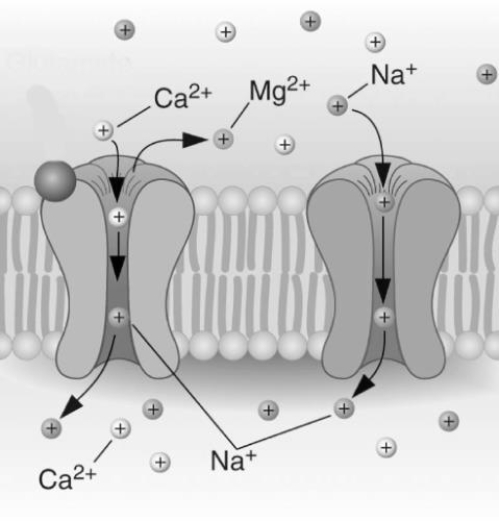
(80) ?(see Figure 4.11c)
In the process illustrated in this figure, the binding of neurochemical coupled with the activation of a nearby receptor leads to the ejection of a molecule of ____________________, allowing ____________________ and ____________________ to enter the cell.
?
(Short Answer)
4.9/5 (73)
(73) Dr. Watts has discovered a new chemical that blocks adenosine receptors. When rats are injected with the new chemical, what is Dr. Watts likely to observe?
(Multiple Choice)
4.9/5 (80)
(80) Small-molecule neurochemicals and neuropeptides are used by neurons in synaptic communication. But beyond the commonality of both being used in synaptic communication, there are substantial differences in how they are used. Compare the mechanism of action and inactivation for small-molecule neurochemicals and neuropeptides, discussing duration of effect, inactivation, and other differences in these mechanisms.
(Essay)
4.9/5 (64)
(64) Relative to neurons using other neurochemicals, serotonergic neurons
(Multiple Choice)
4.9/5 (61)
(61) 
Filters
- Essay(0)
- Multiple Choice(0)
- Short Answer(0)
- True False(0)
- Matching(0)