



 Chat with AI
Exam 4: Psychopharmacology

Exam 1: What Is Behavioral Neuroscience?146 Questions
Exam 2: Functional Neuroanatomy and the Evolution of the Nervous System202 Questions
Exam 3: Neurophysiology: The Structure and Functions of the Cells of the Nervous System163 Questions
Exam 4: Psychopharmacology180 Questions
Exam 5: Genetics and the Development of the Human Brain147 Questions
Exam 6: Vision171 Questions
Exam 7: Nonvisual Sensation and Perception165 Questions
Exam 8: Movement164 Questions
Exam 9: Homeostasis, Motivation, and Reward163 Questions
Exam 10: Sexual Behavior159 Questions
Exam 11: Sleep and Waking169 Questions
Exam 12: Learning and Memory168 Questions
Exam 13: Cognition168 Questions
Exam 14: Emotion, Aggression, and Stress160 Questions
Exam 15: Neuropsychology151 Questions
Exam 16: Psychopathology166 Questions
Select questions type


Botulinum, and its deactivated version Botox, causes muscle paralysis by
(Multiple Choice)
4.8/5  (95)
(95) The NMDA receptor, kainate receptor, and alpha-amino-3-hydroxy-5-methylisoxazole-4-proprionic acid (AMPA) receptor all respond to
(Multiple Choice)
4.9/5 (88)
(88) Methylphenidate (Ritalin) produces its stimulant effects by
(Multiple Choice)
4.8/5 (74)
(74) The ingestion of toxins may trigger a vomiting reflex controlled by the
(Multiple Choice)
4.8/5 (69)
(69) The drug ?-methyl-p-tyrosine (AMPT) serves as a dopamine, epinephrine, and norepinephrine antagonist by
(Multiple Choice)
4.9/5 (78)
(78) Which of the following neuropeptides are released by the pituitary gland?
(Multiple Choice)
4.8/5 (73)
(73) In a medication trial, a participant with ADHD acted very relaxed and focused after trying a new medication that he believed would calm him down. However, the "medication" was really just a sugar pill. Given what you've learned in this chapter, which of the following explanations makes the most sense?
(Multiple Choice)
4.7/5 (86)
(86) ______ represents the body's compensation for a drug's effects seen in the absence of the drug itself, so the characteristics of it are the opposite of the drug's effects.
(Short Answer)
4.7/5 (82)
(82) Chemical messengers released by a neuron that travels in the blood to affect other cells are called
(Multiple Choice)
4.7/5 (85)
(85) Which of the following substances is found only in neurons that produce ACh?
(Multiple Choice)
4.8/5 (72)
(72) Which of the following neurochemicals undergoes its final synthesis step within synaptic vesicles?
(Multiple Choice)
4.9/5 (80)
(80) See Figure 4.18) 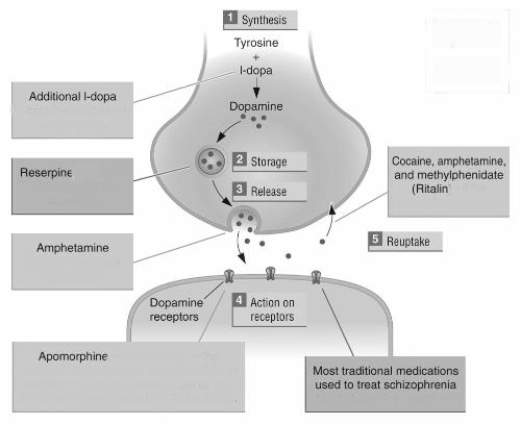 -At the dopaminergic synapse illustrated in this figure, cocaine, amphetamine, and methylphenidate act as ____________________ by ____________________ reuptake.
(Short Answer)
4.8/5 (70)
(70) The fastest acting neurochemical receptors are ionotropic receptors.
(True/False)
4.7/5 (79)
(79) A person who consumes alcohol and drives risks driving while impaired, while the same person who smokes marijuana and drives also risks driving while impaired. Alcohol and marijuana act on different receptors tied to different brain systems, but use of both drugs together compounds the impairment. Why is this the case if the two drugs do not act on the same systems?
(Essay)
4.8/5 (73)
(73) Drugs that are most likely to produce addiction have an effect on
(Multiple Choice)
4.8/5 (73)
(73) 
Filters
- Essay(0)
- Multiple Choice(0)
- Short Answer(0)
- True False(0)
- Matching(0)