



 Chat with AI
Exam 13: Biological Productivity and Energy Transfer

Exam 1: Introduction to Planet Earth76 Questions
Exam 2: Plate Tectonics and the Ocean Floor76 Questions
Exam 3: Marine Provinces74 Questions
Exam 4: Marine Sediments75 Questions
Exam 5: Water and Seawater75 Questions
Exam 6: Air-Sea Interaction75 Questions
Exam 7: Ocean Circulation74 Questions
Exam 8: Waves and Water Dynamics75 Questions
Exam 9: Tides75 Questions
Exam 10: The Coast: Beaches and Shoreline Processes75 Questions
Exam 11: The Coastal Ocean75 Questions
Exam 12: Marine Life and the Marine Environment75 Questions
Exam 13: Biological Productivity and Energy Transfer77 Questions
Exam 14: Animals of the Pelagic Environment75 Questions
Exam 15: Animals of the Benthic Environment75 Questions
Exam 16: The Oceans and Climate Change75 Questions
Select questions type


In temperate oceans of the northern hemisphere during the summer months:
(Multiple Choice)
4.7/5  (89)
(89) The amount of carbon dioxide concentrations and available nutrients affect the rate of primary production in an ecosystem.
(True/False)
4.8/5 (78)
(78) The group of marine macroscopic algae with the highest abundance and greatest geographic distribution belong to the Division Rhodophyta.
(True/False)
4.8/5 (88)
(88) Match the organism or definition with the correct description of its food preference. Use each choice once, more than once, or not at all.
-sand star (Astropecten)
(Multiple Choice)
4.7/5 (88)
(88) If the total caloric content of the autotrophic organisms in a marine ecosystem were 250,000 kilocalories (kcal), then the expected caloric value for the trophic-level consumers at the second level would be 2,500 kcal.
(True/False)
4.8/5 (74)
(74) If 10,000 kilocalories (kcal)of energy were contained in the primary producers (trophic level 1), on average how many kcal of energy would you expect to be transferred to second-order consumers (trophic level 3)?
(Multiple Choice)
4.9/5 (78)
(78) The process by which energy is derived from solar radiation that is used by certain organisms to form organic matter is called:
(Multiple Choice)
4.9/5 (84)
(84) Compensation depth is the depth in the ocean where the photosynthetic rate exceeds the rate of cellular respiration.
(True/False)
4.8/5 (79)
(79) The standing stock of a population is the maximum number or biomass of individuals that can be removed sustainably.
(True/False)
4.8/5 (70)
(70) The efficiency of trophic transfers in ecosystems is on average around:
(Multiple Choice)
4.7/5 (92)
(92) The area of the ocean that produces the largest standing stock of commercial fish is in the:
(Multiple Choice)
4.9/5 (88)
(88) 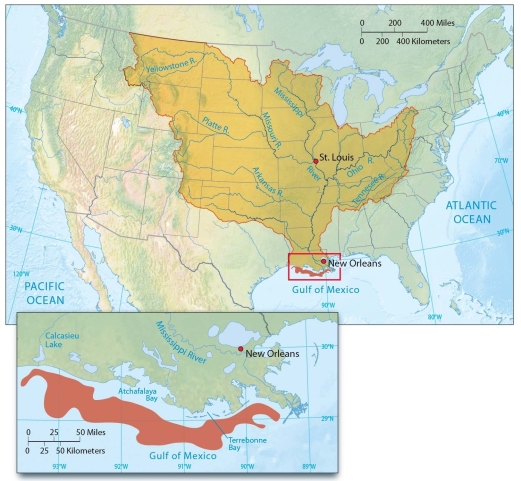 -Discuss the formation of the Gulf of Mexico dead zone. Why does this area form in the warmer months of the year?
 (Essay)
4.8/5 (76)
(76) Overproduction of organic matter resulting in anoxic conditions is attributed to:
(Multiple Choice)
4.9/5 (86)
(86) Match the organism with its correct descriptor of energy use or trophic level. Use each choice once, more than once, or not at all.
-sand star (or starfish)
(Multiple Choice)
4.9/5 (82)
(82) Match the term or phrase with its best descriptor. Use each answer once, more than once, or not at all.
-standing stock
(Multiple Choice)
4.8/5 (84)
(84) Match the term or phrase with its best descriptor. Use each answer once, more than once, or not at all.
-aquaculture
(Multiple Choice)
4.8/5 (70)
(70) 
Filters
- Essay(0)
- Multiple Choice(0)
- Short Answer(0)
- True False(0)
- Matching(0)