



 Chat with AI
Exam 6: Air-Sea Interaction

Exam 1: Introduction to Planet Earth76 Questions
Exam 2: Plate Tectonics and the Ocean Floor76 Questions
Exam 3: Marine Provinces74 Questions
Exam 4: Marine Sediments75 Questions
Exam 5: Water and Seawater75 Questions
Exam 6: Air-Sea Interaction75 Questions
Exam 7: Ocean Circulation74 Questions
Exam 8: Waves and Water Dynamics75 Questions
Exam 9: Tides75 Questions
Exam 10: The Coast: Beaches and Shoreline Processes75 Questions
Exam 11: The Coastal Ocean75 Questions
Exam 12: Marine Life and the Marine Environment75 Questions
Exam 13: Biological Productivity and Energy Transfer77 Questions
Exam 14: Animals of the Pelagic Environment75 Questions
Exam 15: Animals of the Benthic Environment75 Questions
Exam 16: The Oceans and Climate Change75 Questions
Select questions type


Refer to the figure below and use the numbers that correspond to global wind belts and latitudes to answer the following question.
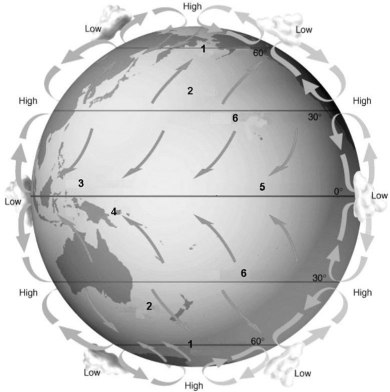 -The area of the globe (latitude)that is characterized by falling air masses and little precipitation is labeled number:
Free
(Multiple Choice)
4.9/5  (82)
(82) Correct Answer: Verified
E
Within the troposphere, the atmosphere gets warmer with increasing altitude.
Free
(True/False)
4.8/5 (75)
(75) Correct Answer:Verified
VerifiedFalse
The percentage of incident light radiation reflected back to space is termed albedo.
Free
(True/False)
4.7/5 (63)
(63) Correct Answer:Verified
VerifiedTrue
A cold front is likely to have heavy, brief showers associated with it.
(True/False)
4.8/5 (68)
(68) Match the term with the appropriate phrase. You may use each answer once, more than once or not at all.
-most abundant greenhouse gas that also influences air density
(Multiple Choice)
4.9/5 (81)
(81) Discuss the impact of the Coriolis effect on atmospheric circulation. Provide at least two examples where the Coriolis effect significantly impacts global atmospheric circulation.
(Essay)
4.9/5 (84)
(84) As a result of the Coriolis effect in the northern hemisphere, winds always are deflected:
(Multiple Choice)
4.7/5 (76)
(76) 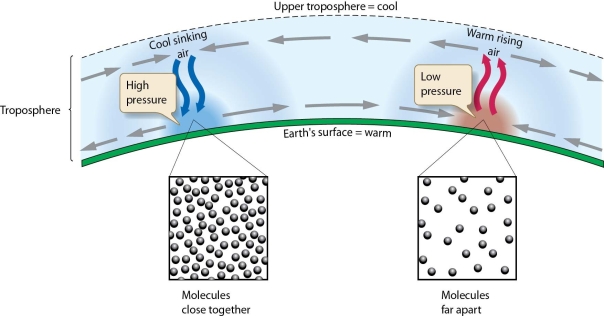 -Compare and contrast the formation of high pressure and low pressure atmospheric systems on precipitation and temperature in the areas where they form.
 (Essay)
4.9/5 (75)
(75) Near the poles, more energy is reflected back into space than is absorbed.
(True/False)
5.0/5 (87)
(87) The trade winds can be found between 30° and 60°N and S latitudes.
(True/False)
4.8/5 (80)
(80) Match the term with the appropriate phrase. You may use each answer once, more than once or not at all.
-rising and sinking air masses moving in a circular fashion
(Multiple Choice)
4.9/5 (71)
(71) All of the following are true of the movement of Earth's atmosphere except:
(Multiple Choice)
4.8/5 (83)
(83) What are the differences between hurricanes, typhoons, and tropical cyclones?
(Essay)
4.9/5 (69)
(69) 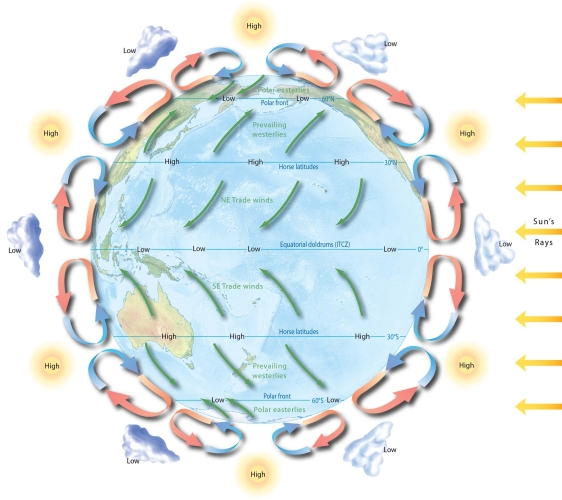 -Why are there high-pressure areas at each pole and a low-pressure belt in the equatorial region?
 (Essay)
5.0/5 (74)
(74) The autumnal equinox occurs when the sun is directly overhead along the equator in March.
(True/False)
4.8/5 (87)
(87) The large atmospheric circulation cells that occur between the equator and 30° latitude in each hemisphere are called Hadley cells.
(True/False)
4.9/5 (76)
(76) The Saffir-Simpson scale rates the relative intensity of tropical cyclones.
(True/False)
4.9/5 (78)
(78) Idealized pressure belts and wind systems are significantly modified by Earth's tilted axis of rotation and:
(Multiple Choice)
4.8/5 (90)
(90) Examine the five words and/or phrases and determine the relationship among the majority of words/phrases. Choose the one option that does not fit the pattern.
(Multiple Choice)
4.9/5 (76)
(76) 
Filters
- Essay(0)
- Multiple Choice(0)
- Short Answer(0)
- True False(0)
- Matching(0)