



 Chat with AI
Exam 3: Marine Provinces

Exam 1: Introduction to Planet Earth76 Questions
Exam 2: Plate Tectonics and the Ocean Floor76 Questions
Exam 3: Marine Provinces74 Questions
Exam 4: Marine Sediments75 Questions
Exam 5: Water and Seawater75 Questions
Exam 6: Air-Sea Interaction75 Questions
Exam 7: Ocean Circulation74 Questions
Exam 8: Waves and Water Dynamics75 Questions
Exam 9: Tides75 Questions
Exam 10: The Coast: Beaches and Shoreline Processes75 Questions
Exam 11: The Coastal Ocean75 Questions
Exam 12: Marine Life and the Marine Environment75 Questions
Exam 13: Biological Productivity and Energy Transfer77 Questions
Exam 14: Animals of the Pelagic Environment75 Questions
Exam 15: Animals of the Benthic Environment75 Questions
Exam 16: The Oceans and Climate Change75 Questions
Select questions type


Examine the five words and/or phrases and determine the relationship among the majority of words/phrases. Choose the one option that does not fit the pattern.

Free
(Multiple Choice)
4.9/5  (79)
(79) Correct Answer: Verified
C
Extending from the base of the continental rises into the deep-ocean basins are flat depositional surfaces called:
Free
(Multiple Choice)
4.9/5 (83)
(83) Correct Answer:Verified
VerifiedE
Match the term with the appropriate phrase. You may use each answer once, more than once or not at all.
-bathymetry
Free
(Multiple Choice)
4.9/5 (68)
(68) Correct Answer:Verified
VerifiedC
A sediment-laden current that flows off the continental shelf is called a turbidity current.
(True/False)
4.8/5 (81)
(81) Relatively few abyssal plains are located in the Pacific Ocean due to:
(Multiple Choice)
4.9/5 (85)
(85) 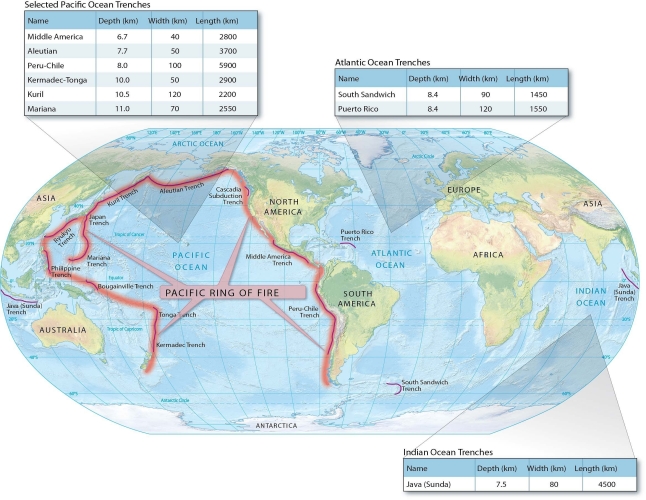 -In which ocean basin are most ocean trenches found? Use plate tectonic processes to explain why.
 (Essay)
4.8/5 (75)
(75) The deepest portions of the ocean are part of the relatively narrow features called submarine canyons.
(True/False)
4.8/5 (84)
(84) All of the following are considered part of the continental margin except the:
(Multiple Choice)
4.8/5 (84)
(84) Match the term with the appropriate phrase. You may use each answer once, more than once or not at all.
-ocean trench
(Multiple Choice)
4.7/5 (81)
(81) The continental shelf is generally defined as a steeply sloping zone extending from the shoreline to the shelf break.
(True/False)
4.8/5 (75)
(75) 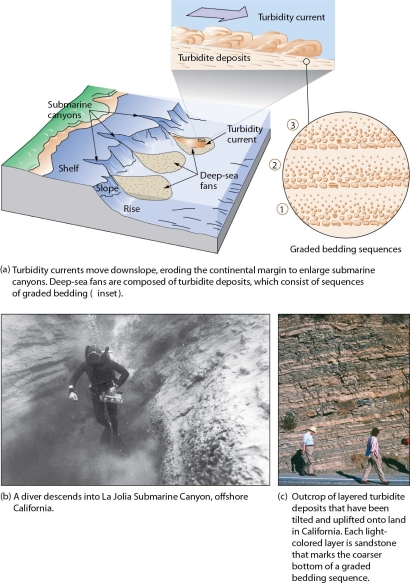 -Briefly describe how submarine canyons are created?
Oceanic ridges are cut by a number of transform faults, which offset spreading zones.
(True/False)
4.9/5 (78)
(78) Examine the five words and/or phrases and determine the relationship among the majority of words/phrases. Choose the one option that does not fit the pattern.
(Multiple Choice)
4.7/5 (76)
(76) Characteristics of active continental margins include all of the following except:
(Multiple Choice)
4.8/5 (74)
(74) Sediments of the continental rise can exhibit characteristics similar to those formed by rivers on land.
(True/False)
4.7/5 (88)
(88) Match the term with the appropriate phrase. You may use each answer once, more than once or not at all.
-seismic reflection profile
(Multiple Choice)
4.8/5 (83)
(83) Describe the relationship between turbidity currents and turbidite deposits.
(Essay)
4.9/5 (81)
(81) 
Filters
- Essay(0)
- Multiple Choice(0)
- Short Answer(0)
- True False(0)
- Matching(0)