



 Chat with AI
Exam 13: Biological Productivity and Energy Transfer

Exam 1: Introduction to Planet Earth76 Questions
Exam 2: Plate Tectonics and the Ocean Floor76 Questions
Exam 3: Marine Provinces74 Questions
Exam 4: Marine Sediments75 Questions
Exam 5: Water and Seawater75 Questions
Exam 6: Air-Sea Interaction75 Questions
Exam 7: Ocean Circulation74 Questions
Exam 8: Waves and Water Dynamics75 Questions
Exam 9: Tides75 Questions
Exam 10: The Coast: Beaches and Shoreline Processes75 Questions
Exam 11: The Coastal Ocean75 Questions
Exam 12: Marine Life and the Marine Environment75 Questions
Exam 13: Biological Productivity and Energy Transfer77 Questions
Exam 14: Animals of the Pelagic Environment75 Questions
Exam 15: Animals of the Benthic Environment75 Questions
Exam 16: The Oceans and Climate Change75 Questions
Select questions type


Energy flow in an ecosystem is:

Free
(Multiple Choice)
4.9/5  (70)
(70) Correct Answer: Verified
E
The distinction between a food chain and a food web is that a food chain describes a linear relationship among trophic levels whereas a food web describes the interconnected relationships among trophic structures in nature.
Free
(True/False)
4.9/5 (78)
(78) Correct Answer:Verified
VerifiedTrue
In general, the rate at which energy is stored by organisms through the formation of organic matter is called:
Free
(Multiple Choice)
4.8/5 (77)
(77) Correct Answer:Verified
VerifiedD
List the major taxonomic groups of marine primary producers and give an example of each.
(Essay)
4.8/5 (78)
(78) Nitrogen and phosphorus concentrations have no impact on primary productivity rates in marine ecosystems.
(True/False)
4.9/5 (79)
(79) Examine the five words and/or phrases and determine the relationship among the majority of words/phrases. Choose the one option that does not fit the pattern.
(Multiple Choice)
4.8/5 (76)
(76) Net primary productivity can be estimated as the amount of photosynthesis plus the amount of respiration.
(True/False)
4.9/5 (98)
(98) Marine seed-bearing plants include all of the following except:
(Multiple Choice)
4.7/5 (84)
(84) 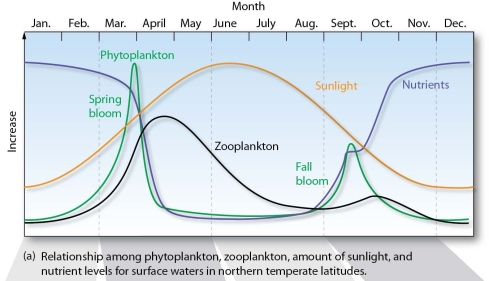 -Why do algal blooms frequently occur during spring and fall in temperate oceans?
 (Essay)
4.9/5 (76)
(76) 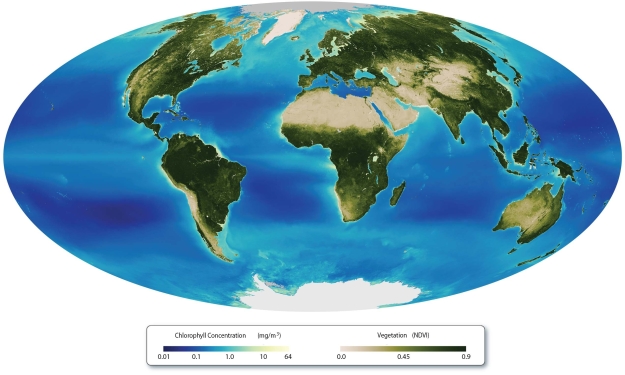 -Distinguish between eutrophic and oligotrophic oceans. Where would you expect to find eutrophic areas in the ocean? Oligotrophic areas?
 (Essay)
5.0/5 (75)
(75) Why are upwelling zones generally more productive than coastal oceans?
(Essay)
4.8/5 (87)
(87) Equatorial upwelling decreases primary productivity in tropical waters.
(True/False)
4.7/5 (78)
(78) Match the organism with its correct descriptor of energy use or trophic level. Use each choice once, more than once, or not at all.
-flounder
(Multiple Choice)
4.8/5 (85)
(85) Match the term or phrase with its best descriptor. Use each answer once, more than once, or not at all.
-Marine Mammal Protection Act
(Multiple Choice)
4.8/5 (79)
(79) All of the following are challenges to managing fisheries except:
(Multiple Choice)
4.9/5 (81)
(81) Many fish stocks are characterized as overfished on a worldwide basis.
(True/False)
4.9/5 (88)
(88) Examine the five words and/or phrases and determine the relationship among the majority of words/phrases. Choose the one option that does not fit the pattern.
(Multiple Choice)
4.8/5 (88)
(88) Many of the organisms responsible for toxic red tides and paralytic shellfish poisoning belong to the Division:
(Multiple Choice)
4.9/5 (81)
(81) 
Filters
- Essay(0)
- Multiple Choice(0)
- Short Answer(0)
- True False(0)
- Matching(0)