



 Chat with AI
Exam 12: Marine Life and the Marine Environment

Exam 1: Introduction to Planet Earth76 Questions
Exam 2: Plate Tectonics and the Ocean Floor76 Questions
Exam 3: Marine Provinces74 Questions
Exam 4: Marine Sediments75 Questions
Exam 5: Water and Seawater75 Questions
Exam 6: Air-Sea Interaction75 Questions
Exam 7: Ocean Circulation74 Questions
Exam 8: Waves and Water Dynamics75 Questions
Exam 9: Tides75 Questions
Exam 10: The Coast: Beaches and Shoreline Processes75 Questions
Exam 11: The Coastal Ocean75 Questions
Exam 12: Marine Life and the Marine Environment75 Questions
Exam 13: Biological Productivity and Energy Transfer77 Questions
Exam 14: Animals of the Pelagic Environment75 Questions
Exam 15: Animals of the Benthic Environment75 Questions
Exam 16: The Oceans and Climate Change75 Questions
Select questions type


Examine the five words and/or phrases and determine the relationship among the majority of words/phrases. Choose the one option that does not fit the pattern.
(Multiple Choice)
4.7/5  (84)
(84) The color pattern in which marine organisms are light on the bottom and dark on the top of their bodies camouflaging them against the water-air interface is:
(Multiple Choice)
5.0/5 (84)
(84) Match the marine zone with its correct location. Use each choice once, more than once, or not at all.
-subtidal
(Multiple Choice)
4.9/5 (85)
(85) Osmosis occurs when salt ions diffuse through a selectively permeable membrane with a lower ion concentration.
(True/False)
4.8/5 (74)
(74) Examine the five words and/or phrases and determine the relationship among the majority of words/phrases. Choose the one option that does not fit the pattern.
(Multiple Choice)
4.8/5 (77)
(77) Organisms that cannot withstand large changes in temperature are referred to as:
(Multiple Choice)
4.8/5 (87)
(87) All of the following are adaptive solutions employed by marine organisms to prevent sinking except:
(Multiple Choice)
4.8/5 (80)
(80) The seasonal temperature range in the deep ocean is usually:
(Multiple Choice)
4.8/5 (92)
(92) Match the description of the marine organism's lifestyle with the correct term. Use each choice once, more than once, or not at all.
-can never swim against a current
(Multiple Choice)
4.8/5 (73)
(73) Examine the five words and/or phrases and determine the relationship among the majority of words/phrases. Choose the one option that does not fit the pattern.
(Multiple Choice)
5.0/5 (80)
(80) Tropical marine organisms tend to grow more slowly, live longer, and are smaller in general than their cold-water counterparts.
(True/False)
4.9/5 (71)
(71) Draw and label a cross-section of the marine environment and include the following biozones: the neritic province (supralittoral, littoral, sublittoral, bathyal, abyssal, and hadal zones)and the oceanic province (epipelagic, mesopelagic, bathypelagic, and abyssopelagic zones).
(Essay)
4.8/5 (85)
(85) Streamlining in fishes and other nektonic organisms means that the minimum amount of energy is expended to swim through the water.
(True/False)
4.9/5 (74)
(74) Match the description of the marine organism's lifestyle with the correct term. Use each choice once, more than once, or not at all.
-swims for its entire life
(Multiple Choice)
4.8/5 (75)
(75) An organism that tolerates a wide range of salinities is referred to as:
(Multiple Choice)
4.9/5 (74)
(74) Compare and contrast the ways marine organisms are classified including: by mode of nutrition, location in the marine environment where they live, and size.
(Essay)
4.9/5 (72)
(72) A small size is advantageous for marine organisms because it:
(Multiple Choice)
4.7/5 (87)
(87) 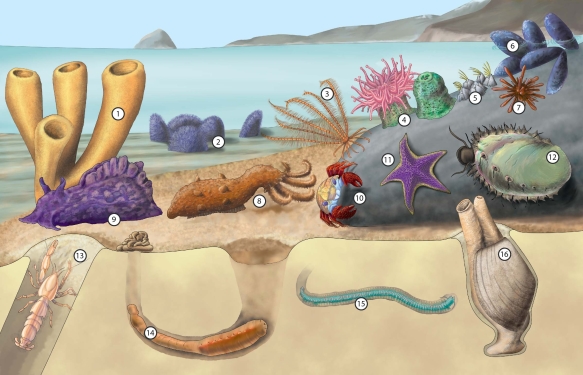 -With respect to their marine environment, these organisms can be referred to as:
 (Multiple Choice)
4.8/5 (78)
(78) Phytoplankton are small in size as a result of predation pressure.
(True/False)
4.8/5 (82)
(82) 
Filters
- Essay(0)
- Multiple Choice(0)
- Short Answer(0)
- True False(0)
- Matching(0)