



 Chat with AI
Exam 4: Marine Sediments

Exam 1: Introduction to Planet Earth76 Questions
Exam 2: Plate Tectonics and the Ocean Floor76 Questions
Exam 3: Marine Provinces74 Questions
Exam 4: Marine Sediments75 Questions
Exam 5: Water and Seawater75 Questions
Exam 6: Air-Sea Interaction75 Questions
Exam 7: Ocean Circulation74 Questions
Exam 8: Waves and Water Dynamics75 Questions
Exam 9: Tides75 Questions
Exam 10: The Coast: Beaches and Shoreline Processes75 Questions
Exam 11: The Coastal Ocean75 Questions
Exam 12: Marine Life and the Marine Environment75 Questions
Exam 13: Biological Productivity and Energy Transfer77 Questions
Exam 14: Animals of the Pelagic Environment75 Questions
Exam 15: Animals of the Benthic Environment75 Questions
Exam 16: The Oceans and Climate Change75 Questions
Select questions type


The most likely place to find abundant manganese nodules is on the:
(Multiple Choice)
4.7/5  (66)
(66) Examine the five words and/or phrases and determine the relationship among the majority of words/phrases. Choose the one option that does not fit the pattern.
(Multiple Choice)
4.8/5 (78)
(78) 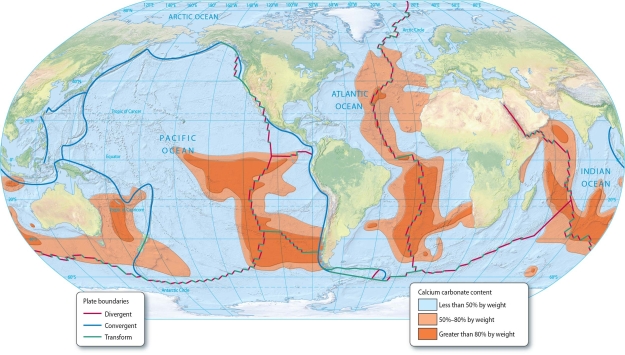 -How is the carbonate compensation depth (CCD)related to the worldwide distribution of calcareous oozes?
 (Short Answer)
4.8/5 (85)
(85) Match the term or person with the appropriate phrase. You may use each answer once, more than once or not at all.
-lysocline
(Multiple Choice)
5.0/5 (75)
(75) Examine the five words and/or phrases and determine the relationship among the majority of words/phrases. Choose the one option that does not fit the pattern.
(Multiple Choice)
4.9/5 (78)
(78) Organisms that live on the ocean floor may be responsible for keeping manganese nodules from being buried in the sediment.
(True/False)
4.9/5 (73)
(73) Examine the five words and/or phrases and determine the relationship among the majority of words/phrases. Choose the one option that does not fit the pattern.
(Multiple Choice)
4.9/5 (88)
(88) Match the term or person with the appropriate phrase. You may use each answer once, more than once or not at all.
-metal sulfides
(Multiple Choice)
4.8/5 (75)
(75) Sediments produced by plants and animals in the sea are called:
(Multiple Choice)
4.8/5 (84)
(84) The organisms that contribute to biogenous sediment are chiefly algae and protozoans.
(True/False)
4.9/5 (89)
(89) Sediment that begins as rocks on continents or islands is called:
(Multiple Choice)
4.7/5 (83)
(83) Match the term or person with the appropriate phrase. You may use each answer once, more than once or not at all.
-halite
(Multiple Choice)
4.8/5 (89)
(89) The deposition of radiolarian oozes is affected by the carbonate compensation depth.
(True/False)
4.9/5 (74)
(74) Ocean sediments provide all of the following mineral resources except:
(Multiple Choice)
4.8/5 (71)
(71) Match the term or person with the appropriate phrase. You may use each answer once, more than once or not at all.
-stromatolites
(Multiple Choice)
4.8/5 (78)
(78) Create a table detailing the four types of marine sediments and their source (parent)material.
(Essay)
4.8/5 (72)
(72) 
Filters
- Essay(0)
- Multiple Choice(0)
- Short Answer(0)
- True False(0)
- Matching(0)