



 Chat with AI
Exam 13: Galaxies: Normal and Active

Exam 1: Here and Now97 Questions
Exam 2: A Users Guide to the Sky116 Questions
Exam 3: Cycles of the Sun and Moon154 Questions
Exam 4: The Origin of Modern Astronomy144 Questions
Exam 5: Light and Telescopes156 Questions
Exam 6: Atoms and Spectra125 Questions
Exam 7: The Sun146 Questions
Exam 8: The Family of Stars190 Questions
Exam 9: The Formation and Structure of Stars136 Questions
Exam 10: The Deaths of Stars127 Questions
Exam 11: Neutron Stars and Black Holes99 Questions
Exam 12: The Milky Way Galaxy117 Questions
Exam 13: Galaxies: Normal and Active151 Questions
Exam 14: Modern Cosmology112 Questions
Exam 15: The Origin of the Solar System108 Questions
Exam 16: Earth and Moon: Bases for Comparative Planetology98 Questions
Exam 17: Mercury, Venus, and Mars83 Questions
Exam 18: The Outer Solar System136 Questions
Exam 19: Meteorites, Asteroids, and Comets91 Questions
Exam 20: Astrobiology: Life on Other Worlds97 Questions
Select questions type


___________ have elongated nuclei with spiral structure extending from the ends of the elongations. The Milky Way is a member of this class of galaxy.
(Multiple Choice)
4.8/5  (73)
(73) That the radio lobes radiate synchrotron radiation indicates that
(Multiple Choice)
4.7/5 (70)
(70) What factors are important when trying to classify a spiral galaxy
(Multiple Choice)
4.8/5 (81)
(81) What observational evidence do we have that quasars are the centers of very distant galaxies
(Essay)
4.9/5 (80)
(80) ____________ galaxies contain a supermassive black hole at their centers while active nuclei are present in ____________of galaxies
(Multiple Choice)
4.9/5 (77)
(77) How are astronomers able to determine that quasars are so small
(Multiple Choice)
4.8/5 (72)
(72) The rotation curve method can be applied only to pairs of galaxies orbiting each other.
(True/False)
4.8/5 (68)
(68) The blue sharp point of light with diffraction spikes in the upper right corner of the visual + NIR image of the Hubble Deep Field, shown above, is a star in our Milky Way Galaxy. 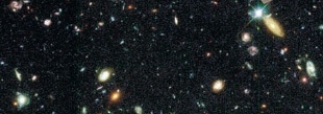
(True/False)
4.9/5 (80)
(80) Jet-shaped regions of radio and optical emission have been observed in
(Multiple Choice)
4.8/5 (82)
(82) in the following visual wavelength image, the two galaxies shown are most likely to have formed from ____________. 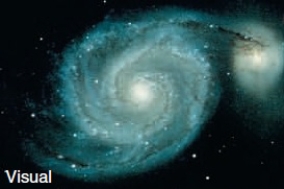
(Multiple Choice)
4.9/5 (81)
(81) What is the major observational difference between a Seyfert galaxy and a normal spiral galaxy
(Multiple Choice)
4.8/5 (68)
(68) ________________ emit radio energy from areas on either side of the galaxy that are inflated by jets.
(Short Answer)
4.8/5 (80)
(80) According to the unified model of active galactic nuclei, ___________ is in the center surrounded by _____________with a Type 1 Seyfert or Type 2 Seyfert being seen depending on the viewing angle.
(Multiple Choice)
4.9/5 (80)
(80) Describe the kind of observations that have led astronomers to believe that supermassive black holes lie at the center of many galaxies.
(Essay)
5.0/5 (75)
(75) 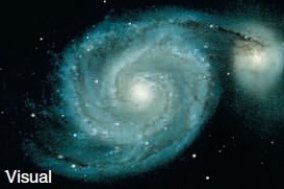
What distance method did Edwin Hubble use to determine the distance to local galaxies
(Multiple Choice)
4.8/5 (90)
(90) 
Filters
- Essay(0)
- Multiple Choice(0)
- Short Answer(0)
- True False(0)
- Matching(0)