



 Chat with AI
Exam 13: Galaxies: Normal and Active

Exam 1: Here and Now97 Questions
Exam 2: A Users Guide to the Sky116 Questions
Exam 3: Cycles of the Sun and Moon154 Questions
Exam 4: The Origin of Modern Astronomy144 Questions
Exam 5: Light and Telescopes156 Questions
Exam 6: Atoms and Spectra125 Questions
Exam 7: The Sun146 Questions
Exam 8: The Family of Stars190 Questions
Exam 9: The Formation and Structure of Stars136 Questions
Exam 10: The Deaths of Stars127 Questions
Exam 11: Neutron Stars and Black Holes99 Questions
Exam 12: The Milky Way Galaxy117 Questions
Exam 13: Galaxies: Normal and Active151 Questions
Exam 14: Modern Cosmology112 Questions
Exam 15: The Origin of the Solar System108 Questions
Exam 16: Earth and Moon: Bases for Comparative Planetology98 Questions
Exam 17: Mercury, Venus, and Mars83 Questions
Exam 18: The Outer Solar System136 Questions
Exam 19: Meteorites, Asteroids, and Comets91 Questions
Exam 20: Astrobiology: Life on Other Worlds97 Questions
Select questions type


 -If the above shown spiral galaxy is 150 million ly away, how fast is it receding
 (Multiple Choice)
4.8/5  (89)
(89) The negative velocity numbers in the following graph represent a galaxy that is moving away from us. 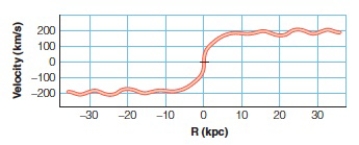
(True/False)
4.9/5 (79)
(79) A ___________ generally contains well over 1000 galaxies and is quite dense. They often contain many giant elliptical galaxies.
(Multiple Choice)
4.8/5 (84)
(84) When a large galaxy collides with a small galaxy, the smaller galaxy may be pulled apart by tidal forces.
(True/False)
4.8/5 (81)
(81) Poor clusters of galaxies often contain an excess of E and S0 galaxies.
(True/False)
4.7/5 (69)
(69) 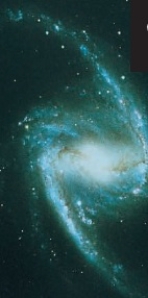 -The above visual wavelength image is of a/an ____________-type galaxy.
 (Multiple Choice)
4.8/5 (75)
(75) The high _______________ of quasars reveals to astronomers that they must be very distant.
(Short Answer)
4.9/5 (72)
(72) _____________ galaxies have a definite disk component, but contain no evidence of spiral pattern, few hot young stars, and little gas and dust.
(Short Answer)
4.8/5 (88)
(88) From nearest to furthest from Earth, list the distance indicators and which type of object is best found at that distant indicator.
(Essay)
4.9/5 (85)
(85) If a galaxy has a radial velocity of 8000 km/s and the Hubble constant is 70 km/s/Mpc, what is the distance to this galaxy
(Multiple Choice)
4.9/5 (72)
(72) The rapid fluctuations of quasars show that the energy emitting portions of these objects must be very small.
(True/False)
4.9/5 (71)
(71) Many disk galaxies, such as Andromeda and the Milky Way, are thought to have extended halos of dark matter because the disk circular orbital speed is observed to ____________ increasing distances from the disk center.
(Multiple Choice)
4.8/5 (80)
(80) ___________ are produced when two galaxies pass near each other and pull large streamers of stars, gas, and dust away from the galaxies.
(Multiple Choice)
5.0/5 (81)
(81) Measuring the Doppler shift of material at various distances from the center of a galaxy can be used to construct a(n) ________________ for that galaxy.
(Short Answer)
4.8/5 (71)
(71) If H equals 50 km/s/Mpc, then a galaxy with a radial velocity of 50,000 km/s will have a distance of about 1 Mpc.
(True/False)
4.8/5 (74)
(74) Elliptical galaxies contain more gas, dust, and young stars than do Sa galaxies.
(True/False)
4.8/5 (70)
(70) 
Filters
- Essay(0)
- Multiple Choice(0)
- Short Answer(0)
- True False(0)
- Matching(0)