



 Chat with AI
Exam 8: The Family of Stars

Exam 1: Here and Now97 Questions
Exam 2: A Users Guide to the Sky116 Questions
Exam 3: Cycles of the Sun and Moon154 Questions
Exam 4: The Origin of Modern Astronomy144 Questions
Exam 5: Light and Telescopes156 Questions
Exam 6: Atoms and Spectra125 Questions
Exam 7: The Sun146 Questions
Exam 8: The Family of Stars190 Questions
Exam 9: The Formation and Structure of Stars136 Questions
Exam 10: The Deaths of Stars127 Questions
Exam 11: Neutron Stars and Black Holes99 Questions
Exam 12: The Milky Way Galaxy117 Questions
Exam 13: Galaxies: Normal and Active151 Questions
Exam 14: Modern Cosmology112 Questions
Exam 15: The Origin of the Solar System108 Questions
Exam 16: Earth and Moon: Bases for Comparative Planetology98 Questions
Exam 17: Mercury, Venus, and Mars83 Questions
Exam 18: The Outer Solar System136 Questions
Exam 19: Meteorites, Asteroids, and Comets91 Questions
Exam 20: Astrobiology: Life on Other Worlds97 Questions
Select questions type


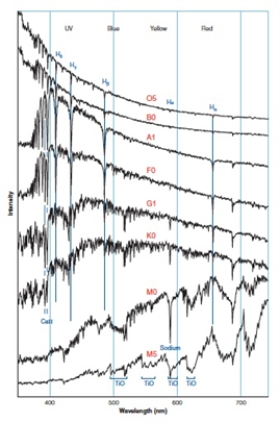 Which statement is incorrect about the above spectra

We know that the numbers of stars _________ from _______ to ________ on the H-R diagram.
(Multiple Choice)
4.9/5  (79)
(79) If a star is located at 10 pc, which of the following statements is correct
(Multiple Choice)
4.8/5 (83)
(83) For what kinds of stars are the masses of stars in the H-R diagram "orderly" For what kinds of stars are they disorderly In other words, could you guess the mass of a star from its location (luminosity, temperature) on the H-R diagram
(Essay)
4.9/5 (81)
(81) The diagram below illustrates two stars in a visual binary system and the center of mass of this system. Based on this diagram, what is the ratio of the mass of star A to the mass of star B 
(Multiple Choice)
4.8/5 (73)
(73) Arcturus has an mV = -0.04 and MV = -0.3. Its distance is 10-3.4 pc.
(True/False)
4.9/5 (74)
(74) Proxima Centauri has an absolute visual magnitude of 15.5 and an apparent visual magnitude of 11.0. What is the distance to Proxima Centauri in units of pc
(Multiple Choice)
4.9/5 (95)
(95) We know the white dwarf star Sirius B has a mass comparable to the Sun because
(Multiple Choice)
4.9/5 (72)
(72) Main-sequence stars have about the same density as the Sun but giant stars have very low densities.
(True/False)
4.9/5 (81)
(81) How do the spectra of giants, supergiants, and main-sequence stars differ
(Essay)
4.8/5 (68)
(68) Why don't we see hydrogen Balmer lines in the spectra of stars with temperatures of 3,200 K
(Multiple Choice)
4.9/5 (73)
(73) The best sample of the true numbers of the different types of stars consists of
(Multiple Choice)
4.9/5 (85)
(85) The method of spectroscopic parallax cannot be applied to stars beyond about 100 pc.
(True/False)
4.8/5 (79)
(79) 
Filters
- Essay(0)
- Multiple Choice(0)
- Short Answer(0)
- True False(0)
- Matching(0)