



 Chat with AI
Exam 8: The Family of Stars

Exam 1: Here and Now97 Questions
Exam 2: A Users Guide to the Sky116 Questions
Exam 3: Cycles of the Sun and Moon154 Questions
Exam 4: The Origin of Modern Astronomy144 Questions
Exam 5: Light and Telescopes156 Questions
Exam 6: Atoms and Spectra125 Questions
Exam 7: The Sun146 Questions
Exam 8: The Family of Stars190 Questions
Exam 9: The Formation and Structure of Stars136 Questions
Exam 10: The Deaths of Stars127 Questions
Exam 11: Neutron Stars and Black Holes99 Questions
Exam 12: The Milky Way Galaxy117 Questions
Exam 13: Galaxies: Normal and Active151 Questions
Exam 14: Modern Cosmology112 Questions
Exam 15: The Origin of the Solar System108 Questions
Exam 16: Earth and Moon: Bases for Comparative Planetology98 Questions
Exam 17: Mercury, Venus, and Mars83 Questions
Exam 18: The Outer Solar System136 Questions
Exam 19: Meteorites, Asteroids, and Comets91 Questions
Exam 20: Astrobiology: Life on Other Worlds97 Questions
Select questions type


On the H-R diagram below, indicate the location of the white dwarf stars. 
(Essay)
4.9/5  (87)
(87) ____________________ can be used to determine the distance to a star when the spectrum of the star can be used to determine its spectral type and luminosity class.
(Short Answer)
5.0/5 (77)
(77) The masses and diameters of each star in a binary can be determined from ____________________ binaries.
(Short Answer)
4.8/5 (78)
(78)  -Which star in Diagram 8-1 is most like the Sun
________ dwarfs are M dwarfs on the main sequence whereas _________ dwarfs are hot, dim, and not on the main sequence.
(Short Answer)
4.9/5 (83)
(83) If the orbital velocity of an eclipsing binary is 97 km/s and the smaller star is completely eclipsed in 2 hours, what is the diameter of the smaller star
(Multiple Choice)
4.8/5 (80)
(80) White dwarfs have such a low luminosity that even the nearest white dwarfs are not visible to the naked eye.
(True/False)
4.9/5 (89)
(89) The largest of the red stars are the ____________________ stars.
(Short Answer)
4.9/5 (73)
(73) The absorption lines in the infrared portion of the spectrum of a star that are produced by hydrogen are from the
(Multiple Choice)
4.9/5 (81)
(81) Consider a two-body system of the Earth orbiting the Sun. The center of mass would be located near the _________.
(Multiple Choice)
4.8/5 (71)
(71) If a star's spectrum does not contain spectral lines characteristic of a certain element, can we conclude that the star does not contain that element Why or why not
(Essay)
4.8/5 (71)
(71) How does an H-R diagram make it clear that giant stars are larger than main-sequence stars of the same temperature
(Essay)
4.8/5 (85)
(85) A G2 I star is ____________________ in diameter and ____________________ luminous than the Sun.
(Short Answer)
4.7/5 (85)
(85) 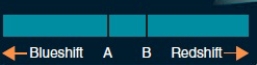 A ___________________ binary is shown in the following simulated spectra.
 (Multiple Choice)
4.8/5 (89)
(89) Which is the binary system, and what is the type, in the following figure 
(Multiple Choice)
4.9/5 (80)
(80) From the mass-luminosity relation, a 2-solar-mass star on the main sequence would have a luminosity of approximately ____ solar luminosities.
(Multiple Choice)
4.7/5 (82)
(82) Why don't we see hydrogen Balmer lines in the spectra of stars with temperatures of 45,000 K
(Multiple Choice)
4.9/5 (83)
(83) _____ spectral type stars are hotter than _____ spectral type stars.
(Multiple Choice)
5.0/5 (84)
(84) 
Filters
- Essay(0)
- Multiple Choice(0)
- Short Answer(0)
- True False(0)
- Matching(0)