



 Chat with AI
Exam 6: Atoms and Spectra

Exam 1: Here and Now97 Questions
Exam 2: A Users Guide to the Sky116 Questions
Exam 3: Cycles of the Sun and Moon154 Questions
Exam 4: The Origin of Modern Astronomy144 Questions
Exam 5: Light and Telescopes156 Questions
Exam 6: Atoms and Spectra125 Questions
Exam 7: The Sun146 Questions
Exam 8: The Family of Stars190 Questions
Exam 9: The Formation and Structure of Stars136 Questions
Exam 10: The Deaths of Stars127 Questions
Exam 11: Neutron Stars and Black Holes99 Questions
Exam 12: The Milky Way Galaxy117 Questions
Exam 13: Galaxies: Normal and Active151 Questions
Exam 14: Modern Cosmology112 Questions
Exam 15: The Origin of the Solar System108 Questions
Exam 16: Earth and Moon: Bases for Comparative Planetology98 Questions
Exam 17: Mercury, Venus, and Mars83 Questions
Exam 18: The Outer Solar System136 Questions
Exam 19: Meteorites, Asteroids, and Comets91 Questions
Exam 20: Astrobiology: Life on Other Worlds97 Questions
Select questions type


____ has a negative charge and a mass about 2000 times smaller than a proton.
(Multiple Choice)
4.9/5  (89)
(89) A zero Kelvin temperature is also known as ________________________.
(Short Answer)
4.9/5 (83)
(83) Since an electron is so less massive than a proton, what is the approximate mass and charge of a neutral hydrogen atom
(Multiple Choice)
4.9/5 (72)
(72) in the following model of an atom, draw a transition from the ground state to the first excited state. To draw this, draw the electron's motion as a line with an arrow to indicate direction and draw the photon as a wave with an arrow to indicated direction. Label the electron and photon. Label whether this is an absorption, emission, or continuous spectrum. 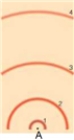
(Not Answered)
This question doesn't have any answer yet
What is the order of star colors with increasing temperature
(Multiple Choice)
4.9/5 (78)
(78) __________________ is the agitation among the molecules and/or atoms of a body.
(Short Answer)
4.7/5 (89)
(89) 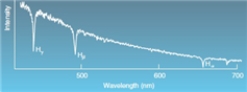 -Which series is shown above
Figure 6-1
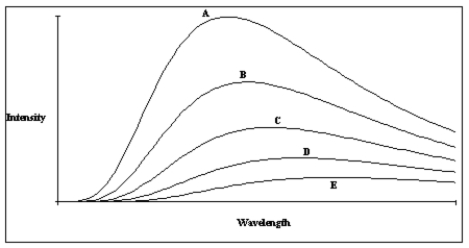 -A plot of the continuous spectra of five different stars is shown in Figure 6-1. Based on these spectra, which of the stars is the hottest
 (Multiple Choice)
4.8/5 (75)
(75) Suppose the laboratory wavelength of a spectral line is 600 nm. In a star it is measured to be 599.4 nm. Is the star moving toward or away from us, relative to the line of sight How fast is it moving (Hint: c = 300,000 km/s)
(Multiple Choice)
4.8/5 (84)
(84) 
You would like to know if a star is coming towards you or away from you. Therefore, you will need to obtain the star's _______________ from its shifted spectra.
(Short Answer)
4.9/5 (86)
(86) 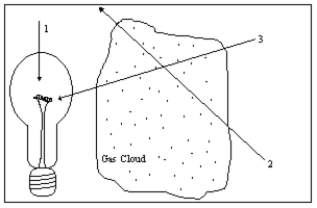 -Diagram 6-2 illustrates a light source, a gas cloud, and three different lines of sight. Along which line of sight would an observer see an absorption spectrum
 (Multiple Choice)
4.8/5 (81)
(81) You would like to find the surface temperature of a star so you will need the star's _____________________ spectrum and use _____________ to find the temperature. Knowing the temperature, you can use _________________ to find the total energy the star radiates at its surface.
(Short Answer)
5.0/5 (80)
(80) A hotter star is brighter than a cooler star of the same size. Assume both are typical stars.
(True/False)
4.8/5 (80)
(80) You would like to know the chemical composition of a star's atmosphere. Therefore you will need to obtain the star's ______________ spectra.
(Short Answer)
4.9/5 (77)
(77) To know the element name on the periodic table, you need to know the number of neutrons in the nucleus.
(True/False)
4.7/5 (81)
(81) The Sun has a surface temperature of approximately 5800 K. At what wavelength does the maximum energy radiated by the Sun occur
(Multiple Choice)
4.8/5 (83)
(83) An atom is ionized if one of its electrons jumps to a higher energy level in the atom.
(True/False)
4.8/5 (78)
(78) 
Filters
- Essay(0)
- Multiple Choice(0)
- Short Answer(0)
- True False(0)
- Matching(0)