



 Chat with AI
Exam 6: Atoms and Spectra

Exam 1: Here and Now97 Questions
Exam 2: A Users Guide to the Sky116 Questions
Exam 3: Cycles of the Sun and Moon154 Questions
Exam 4: The Origin of Modern Astronomy144 Questions
Exam 5: Light and Telescopes156 Questions
Exam 6: Atoms and Spectra125 Questions
Exam 7: The Sun146 Questions
Exam 8: The Family of Stars190 Questions
Exam 9: The Formation and Structure of Stars136 Questions
Exam 10: The Deaths of Stars127 Questions
Exam 11: Neutron Stars and Black Holes99 Questions
Exam 12: The Milky Way Galaxy117 Questions
Exam 13: Galaxies: Normal and Active151 Questions
Exam 14: Modern Cosmology112 Questions
Exam 15: The Origin of the Solar System108 Questions
Exam 16: Earth and Moon: Bases for Comparative Planetology98 Questions
Exam 17: Mercury, Venus, and Mars83 Questions
Exam 18: The Outer Solar System136 Questions
Exam 19: Meteorites, Asteroids, and Comets91 Questions
Exam 20: Astrobiology: Life on Other Worlds97 Questions
Select questions type


The flow of energy is always from hot to cold and is called ___________.
(Short Answer)
4.9/5  (71)
(71) In the diagram below, draw the transition that would emit a photon with the shortest wavelength. 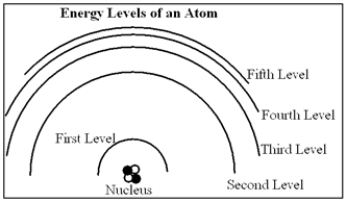
(Short Answer)
4.9/5 (81)
(81) A(n) ____ contains two or more atoms that are bound together by exchanging or sharing electrons with each other.
(Multiple Choice)
4.7/5 (87)
(87) The Hδ line has a wavelength of 410.2 nm when observed in the laboratory. If the Hδ line appears in a stars spectrum at 410.0 nm, what is the radial velocity of the star
(Multiple Choice)
4.7/5 (85)
(85) Blue stars emit most of their energy at shorter wavelengths than red stars.
(True/False)
4.8/5 (86)
(86) You are standing near a railroad track and a train is moving toward you at 60 mph and blowing its horn. What will you notice as the train moves past you
(Multiple Choice)
5.0/5 (83)
(83) Each element has its own set of characteristic absorption lines because
(Multiple Choice)
4.8/5 (84)
(84) ______________ will give you information on the surface temperature of the star after you obtain the wavelength of maximum emission from the ________________ spectra.
(Short Answer)
4.9/5 (72)
(72) The radiation emitted from a star has a maximum intensity at a wavelength of 500 nm. What is the temperature of this star
(Multiple Choice)
4.8/5 (82)
(82) The Doppler effect states that the motion of any object can
(Multiple Choice)
4.8/5 (79)
(79) Atoms that have the same number of protons but a different number of neutrons are called
(Multiple Choice)
4.9/5 (96)
(96) To create the above spectra, which of the following is NOT true 
(Multiple Choice)
4.8/5 (88)
(88) A blackbody's emission as observed through a low-density gas will produce a ____________________ spectrum.
(Short Answer)
4.8/5 (75)
(75) One star has a temperature of 10,000 K and another star has a temperature of 5,000 K. Compared to the cooler star, how much more energy per second will the hotter star radiate from each square meter of its surface
(Multiple Choice)
4.9/5 (70)
(70) 
Filters
- Essay(0)
- Multiple Choice(0)
- Short Answer(0)
- True False(0)
- Matching(0)