



 Chat with AI
Exam 13: Aggregate Planning to Balance Supply and Demand

Exam 1: Product Line Planning and the Systems Approach114 Questions
Exam 2: Productivity and Strategic Planning115 Questions
Exam 3: Demand Creation and Predictive Planning114 Questions
Exam 4: Understanding Quality: ITS Management and Strategic Importance114 Questions
Exam 5: Process Configuration Strategies111 Questions
Exam 6: Process Analysis and Redesign115 Questions
Exam 7: Quality Assurance115 Questions
Exam 8: Management of Technology Mot101 Questions
Exam 9: Teamwork Planning Requires Job Design113 Questions
Exam 10: Supply Chain Capacity Planning113 Questions
Exam 11: Facilities Planning: Location and Layout112 Questions
Exam 12: Materials Management Impacts All Supply Chain Participants110 Questions
Exam 13: Aggregate Planning to Balance Supply and Demand106 Questions
Exam 14: Inventory Management for Smooth and Continuous Demand Patterns114 Questions
Exam 15: Material Requirements Planning Mrp for Sporadic Demand Patterns116 Questions
Exam 16: Production Scheduling for Manufacturing and Service Operations116 Questions
Exam 17: Cycle-Time Management Increases Productivity117 Questions
Exam 18: Project Management for New Products and Processes110 Questions
Exam 19: Change Management With Faster Project Completions103 Questions
Exam 20: Sustainability Issues: Environment, Ethics, and Security111 Questions
Select questions type


Because many job shops provide services and not goods,it pays to emphasize the fact that:
(Multiple Choice)
4.8/5  (82)
(82) HMMS is a pioneering aggregate-planning model that uses linear costs for its resource constraints.
(True/False)
4.8/5 (82)
(82) The trade-off model provides a convenient representation of the aggregate-planning problem.
(True/False)
4.7/5 (74)
(74) The first version of the TM model in the text for aggregate planning _____ backorders.
(Multiple Choice)
4.9/5 (77)
(77) The driver of AP (aggregate planning) is forecasted customer demand in standard units.
(True/False)
4.9/5 (74)
(74) The HMMS model addresses five separate issues-including,in practice,how much is it used?
(True/False)
4.8/5 (90)
(90) Demands for different outputs are _____ by considering them all to be a unified demand for the output capacity of the facility.
(Multiple Choice)
4.9/5 (68)
(68) Buyers who refuse to accept backorders create the situation called fill or kill.In that case,the cost of a backorder is a lost sale at the minimum and possibly the loss of a customer over a long purchasing period.
(True/False)
4.8/5 (85)
(85) What was the traditional customer-to-teller relationship replaced with after the 1970s?
(Essay)
4.8/5 (92)
(92) 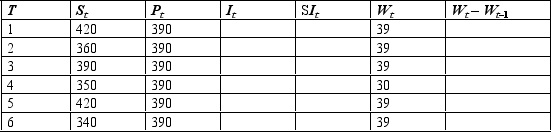
Sensitivity analysis allows investigation of the effect of altering supply capacities,demand levels,and costs on a "what if" basis.
(True/False)
5.0/5 (86)
(86) The quality of sequencing decisions is always a consequence of _____.
(Multiple Choice)
4.8/5 (93)
(93) Aggregation methods for scheduling farming (harvesting) activities have useful _____ to service and manufacturing applications.The _____ can be accounted for at a later time.
(Multiple Choice)
4.8/5 (70)
(70) The quality of sequencing decisions is always a consequence of using 1._____,and 2._____,however sequencing skills and knowledge are based on experience with customers' wants and process requirements.
(Multiple Choice)
4.8/5 (68)
(68) A growing number of bank customers have demonstrated willingness to pay for the convenience of automated banking because an automated relationship permits access on a 24/7 basis.The ATM does not have to be scheduled for work by an AP analysis.
(True/False)
4.8/5 (83)
(83) HMMS used only linear cost equations to approximate the actual cost system for the PPG job shop.
(True/False)
4.9/5 (71)
(71) What is determined by the position of the cost lines in trade-off model (such as Figure 13-7)?
(Essay)
4.7/5 (70)
(70) _____ occurs when production is constant and demand varies.
(Multiple Choice)
4.8/5 (76)
(76) 
Filters
- Essay(0)
- Multiple Choice(0)
- Short Answer(0)
- True False(0)
- Matching(0)