



 Chat with AI
Exam 7: Dysrhythmia Interpretation and Management

Exam 1: Overview of Critical Care Nursing24 Questions
Exam 2: Patient and Family Response to the Critical Care Experience28 Questions
Exam 3: Ethical and Legal Issues in Critical Care Nursing23 Questions
Exam 4: End-Of-Life Care and Palliative Care in Critical Care Settings26 Questions
Exam 5: Comfort and Sedation33 Questions
Exam 6: Nutritional Support30 Questions
Exam 7: Dysrhythmia Interpretation and Management59 Questions
Exam 8: Hemodynamic Monitoring35 Questions
Exam 9: Ventilatory Assistance36 Questions
Exam 10: Rapid Response Teams and Code Management31 Questions
Exam 11: Organ Donation35 Questions
Exam 12: Shock,sepsis,and Multiple Organ Dysfunction Syndrome34 Questions
Exam 13: Cardiovascular Alterations37 Questions
Exam 14: Nervous System Alterations35 Questions
Exam 15: Acute Respiratory Failure36 Questions
Exam 16: Acute Kidney Injury50 Questions
Exam 17: Hematological and Immune Disorders56 Questions
Exam 18: Gastrointestinal Alterations52 Questions
Exam 19: Endocrine Alterations35 Questions
Exam 20: Trauma and Surgical Management31 Questions
Exam 21: Burns31 Questions
Select questions type


The patient is admitted with a fever and rapid heart rate.The patient's temperature is 103° F (39.4° C).The nurse places the patient on a cardiac monitor and finds the patient's atrial and ventricular rates are above 105 beats per minute.P waves are clearly seen and appear normal in configuration.QRS complexes are normal in appearance and 0.08 seconds wide.The rhythm is regular,and blood pressure is normal.The nurse should focus on providing:
(Multiple Choice)
4.7/5  (63)
(63) The patient's heart rate is 165 beats per minute.The cardiac monitor shows a rapid rate with narrow QRS complexes.The P waves cannot be seen,but the rhythm is regular.The patient's blood pressure has dropped from 124/62 mm Hg to 78/30 mm Hg.The patient's skin is cold and diaphoretic,and the patient is complaining of nausea.The nurse prepares the patient for
(Multiple Choice)
4.8/5 (87)
(87) The patient is alert and talking when the nurse notices the following rhythm.The patient's blood pressure is 90/44 mm Hg.The nurse should 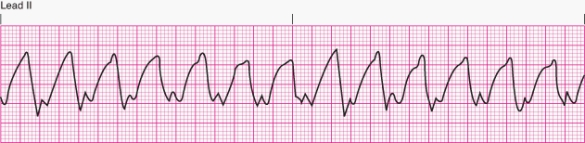
(Multiple Choice)
4.7/5 (88)
(88) The nurse using cardiac monitoring understands that each horizontal box on the electrocardiogram (ECG)paper indicates
(Multiple Choice)
4.8/5 (74)
(74) The nurse is calculating the rate for a regular rhythm.There are 20 small boxes between each P wave and 20 small boxes between each R wave.What is the ventricular rate?
(Multiple Choice)
4.8/5 (89)
(89) 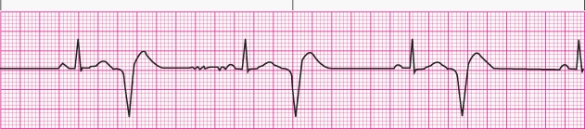
The patient is admitted with sinus pauses causing periods of loss of consciousness.The patient is asymptomatic,awake and alert,but fatigued.He answers questions appropriately.When admitting this patient,the nurse should first
(Multiple Choice)
4.9/5 (72)
(72) The nurse notes the following rhythm on the heart monitor.The patient is unresponsive and not breathing.The nurse should 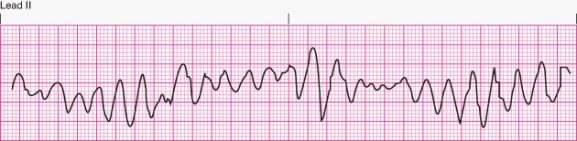
(Multiple Choice)
4.8/5 (89)
(89) The nurse is caring for a patient who is on a cardiac monitor.The nurse realizes that the sinus node is the pacemaker of the heart because it is
(Multiple Choice)
4.8/5 (67)
(67) 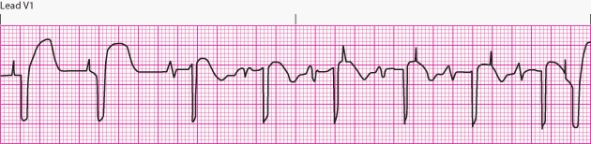
The nurse is talking with the patient when the monitor alarms and shows a wavy baseline without a PQRST complex.The nurse should
(Multiple Choice)
4.9/5 (91)
(91) 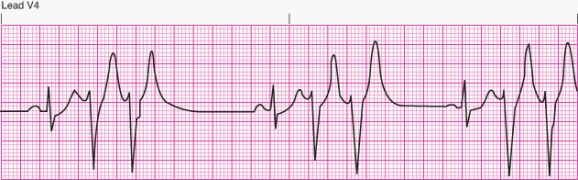
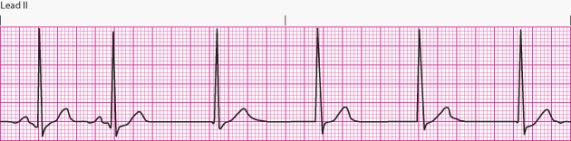
The patient has a permanent pacemaker in place with a demand rate set at 60 beats/min.The cardiac monitor is showing a heart rate of 44 beats/min with no pacemaker spikes.The nurse recognizes this as:
(Multiple Choice)
4.9/5 (75)
(75) 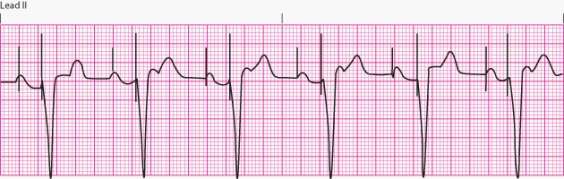
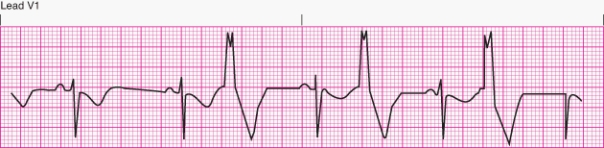
The patient is having premature ventricular contractions (PVCs).The nurse's greatest concern should be:
(Multiple Choice)
4.7/5 (88)
(88) The patient has an irregular heart rhythm.To determine an accurate heart rate,the nurse would first
(Multiple Choice)
4.8/5 (72)
(72) The normal rate for the SA node when the patient is at rest is
(Multiple Choice)
4.8/5 (81)
(81) 
Filters
- Essay(0)
- Multiple Choice(0)
- Short Answer(0)
- True False(0)
- Matching(0)