



 Chat with AI
Exam 7: Dysrhythmia Interpretation and Management

Exam 1: Overview of Critical Care Nursing24 Questions
Exam 2: Patient and Family Response to the Critical Care Experience28 Questions
Exam 3: Ethical and Legal Issues in Critical Care Nursing23 Questions
Exam 4: End-Of-Life Care and Palliative Care in Critical Care Settings26 Questions
Exam 5: Comfort and Sedation33 Questions
Exam 6: Nutritional Support30 Questions
Exam 7: Dysrhythmia Interpretation and Management59 Questions
Exam 8: Hemodynamic Monitoring35 Questions
Exam 9: Ventilatory Assistance36 Questions
Exam 10: Rapid Response Teams and Code Management31 Questions
Exam 11: Organ Donation35 Questions
Exam 12: Shock,sepsis,and Multiple Organ Dysfunction Syndrome34 Questions
Exam 13: Cardiovascular Alterations37 Questions
Exam 14: Nervous System Alterations35 Questions
Exam 15: Acute Respiratory Failure36 Questions
Exam 16: Acute Kidney Injury50 Questions
Exam 17: Hematological and Immune Disorders56 Questions
Exam 18: Gastrointestinal Alterations52 Questions
Exam 19: Endocrine Alterations35 Questions
Exam 20: Trauma and Surgical Management31 Questions
Exam 21: Burns31 Questions
Select questions type


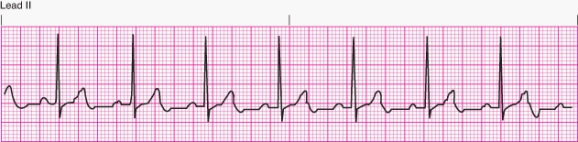
The patient's heart rhythm shows an inverted P wave with a PR interval of 0.06 seconds.The heart rate is 54 beats per minute.The nurse recognizes the rhythm is due to the
(Multiple Choice)
4.7/5  (73)
(73) 
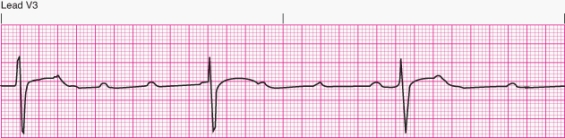
Which of the following is true about a patient diagnosed with sinus arrhythmia?
(Multiple Choice)
4.8/5 (95)
(95) The patient is asymptomatic but is diagnosed with second-degree heart block Mobitz I.The patient is on digitalis medication at home.The nurse should expect that
(Multiple Choice)
4.8/5 (89)
(89) The nurse is reading the cardiac monitor and notes that the patient's heart rhythm is extremely irregular and that there are no discernible P waves.The ventricular rate is 90 beats per minute,and the patient is hemodynamically stable.The nurse realizes that the patient's rhythm is
(Multiple Choice)
4.8/5 (87)
(87) The nurse is caring for a patient who has atrial fibrillation.Sequelae that place the patient at greater risk for mortality/morbidity include which of the following?
(Multiple Choice)
4.8/5 (68)
(68) Which of the following are common causes of sinus tachycardia?
(Multiple Choice)
4.8/5 (88)
(88) 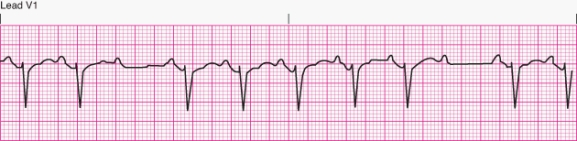
The normal width of the QRS complex is which of the following?
(Multiple Choice)
4.8/5 (77)
(77) 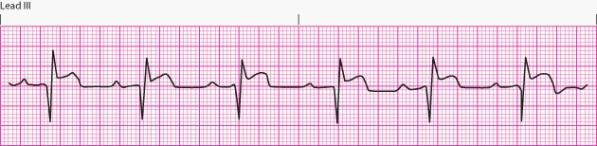
The nurse notices sinus bradycardia on the patient's cardiac monitor.The nurse should
(Multiple Choice)
4.9/5 (72)
(72) The nurse caring for patients on cardiac monitors assesses the patient with a prolonged QT interval for
(Multiple Choice)
4.9/5 (92)
(92) 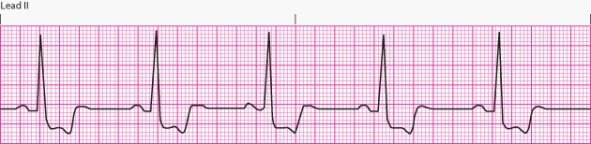
The nurse notices that the patient has a first-degree AV block.Everything else about the rhythm is normal.The nurse should
(Multiple Choice)
4.8/5 (74)
(74) 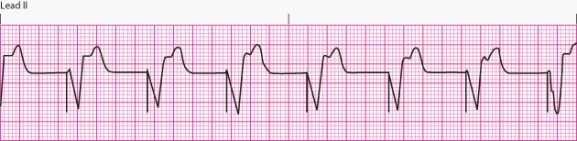
The rhythm on the cardiac monitor is showing numerous pacemaker spikes,but no P waves or QRS complexes following the spikes.The nurse recognizes this as:
(Multiple Choice)
4.9/5 (72)
(72) The patient's heart rate is 70 beats per minute,but the P waves come after the QRS complex.The nurse correctly determines that the patient's heart rhythm is
(Multiple Choice)
4.8/5 (77)
(77) 
Filters
- Essay(0)
- Multiple Choice(0)
- Short Answer(0)
- True False(0)
- Matching(0)