



 Chat with AI
Exam 9: Ventilatory Assistance

Exam 1: Overview of Critical Care Nursing24 Questions
Exam 2: Patient and Family Response to the Critical Care Experience28 Questions
Exam 3: Ethical and Legal Issues in Critical Care Nursing23 Questions
Exam 4: End-Of-Life Care and Palliative Care in Critical Care Settings26 Questions
Exam 5: Comfort and Sedation33 Questions
Exam 6: Nutritional Support30 Questions
Exam 7: Dysrhythmia Interpretation and Management59 Questions
Exam 8: Hemodynamic Monitoring35 Questions
Exam 9: Ventilatory Assistance36 Questions
Exam 10: Rapid Response Teams and Code Management31 Questions
Exam 11: Organ Donation35 Questions
Exam 12: Shock,sepsis,and Multiple Organ Dysfunction Syndrome34 Questions
Exam 13: Cardiovascular Alterations37 Questions
Exam 14: Nervous System Alterations35 Questions
Exam 15: Acute Respiratory Failure36 Questions
Exam 16: Acute Kidney Injury50 Questions
Exam 17: Hematological and Immune Disorders56 Questions
Exam 18: Gastrointestinal Alterations52 Questions
Exam 19: Endocrine Alterations35 Questions
Exam 20: Trauma and Surgical Management31 Questions
Exam 21: Burns31 Questions
Select questions type


A patient's status worsens and needs mechanical ventilation.The pulmonologist wants the patient to receive 10 breaths/min from the ventilator but wants to encourage the patient to breathe spontaneously between the mechanical breaths at his own tidal volume.This mode of ventilation is called

Free
(Multiple Choice)
5.0/5  (83)
(83) Correct Answer: Verified
C
The nurse is caring for a patient who is mechanically ventilated.As part of the nursing care,the nurse understands that
Free
(Multiple Choice)
4.8/5 (87)
(87) Correct Answer:Verified
VerifiedA
The primary mode of action of neuromuscular blocking agents is
Free
(Multiple Choice)
4.9/5 (78)
(78) Correct Answer:Verified
VerifiedC
Select all of the factors that may predispose the patient to respiratory acidosis.
(Multiple Choice)
4.8/5 (89)
(89) The nurse is caring for a patient whose ventilator settings include 15 cm H2O of positive end-expiratory pressure (PEEP).What complication does the nurse assess the patient for?
(Multiple Choice)
4.9/5 (64)
(64) The nurse notes that the patient's arterial blood gas levels indicate hypoxemia.The patient is not intubated and has a respiratory rate of 22 breaths/min.The nurse's first intervention to relieve hypoxemia is to:
(Multiple Choice)
5.0/5 (85)
(85) A patient is being mechanically ventilated in the synchronized intermittent mandatory ventilation mode at a rate of 4 breaths/min.His spontaneous respirations are 12 breaths/min.He receives a dose of morphine sulfate,and his respirations decrease to 4 breaths/min.What adjustments may need to be made to the patient's ventilator settings?
(Multiple Choice)
4.9/5 (69)
(69) A patient is admitted to the progressive care unit with a diagnosis of community-acquired pneumonia.The patient has a history of chronic obstructive pulmonary disease and diabetes.A set of arterial blood gases obtained on admission without supplemental oxygen shows pH 7.35; PaCO2 55 mm Hg; bicarbonate 30 mEq/L; PaO2 65 mm Hg.These blood gases reflect:
(Multiple Choice)
4.9/5 (84)
(84) The nurse is caring for a mechanically ventilated patient and notes the high pressure alarm sounding.The nurse cannot quickly identify the cause of the alarm and notes the patient's oxygen saturation is decreasing and heart rate and respiratory rate are increasing.The nurse's priority action is to
(Multiple Choice)
4.8/5 (89)
(89) The amount of effort needed to maintain a given level of ventilation is termed
(Multiple Choice)
4.9/5 (65)
(65) A patient is admitted to the cardiac surgical intensive care unit after cardiac surgery.Four hours after admission to the surgical intensive care unit at 4 PM,the patient has stable vital signs and normal arterial blood gases (ABGs),and is placed on a T-piece for ventilatory weaning.The following information pertains to the 1900 assessment. 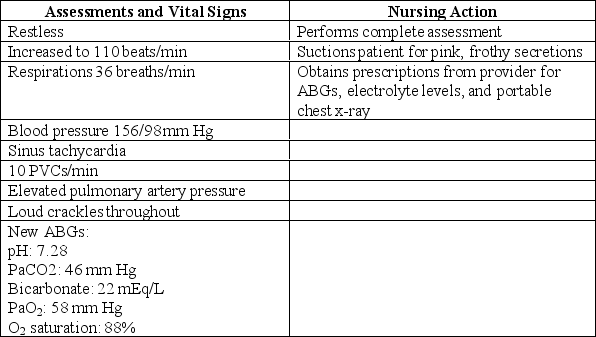 What action by the nurse is best?
 (Multiple Choice)
4.7/5 (88)
(88) Positive end-expiratory pressure (PEEP)is a mode of ventilatory assistance that produces the following condition:
(Multiple Choice)
4.9/5 (72)
(72) The provider orders the following mechanical ventilation settings for a patient who weighs 75 kg.The patient's spontaneous respiratory rate is 22 breaths/min.Which arterial blood gas abnormality may occur if the patient continues to be tachypneic at these ventilator settings? Settings:
Tidal volume: 600 mL (8 mL per kg)
FiO2: 0.5
Respiratory rate: 14 breaths/min
Mode assist/control
Positive end-expiratory pressure: 10 cm H2O
(Multiple Choice)
4.8/5 (80)
(80) Current guidelines recommend the oral route for endotracheal intubation.The rationale for this recommendation is that nasotracheal intubation is associated with a greater risk for
(Multiple Choice)
4.8/5 (81)
(81) The nurse is caring for a patient with an endotracheal tube.The nurse understands that endotracheal suctioning is needed to facilitate removal of secretions and that the procedure
(Multiple Choice)
4.8/5 (80)
(80) A patient is having difficulty weaning from mechanical ventilation.The nurse assesses the patient for which potential cause of this difficult weaning?
(Multiple Choice)
4.8/5 (85)
(85) The nurse is caring for a mechanically ventilated patient and responds to a high inspiratory pressure alarm.Recognizing possible causes for the alarm,the nurse assesses for which of the following?
(Multiple Choice)
4.9/5 (82)
(82) The nurse is assisting with endotracheal intubation and understands that correct placement of the endotracheal tube in the trachea would be identified by which of the following?
(Multiple Choice)
4.9/5 (71)
(71) 
Filters
- Essay(0)
- Multiple Choice(0)
- Short Answer(0)
- True False(0)
- Matching(0)