



 Chat with AI
Exam 8: Hemodynamic Monitoring

Exam 1: Overview of Critical Care Nursing24 Questions
Exam 2: Patient and Family Response to the Critical Care Experience28 Questions
Exam 3: Ethical and Legal Issues in Critical Care Nursing23 Questions
Exam 4: End-Of-Life Care and Palliative Care in Critical Care Settings26 Questions
Exam 5: Comfort and Sedation33 Questions
Exam 6: Nutritional Support30 Questions
Exam 7: Dysrhythmia Interpretation and Management59 Questions
Exam 8: Hemodynamic Monitoring35 Questions
Exam 9: Ventilatory Assistance36 Questions
Exam 10: Rapid Response Teams and Code Management31 Questions
Exam 11: Organ Donation35 Questions
Exam 12: Shock,sepsis,and Multiple Organ Dysfunction Syndrome34 Questions
Exam 13: Cardiovascular Alterations37 Questions
Exam 14: Nervous System Alterations35 Questions
Exam 15: Acute Respiratory Failure36 Questions
Exam 16: Acute Kidney Injury50 Questions
Exam 17: Hematological and Immune Disorders56 Questions
Exam 18: Gastrointestinal Alterations52 Questions
Exam 19: Endocrine Alterations35 Questions
Exam 20: Trauma and Surgical Management31 Questions
Exam 21: Burns31 Questions
Select questions type


The nurse is caring for a mechanically ventilated patient being monitored with a left radial arterial line.During the inspiratory phase of ventilation,the nurse assesses a 20 mm Hg decrease in arterial blood pressure.What is the best interpretation of this finding by the nurse?

Free
(Multiple Choice)
4.9/5  (72)
(72) Correct Answer: Verified
B
When performing an initial pulmonary artery occlusion pressure (PAOP),what are the best nursing actions?
Free
(Multiple Choice)
4.7/5 (69)
(69) Correct Answer:Verified
VerifiedA,B,D
While inflating the balloon of a pulmonary artery catheter (PAC)with 1.0 mL of air to obtain a pulmonary artery occlusion pressure (PAOP),the nurse encounters resistance.What is the best nursing action?
Free
(Multiple Choice)
4.8/5 (75)
(75) Correct Answer:Verified
VerifiedC
The nurse is preparing to measure the thermodilution cardiac output (TdCO)in a patient being monitored with a pulmonary artery catheter.Which action by the nurse best ensures the safety of the patient?
(Multiple Choice)
4.8/5 (75)
(75) The nurse is caring for a patient following insertion of a left subclavian central venous catheter (CVC).Which assessment finding 2 hours after insertion by the nurse warrants immediate action?
(Multiple Choice)
4.8/5 (90)
(90) The nurse is caring for a patient with a left radial arterial line and a pulmonary artery catheter inserted into the right subclavian vein.Which action by the nurse best ensures the safety of the patient being monitored with invasive hemodynamic monitoring lines?
(Multiple Choice)
4.9/5 (84)
(84) The nurse is caring for a 100-kg patient being monitored with a pulmonary artery catheter.The nurse assesses a blood pressure of 90/60 mm Hg,heart rate 110 beats/min,respirations 36/min,oxygen saturation of 89% on 3 L of oxygen via nasal cannula.Bilateral crackles are audible upon auscultation.Which hemodynamic value requires immediate action by the nurse?
(Multiple Choice)
4.9/5 (79)
(79) The charge nurse is supervising care for a group of patients monitored with a variety of invasive hemodynamic devices.Which patient should the charge nurse evaluate first?
(Multiple Choice)
4.9/5 (77)
(77) Following insertion of a central venous catheter,the nurse obtains a stat chest x-ray film to verify proper catheter placement.The radiologist reports to the nurse: "The tip of the catheter is located in the superior vena cava." What is the best interpretation of these results by the nurse?
(Multiple Choice)
4.8/5 (73)
(73) The nurse is preparing for insertion of a pulmonary artery catheter (PAC).During insertion of the catheter,what are the priority nursing actions?
(Multiple Choice)
4.9/5 (66)
(66) The provider prescribes a pulmonary artery occlusive pressure reading (PAOP)for a patient being monitored with a pulmonary artery catheter.Immediately after obtaining an occlusive pressure,the nurse notes the change in waveform indicated on the strip below.What are the best actions by the nurse? 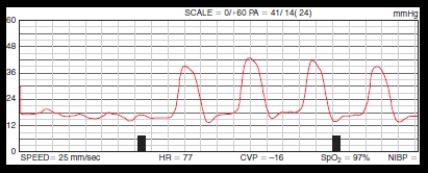 Figure from Geiter H,Jr.: Swan-Ganz Catheters.http://www.nurse411.com.Accessed April 2012.
 (Multiple Choice)
4.9/5 (98)
(98) The nurse is caring for a patient with an arterial monitoring system.The nurse assesses the patient's noninvasive cuff blood pressure to be 70/40 mm Hg.The arterial blood pressure measurement via an intraarterial catheter in the same arm is assessed by the nurse to be 108/70 mm Hg.What is the best action by the nurse?
(Multiple Choice)
4.8/5 (82)
(82) The provider writes an order to discontinue a patient's left radial arterial line.When discontinuing the patient's invasive line,what is the priority nursing action?
(Multiple Choice)
4.9/5 (78)
(78) The charge nurse is supervising the care of four critical care patients being monitored using invasive hemodynamic modalities.Which patient should the charge nurse evaluate first?
(Multiple Choice)
4.7/5 (69)
(69) A patient is admitted to the hospital with multiple trauma and extensive blood loss.The nurse assesses vital signs to be BP 80/50 mm Hg,heart rate 135 beats/min,respirations 36 breaths/min,cardiac output (CO)of 2 L/min,systemic vascular resistance of 3000 dynes/sec/cm-5,and a hematocrit of 20%.The nurse anticipates administration of which the following therapies or medications?
(Multiple Choice)
4.8/5 (71)
(71) Upon entering the room of a patient with a right radial arterial line,the nurse assesses the waveform to be slightly dampened and notices blood to be backed up into the pressure tubing.What is the best action by the nurse?
(Multiple Choice)
4.7/5 (70)
(70) The nurse is caring for a patient with a left subclavian central venous catheter (CVC)and a left radial arterial line.Which assessment finding by the nurse requires immediate action?
(Multiple Choice)
4.8/5 (87)
(87) The nurse returns from the cardiac catheterization laboratory with a patient following insertion of a pulmonary artery catheter and assists in transferring the patient from the stretcher to the bed.Before obtaining a cardiac output,which action is most important for the nurse to complete?
(Multiple Choice)
4.7/5 (66)
(66) Which of the following situations may result in a low cardiac output and low cardiac index?
(Multiple Choice)
4.9/5 (66)
(66) The nurse is caring for a patient following insertion of a left subclavian central venous catheter (CVC).Which action by the nurse best reduces the risk of catheter-related bloodstream infection (CRBSI)?
(Multiple Choice)
4.9/5 (76)
(76) 
Filters
- Essay(0)
- Multiple Choice(0)
- Short Answer(0)
- True False(0)
- Matching(0)