



 Chat with AI
Exam 11: Hemolytic Disease of the Fetus and Newborn

Exam 1: Immunology: Basic Principles and Applications in the Blood Bank40 Questions
Exam 2: Blood Banking Reagents: Overview and Applications34 Questions
Exam 3: Genetic Principles in Blood Banking32 Questions
Exam 4: Abo and H Blood Group Systems and Secretor Status25 Questions
Exam 5: Rh Blood Group System30 Questions
Exam 6: Other Blood Group Systems27 Questions
Exam 7: Antibody Detection and Identification30 Questions
Exam 8: Compatibility Testing30 Questions
Exam 9: Blood Bank Automation for Transfusion Services10 Questions
Exam 10: Adverse Complications of Transfusions30 Questions
Exam 11: Hemolytic Disease of the Fetus and Newborn30 Questions
Exam 12: Donor Selection and Phlebotomy30 Questions
Exam 13: Testing of Donor Blood25 Questions
Exam 14: Blood Component Preparation and Therapy29 Questions
Exam 15: Transfusion Therapy in Selected Patients25 Questions
Exam 16: Quality Assurance and Regulation of the Blood Industry and Safety Issues in the Blood Bank38 Questions
Select questions type


Rh immune globulin should be given within how many hours following delivery?

Free
(Multiple Choice)
4.7/5  (87)
(87) Correct Answer: Verified
D
In a suspected case of HDFN,what significant information can be obtained from the baby's blood smear?
Free
(Multiple Choice)
4.9/5 (98)
(98) Correct Answer:Verified
VerifiedC
The rosette test will detect a fetomaternal hemorrhage as small as:
Free
(Multiple Choice)
4.8/5 (74)
(74) Correct Answer:Verified
VerifiedB
All of the following are goals of an exchange transfusion except to:
(Multiple Choice)
4.8/5 (68)
(68) To identify the cause of suspected hemolytic disease of the fetus and newborn,which tests are performed?
(Multiple Choice)
4.9/5 (70)
(70) Select the situation where the administration of Rh immune globulin would be contraindicated.
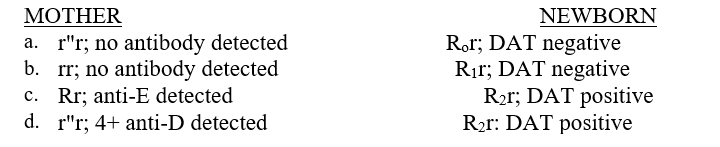
(Short Answer)
5.0/5 (72)
(72) Anti-D in the serum of a third-trimester pregnant woman with a titer of 16 is indicative of:
(Multiple Choice)
4.8/5 (82)
(82) A weakly reactive anti-D was detected in a sample from a D-negative mother one day following delivery of a D-negative baby.Based on these results the lab should:
(Multiple Choice)
4.9/5 (69)
(69) A large fetomaternal bleed in a D-negative woman who delivered a D-positive infant should be suspected if the:
(Multiple Choice)
4.7/5 (84)
(84) A group O,D-positive mother gave birth to an A-negative infant.After 24 hours,the newborn's bilirubin level rose to 19 mg/dL.A direct antiglobulin test performed on the cord blood specimen was positive with anti-IgG.What is the most probable antibody causing this?
(Multiple Choice)
4.8/5 (85)
(85) All of the following are common characteristics of ABO hemolytic disease of the fetus and newborn except:
(Multiple Choice)
4.9/5 (78)
(78) To be considered a candidate for Rh immune globulin,the mother is __________ and the infant is __________.
(Multiple Choice)
4.8/5 (83)
(83) In testing amniotic fluid,the Liley method of predicting the severity of hemolytic disease of the fetus and newborn is based on:
(Multiple Choice)
4.9/5 (85)
(85) A 300- g dose of Rh immune globulin contains sufficient anti-D to protect against how much whole blood?
(Multiple Choice)
4.9/5 (76)
(76) Select the true statement regarding ABO hemolytic disease of the fetus and newborn.
(Multiple Choice)
4.9/5 (98)
(98) A newborn phenotypes as group O,D-positive with a 1+ direct antiglobulin test.The mother's antibody screening test is negative.Assuming the antibody screen is valid,one should consider the reason for the positive DAT is due to an antibody against __________ antigen.
(Multiple Choice)
5.0/5 (84)
(84) Which of the following antibodies have not been known to cause hemolytic disease of the fetus and newborn?
(Multiple Choice)
4.9/5 (65)
(65) 
Filters
- Essay(0)
- Multiple Choice(0)
- Short Answer(0)
- True False(0)
- Matching(0)