



 Chat with AI
Exam 17: Property Rights, externalities, rivalry, and Exclusion

Exam 1: Introduction43 Questions
Exam 2: Supply and Demand226 Questions
Exam 3: A Consumers Constrained Choice129 Questions
Exam 4: Demand123 Questions
Exam 5: Consumer Welfare and Policy Analysis73 Questions
Exam 6: Firms and Production111 Questions
Exam 7: Costs132 Questions
Exam 8: Competitive Firms and Markets112 Questions
Exam 9: Properties and Applications of the Competitive Model101 Questions
Exam 10: General Equilibrium and Economic Welfare108 Questions
Exam 11: Monopoly and Monopsony141 Questions
Exam 12: Pricing and Advertising91 Questions
Exam 13: Game Theory84 Questions
Exam 14: Oligopoly and Monopolistic Competition114 Questions
Exam 15: Factor Markets115 Questions
Exam 16: Uncertainty103 Questions
Exam 17: Property Rights, externalities, rivalry, and Exclusion105 Questions
Exam 18: Asymmetric Information85 Questions
Exam 19: Contracts and Moral Hazards79 Questions
Select questions type


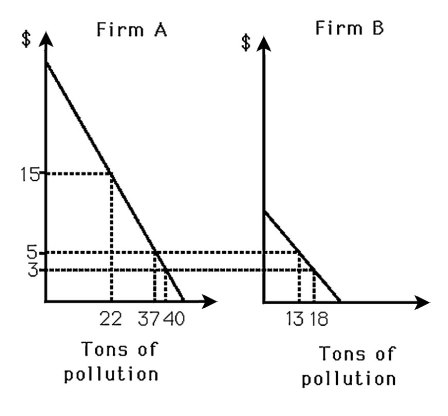 -The above figure shows the marginal benefit from pollution for two firms.If both firms receive a marketable permit to pollute 25 units of pollution each,how much will each firm pollute and how much will a permit for one unit of pollution be worth?
 (Essay)
4.9/5  (72)
(72) 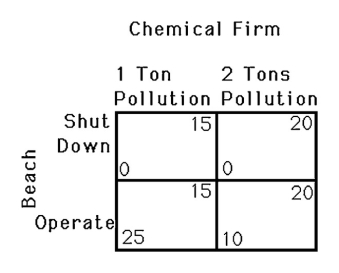 -The above figure shows the payoff matrix for two firms.A chemical firm must choose between a low level of production which yields one ton of pollution into a nearby lake and a high level of production which yields two tons of pollution into the nearby lake.A private beach on the lake must decide whether to operate or not.Increased pollution reduces the number of people who wish to visit the beach.If nobody owns the lake,then
 (Multiple Choice)
4.8/5 (87)
(87) A monopoly might produce less than the socially optimal amount of pollution because
(Multiple Choice)
4.7/5 (77)
(77) 
Filters
- Essay(0)
- Multiple Choice(0)
- Short Answer(0)
- True False(0)
- Matching(0)