



 Chat with AI
Exam 17: Property Rights, externalities, rivalry, and Exclusion

Exam 1: Introduction43 Questions
Exam 2: Supply and Demand226 Questions
Exam 3: A Consumers Constrained Choice129 Questions
Exam 4: Demand123 Questions
Exam 5: Consumer Welfare and Policy Analysis73 Questions
Exam 6: Firms and Production111 Questions
Exam 7: Costs132 Questions
Exam 8: Competitive Firms and Markets112 Questions
Exam 9: Properties and Applications of the Competitive Model101 Questions
Exam 10: General Equilibrium and Economic Welfare108 Questions
Exam 11: Monopoly and Monopsony141 Questions
Exam 12: Pricing and Advertising91 Questions
Exam 13: Game Theory84 Questions
Exam 14: Oligopoly and Monopolistic Competition114 Questions
Exam 15: Factor Markets115 Questions
Exam 16: Uncertainty103 Questions
Exam 17: Property Rights, externalities, rivalry, and Exclusion105 Questions
Exam 18: Asymmetric Information85 Questions
Exam 19: Contracts and Moral Hazards79 Questions
Select questions type


The efficient quantity of a pure public good occurs when the marginal cost of producing that good equals the
(Multiple Choice)
4.9/5  (76)
(76) Which of the following statements about private and social costs is TRUE in the presence of negative externalities created by pollution?
(Multiple Choice)
4.9/5 (79)
(79) If a production process creates positive externalities,a competitive market produces too few positive externalities because the producer
(Multiple Choice)
4.9/5 (74)
(74) Production of a good produces pollution that is very damaging with each additional unit.A monopoly facing a very elastic demand curve will most likely produce
(Multiple Choice)
4.9/5 (86)
(86) When majority rule voting is used to determine whether to purchase a public good,
(Multiple Choice)
4.9/5 (78)
(78) Suppose that in the market for paper,demand is p = 100 - Q.The private marginal cost is MCᵖ = 10 + Q.Pollution generated during the production process creates external marginal harm equal to MCᵉ = Q.What specific tax would result in a competitive market producing the socially optimal quantity of paper?
(Essay)
4.8/5 (81)
(81) Suppose two neighbors share a park.One neighbor,Al,leaves trash in the park.This bothers the other neighbor,Bert.According to Coase's theorem,the optimal level of trash in the park can be achieved if
(Multiple Choice)
4.9/5 (76)
(76) Suppose two neighbors share a park.One neighbor,Al,leaves trash in the park.This bothers the other neighbor,Bert.According to Coase's theorem,one necessary condition to alleviate the externality is that
(Multiple Choice)
4.9/5 (81)
(81) 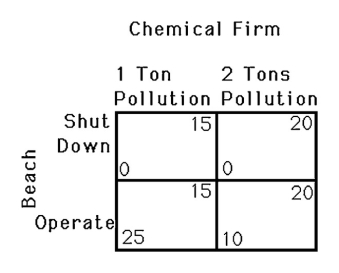 -The above figure shows the payoff matrix for two firms.A chemical firm must choose between a low level of production which yields one ton of pollution into a nearby lake and a high level of production which yields two tons of pollution into the nearby lake.A private beach on the lake must decide whether to operate or not.Increased pollution reduces the number of people who wish to visit the beach.If nobody owns the lake,then
 (Multiple Choice)
4.9/5 (82)
(82)  -Suppose the government wishes to regulate mercury emissions of factories in a specific industry by either setting an emissions standard or imposing an emissions fee (per ton of mercury).The government is uncertain as to the marginal abatement costs,which may be high (MC₁)or low (MC₂).
MC₁ = 15M + 500
MC₂ = 15M - 500
where M is the units of mercury abated.The government believes there is a 50% chance of each of the marginal abatement costs.The marginal benefit of abatement is known to be:
MB = 1500 - 10M
a.What is the optimal level of emissions for each of the cost curves above?
b.What is the expected marginal abatement cost (equation)?
c.What is the optimal emissions standard according to the expected abatement costs?
d.What is the optimal abatement fee according to the expected abatement costs?
e.Which regulation will result in a lower DWL in the presence of the uncertainty? Explicitly compute the expected DWL arising from each proposal.
-Suppose the government wishes to regulate mercury emissions of factories in a specific industry by either setting an emissions standard or imposing an emissions fee (per ton of mercury).The government is uncertain as to the marginal abatement costs,which may be high (MC₁)or low (MC₂).
MC₁ = 15M + 500
MC₂ = 15M - 500
where M is the units of mercury abated.The government believes there is a 50% chance of each of the marginal abatement costs.The marginal benefit of abatement is known to be:
MB = 1500 - 10M
a.What is the optimal level of emissions for each of the cost curves above?
b.What is the expected marginal abatement cost (equation)?
c.What is the optimal emissions standard according to the expected abatement costs?
d.What is the optimal abatement fee according to the expected abatement costs?
e.Which regulation will result in a lower DWL in the presence of the uncertainty? Explicitly compute the expected DWL arising from each proposal. (Essay)
4.8/5 (89)
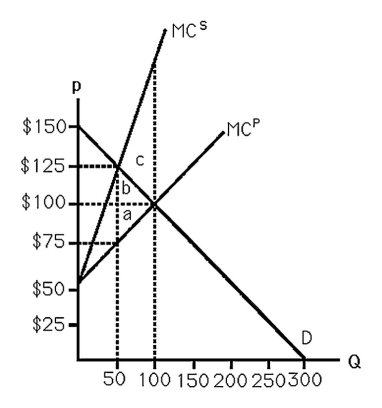
(89) 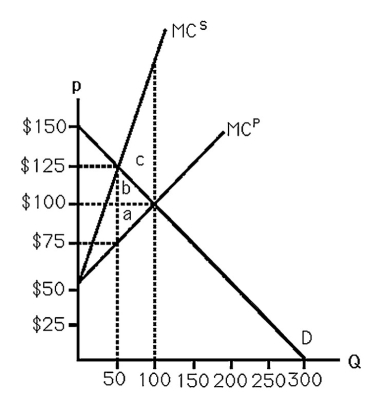 -Suppose that the market for steel is shown in the above figure.Is social welfare greater under monopoly or under competition?
 (Essay)
4.9/5 (79)
(79)
-The above figure shows the payoff matrix for two firms.A chemical firm must choose between a low level of production which yields one ton of pollution into a nearby lake and a high level of production which yields two tons of pollution into the nearby lake.A private beach on the lake must decide whether to operate or not.Increased pollution reduces the number of people who wish to visit the beach.If the beach owner also owns the lake,and the chemical firm must pay $10 per ton to pollute,then
-The above figure shows the payoff matrix for two firms.A chemical firm must choose between a low level of production which yields one ton of pollution into a nearby lake and a high level of production which yields two tons of pollution into the nearby lake.A private beach on the lake must decide whether to operate or not.Increased pollution reduces the number of people who wish to visit the beach.If the beach owner also owns the lake,and the chemical firm must pay $10 per ton to pollute,then (Multiple Choice)
4.8/5 (77)
(77) In the presence of a negative externality in production,a monopoly will produce
(Multiple Choice)
4.8/5 (62)
(62) If the government wanted to efficiently limit the emission of Carbon Monoxide by all firms to exactly 4 Million tons it could
(Multiple Choice)
4.8/5 (99)
(99) The optimal provision of a public good occurs when the sum of the marginal rate of substitution for all members of society equals 1,the marginal rate of transformation.What is the relationship between the marginal rates of substitution in the competitive market? Use this relationship to explain why too few public goods are provided in the competitive market.
(Essay)
4.9/5 (70)
(70) 
Filters
- Essay(0)
- Multiple Choice(0)
- Short Answer(0)
- True False(0)
- Matching(0)