



 Chat with AI
Exam 7: Costs

Exam 1: Introduction43 Questions
Exam 2: Supply and Demand226 Questions
Exam 3: A Consumers Constrained Choice129 Questions
Exam 4: Demand123 Questions
Exam 5: Consumer Welfare and Policy Analysis73 Questions
Exam 6: Firms and Production111 Questions
Exam 7: Costs132 Questions
Exam 8: Competitive Firms and Markets112 Questions
Exam 9: Properties and Applications of the Competitive Model101 Questions
Exam 10: General Equilibrium and Economic Welfare108 Questions
Exam 11: Monopoly and Monopsony141 Questions
Exam 12: Pricing and Advertising91 Questions
Exam 13: Game Theory84 Questions
Exam 14: Oligopoly and Monopolistic Competition114 Questions
Exam 15: Factor Markets115 Questions
Exam 16: Uncertainty103 Questions
Exam 17: Property Rights, externalities, rivalry, and Exclusion105 Questions
Exam 18: Asymmetric Information85 Questions
Exam 19: Contracts and Moral Hazards79 Questions
Select questions type


For the following, please answer "True" or "False" and explain why.
-The "Law of Diminishing Marginal Returns" could also be termed the "Law of Increasing Marginal Costs."

Free
(True/False)
4.9/5  (73)
(73) Correct Answer: Verified
True
A firm pays $5 for each unit of capital.Labor costs $5 per hour for the first 10 hours and $10 per hour for every hour thereafter.Draw the isocost curves for total costs of $50 and $100.
Free
(Essay)
4.8/5 (96)
(96) Correct Answer:Verified
Verified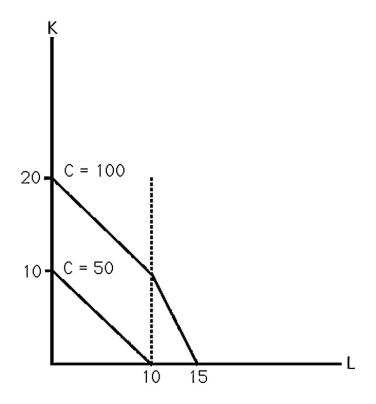
Consider a firm with two technologies to choose between when producing output.The cost function when using technology 1 is given by:
c₁(q)= 3600 + 65q + 36q²
The cost function when using technology 2 is given by:
c₂(q)= 900 + 900q +q²
ᴬˢˢᵘᵐᵉ ᵗʰᵃᵗ ᵗʰᵉ ᶠᶦʳᵐ ᶜᵃⁿ ᵒⁿˡʸ ᶦᵐᵖˡᵉᵐᵉⁿᵗ ᵒⁿᵉ ᵒᶠ ᵗʰᵉ ᵗʷᵒ ᵗᵉᶜʰⁿᵒˡᵒᵍᶦᵉˢ ᵃᵗ ᵃ ᵗᶦᵐᵉ.
a.If the firm wishes to produce output at the lowest per-unit cost,which technology should it choose and how much output should it produce?
b.Which technology should the firm choose if it wishes to produce 15 units of output? What about 25 units of output?
(Essay)
4.8/5 (87)
(87) Suppose the short-run production function is q = 10 ∗ L.If the wage rate is $10 per unit of labor,then AVC equals
(Multiple Choice)
4.9/5 (71)
(71) Economists proclaim that competitive firms make zero economic profit in the long run.This shows how
(Multiple Choice)
4.9/5 (74)
(74) The total cost of producing one unit is $50.The total cost of producing two units is $75.At a production level of two units,the cost function exhibits
(Multiple Choice)
4.9/5 (88)
(88) Explain why the long-run total cost curve,not the short-run total cost curve,shows the lowest cost of producing any level of output.Is there an exception?
(Essay)
4.9/5 (78)
(78) Evren wants to go into the donut business.For $500 per month he can rent a bakery complete with all the equipment he needs to make a dozen different kinds of donuts (K = l,r = 500).He must pay unionized donut bakers a monthly salary of $400 each.He projects his monthly production function to be
Q = 5KL
where Q is tons of donuts.
a.With the current level of capital,what is the marginal product of labor? Is the marginal product diminishing? Explain.
b.If Evren wishes to make 25 tons of donuts,how many bakers are required given the current level of capital? How much will it cost to produce this (total cost)?
c.Derive Evren's short-run cost function with K=1.
d.Derive the marginal cost curve from your answer to c.and show the relationship between the marginal cost and marginal product of labor.
(Essay)
4.8/5 (91)
(91) Many universities have either a top football program OR a top basketball program.Very few have both.These results suggest the presence of
(Multiple Choice)
4.8/5 (78)
(78) What is the last dollar rule for cost-minimization? Provide a brief explanation (in words)as well as the corresponding mathematical equality.If the firm is producing at a point where the isocost line is steeper than the isoquant,what does the last dollar rule imply (i.e.,where is the last dollar most productive,L or K)and how should the firm alter its capital and labor in the long run?
(Essay)
4.8/5 (90)
(90) 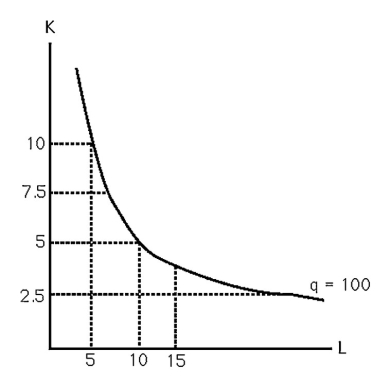 -At Albert's Pretzel Company,MPL = 1/L,and MPK = 1/K.The isoquant for 100 pounds of pretzels daily is shown in the above figure.Albert minimizes the cost of producing 100 pounds of pretzels daily by hiring five units of labor and 10 units of capital when w = 50 and r = 25.When r rises to 100,what is the minimum cost of producing 100 pounds of pretzels daily in the short run? in the long run?
 (Essay)
5.0/5 (78)
(78) For the following, please answer "True" or "False" and explain why.
-Short-run average cost exceeds long-run average cost only when there are economies of scale.
(True/False)
5.0/5 (81)
(81) A firm produces output according to the following function:
q = f (L,K)= L¹/² K¹/³
The cost of labor is $9 per hour and the rental cost of capital is $4 per hour.
a.With the given prices,use the Lagrangian method to compute the optimal (cost-minimizing)capital to labor ratio (K/L)for the firm.
b.Suppose the firm wishes to produce 72 units of output.How much capital and how much labor does the firm employ?
c.What is the total cost of producing 72 units of output?
d.Suppose that the firm suddenly decides to double the quantity of output but only has a day to complete the order.Therefore,in that time,the amount of capital is fixed but labor hours are not.How much will it cost to produce 144 units of output? How much would it cost if the firm could also vary capital? Compute as well as providing a graph (isocost/isoquant)illustrating the optimal bundles.
(Essay)
4.8/5 (73)
(73) Explain why in the long run a firm that is cost minimizing will choose K and L where:
w/MPL = r/MPK
What does this tell you about the marginal cost of increasing output through hiring labor and the marginal cost of increasing output through adding capital?
(Essay)
4.7/5 (73)
(73) Suppose the total cost of producing T-shirts can be represented as TC = 50 + 2q.Which of the following statements is TRUE at all levels of production?
(Multiple Choice)
4.9/5 (67)
(67) 
Filters
- Essay(0)
- Multiple Choice(0)
- Short Answer(0)
- True False(0)
- Matching(0)