



 Chat with AI
Exam 17: Property Rights, externalities, rivalry, and Exclusion

Exam 1: Introduction43 Questions
Exam 2: Supply and Demand226 Questions
Exam 3: A Consumers Constrained Choice129 Questions
Exam 4: Demand123 Questions
Exam 5: Consumer Welfare and Policy Analysis73 Questions
Exam 6: Firms and Production111 Questions
Exam 7: Costs132 Questions
Exam 8: Competitive Firms and Markets112 Questions
Exam 9: Properties and Applications of the Competitive Model101 Questions
Exam 10: General Equilibrium and Economic Welfare108 Questions
Exam 11: Monopoly and Monopsony141 Questions
Exam 12: Pricing and Advertising91 Questions
Exam 13: Game Theory84 Questions
Exam 14: Oligopoly and Monopolistic Competition114 Questions
Exam 15: Factor Markets115 Questions
Exam 16: Uncertainty103 Questions
Exam 17: Property Rights, externalities, rivalry, and Exclusion105 Questions
Exam 18: Asymmetric Information85 Questions
Exam 19: Contracts and Moral Hazards79 Questions
Select questions type


In the case of a good that has no exclusion and no rivalry,private markets fail because

Free
(Multiple Choice)
4.9/5  (83)
(83) Correct Answer: Verified
A
Suppose three neighbors must vote on the installation of a traffic light that costs $210.The cost of the light will be shared by all three.Voter A values the light at $50; voter B values the light at $50; and voter C (who drives the most)values the light at $200.If the voting rule is that the majority wins,does the light get purchased? Is it efficient to purchase the light?
Free
(Essay)
4.8/5 (94)
(94) Correct Answer:Verified
VerifiedThe cost of the light to each voter is $70.Since MC > MB for two of them,the light does not get purchased.It is efficient to purchase the light since SMB = 300 which exceeds the MC of 210.
Because a monopoly ignores external costs,it is possible that it will
Free
(Multiple Choice)
4.7/5 (75)
(75) Correct Answer:Verified
VerifiedD
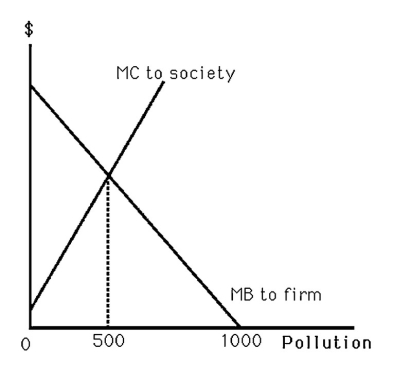 -The above figure shows the marginal benefit to a firm of polluting in the local river while producing its output,and the marginal cost to the surrounding neighbors.The marginal cost of production is zero for the firm.If the firm owns the river and there is just one neighbor affected by the pollution,how much pollution is likely to occur?
 (Multiple Choice)
4.7/5 (73)
(73) 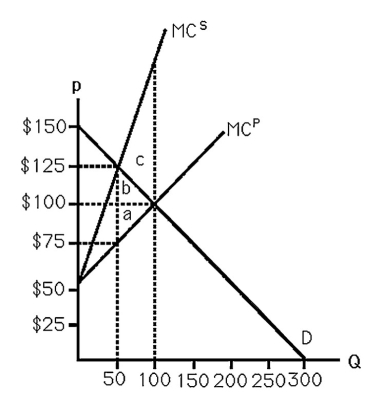 -The above figure shows the market for steel ingots.If the market is competitive,then
 (Multiple Choice)
4.8/5 (76)
(76) Two neighboring farmers must each decide whether to contribute to a fence that separates their properties.The fence costs a total of $20.Both farmers currently have a profit of $30 each.With a fence to keep each farmer's animals from wandering onto the other's property,both farmers would experience a $15 rise in profits.Draw the payoff matrix and discuss the possible outcomes.
(Essay)
4.7/5 (72)
(72) Explain why the social demand curve for a public good is the vertical sum of the demand curves of each individual.
(Essay)
4.8/5 (90)
(90) 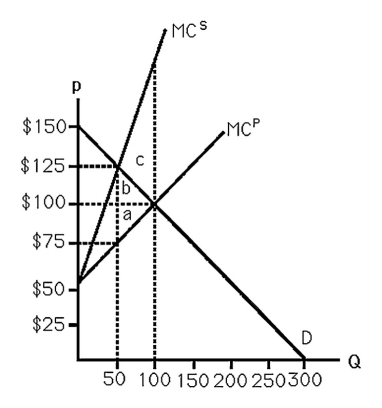 -The above figure shows the market for steel ingots.If the market is competitive,then the deadweight loss to society is
 (Multiple Choice)
4.9/5 (90)
(90) For the following, please answer "True" or "False" and explain why.
-To maximize welfare in a competitive market that has a negative externality in production,government should tax a pollution-generating good at a specific tax equal to the marginal cost of producing the good.
(True/False)
4.9/5 (77)
(77) A specific tax in a monopoly market equal to the marginal harm of pollution
(Multiple Choice)
4.9/5 (72)
(72)
-The above figure shows the marginal benefit to a firm of polluting in the local river while producing its output,and the marginal cost to the surrounding neighbors.The marginal cost of production is zero for the firm.If the firm owns the river and there are thousands of surrounding neighbors,how much pollution is likely to occur?
-The above figure shows the marginal benefit to a firm of polluting in the local river while producing its output,and the marginal cost to the surrounding neighbors.The marginal cost of production is zero for the firm.If the firm owns the river and there are thousands of surrounding neighbors,how much pollution is likely to occur? (Multiple Choice)
4.8/5 (85)
(85) 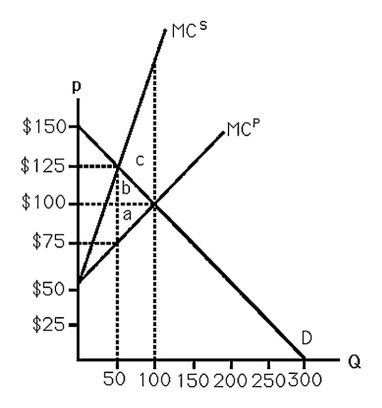 -The above figure shows the market for steel ingots.What is the change in externality cost if the market switches from competitive equilibrium to social optimum?
 (Multiple Choice)
4.8/5 (79)
(79) Suppose two neighbors share a park.One neighbor,Al,leaves trash in the park.This bothers the other neighbor,Bert.According to Coase's theorem,the optimal level of trash in the park can be achieved if
(Multiple Choice)
4.8/5 (72)
(72) If the social marginal cost of a good is very high relative to the private marginal cost,then a monopoly will most likely
(Multiple Choice)
5.0/5 (79)
(79)
-The above figure shows the marginal benefit to a firm of polluting in the local river while producing its output,and the marginal cost to the surrounding neighbors.The marginal cost of production is zero for the firm.If property rights are not defined,how much pollution will occur?
-The above figure shows the marginal benefit to a firm of polluting in the local river while producing its output,and the marginal cost to the surrounding neighbors.The marginal cost of production is zero for the firm.If property rights are not defined,how much pollution will occur? (Multiple Choice)
4.8/5 (95)
(95) Fishermen on the East Coast are using lobster traps out of which most of the lobsters that enter can escape.Why?
(Multiple Choice)
4.8/5 (86)
(86) Explain how a specific tax equal to the marginal harm of pollution can increase or decrease total welfare in a monopoly market.
(Essay)
4.9/5 (77)
(77) 
Filters
- Essay(0)
- Multiple Choice(0)
- Short Answer(0)
- True False(0)
- Matching(0)