



 Chat with AI
Exam 17: Property Rights, externalities, rivalry, and Exclusion

Exam 1: Introduction43 Questions
Exam 2: Supply and Demand226 Questions
Exam 3: A Consumers Constrained Choice129 Questions
Exam 4: Demand123 Questions
Exam 5: Consumer Welfare and Policy Analysis73 Questions
Exam 6: Firms and Production111 Questions
Exam 7: Costs132 Questions
Exam 8: Competitive Firms and Markets112 Questions
Exam 9: Properties and Applications of the Competitive Model101 Questions
Exam 10: General Equilibrium and Economic Welfare108 Questions
Exam 11: Monopoly and Monopsony141 Questions
Exam 12: Pricing and Advertising91 Questions
Exam 13: Game Theory84 Questions
Exam 14: Oligopoly and Monopolistic Competition114 Questions
Exam 15: Factor Markets115 Questions
Exam 16: Uncertainty103 Questions
Exam 17: Property Rights, externalities, rivalry, and Exclusion105 Questions
Exam 18: Asymmetric Information85 Questions
Exam 19: Contracts and Moral Hazards79 Questions
Select questions type


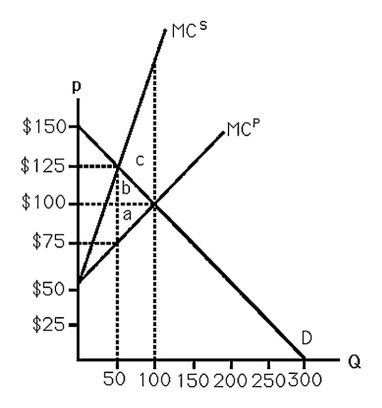 -The above figure shows the market for steel ingots.What is the change in consumer surplus if the market switches from competitive equilibrium to social optimum?
 (Multiple Choice)
4.9/5  (75)
(75) 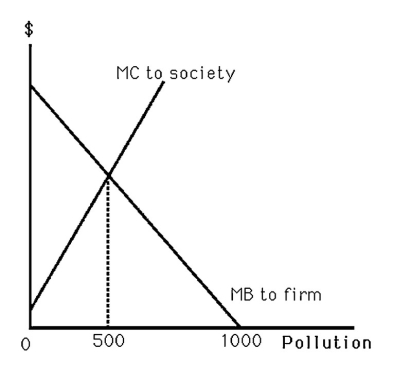 -The above figure shows the marginal benefit to a firm of polluting in the local river while producing its output,and the marginal cost to the firm's neighbor.The marginal cost of production is zero for the firm.If there is just one neighbor who owns the river,how much pollution is likely to occur?
 (Multiple Choice)
4.7/5 (80)
(80) You are having a party and one of your guests lights up a cigar without asking.Explain why this creates an externality.
(Essay)
4.9/5 (90)
(90) A tax on a previously untaxed monopoly-produced good will necessarily lower total welfare if
(Multiple Choice)
4.9/5 (78)
(78) 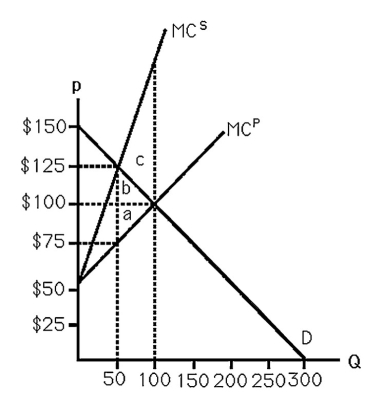 -The above figure shows the market for steel ingots.An externality can be seen because
 (Multiple Choice)
4.8/5 (82)
(82) 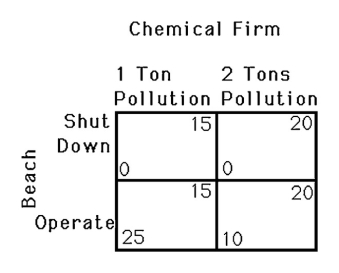 -The above figure shows the payoff matrix for two firms.A chemical firm must choose between a low level of production which yields one ton of pollution into a nearby lake and a high level of production which yields two tons of pollution into the nearby lake.A private beach on the lake must decide whether to operate or not.Increased pollution reduces the number of people who wish to visit the beach.Joint profits are maximized when
 (Multiple Choice)
4.9/5 (91)
(91)
-The above figure shows the payoff matrix for two firms.A chemical firm must choose between a low level of production which yields one ton of pollution into a nearby lake and a high level of production which yields two tons of pollution into the nearby lake.A private beach on the lake must decide whether to operate or not.Increased pollution reduces the number of people who wish to visit the beach.If the chemical firm owns the lake,and the beach owner must pay $10 to keep the chemical firm at just one ton of pollution,then
-The above figure shows the payoff matrix for two firms.A chemical firm must choose between a low level of production which yields one ton of pollution into a nearby lake and a high level of production which yields two tons of pollution into the nearby lake.A private beach on the lake must decide whether to operate or not.Increased pollution reduces the number of people who wish to visit the beach.If the chemical firm owns the lake,and the beach owner must pay $10 to keep the chemical firm at just one ton of pollution,then (Multiple Choice)
5.0/5 (88)
(88) Suppose twenty neighbors share a park.One of the neighbors,Al,leaves trash in the park.This bothers the other neighbors.According to Coase's theorem,assigning the property rights to the park to Al
(Multiple Choice)
4.8/5 (82)
(82) Which of the following statements about private and social costs is TRUE?
(Multiple Choice)
4.9/5 (102)
(102) If a production process generates pollution,then a competitive market will produce more of the good than is socially optimal because
(Multiple Choice)
4.8/5 (70)
(70) In the presence of pollution,social welfare is maximized by
(Multiple Choice)
4.8/5 (84)
(84) According to the Coase approach,to achieve socially optimal outcome,two sides must bargain.The bargaining might not be successful because
(Multiple Choice)
4.8/5 (76)
(76) Markets tend to produce too little of an excludable public good because
(Multiple Choice)
4.9/5 (87)
(87) 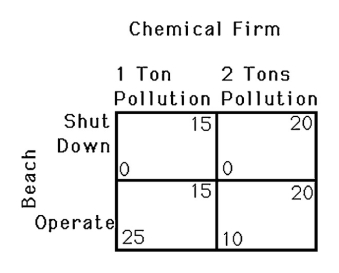 -The above figure shows the payoff matrix for two firms.A chemical firm must choose between a low level of production which yields one ton of pollution into a nearby lake and a high level of production which yields two tons of pollution into the nearby lake.A private beach on the lake must decide whether to operate or not.Increased pollution reduces the number of people who wish to visit the beach.If the chemical firm owns the lake and the beach owner must pay the chemical firm $10 to produce only one ton of pollution,what is the outcome? If the beach owner owns the lake and the chemical firm must pay $10 per ton of pollution,what is the outcome? Compare this result to the case where nobody owns the lake.
 (Essay)
4.9/5 (76)
(76)
-The above figure shows the marginal benefit to a firm of polluting in the local river while producing its output,and the marginal cost to the surrounding neighbors.The marginal cost of production is zero for the firm.According to Coase's Theorem,which of the following scenarios is most likely to lead to the socially optimal level of pollution?
-The above figure shows the marginal benefit to a firm of polluting in the local river while producing its output,and the marginal cost to the surrounding neighbors.The marginal cost of production is zero for the firm.According to Coase's Theorem,which of the following scenarios is most likely to lead to the socially optimal level of pollution? (Multiple Choice)
5.0/5 (85)
(85)
-The above figure shows the market for steel ingots.At the social optimum,the private producer surplus is
-The above figure shows the market for steel ingots.At the social optimum,the private producer surplus is (Multiple Choice)
5.0/5 (75)
(75) A commodity or service whose consumption by one person does not preclude others from also consuming it is called a
(Multiple Choice)
4.9/5 (72)
(72) Which of the following statements about externality is INCORRECT?
(Multiple Choice)
5.0/5 (82)
(82) 
Filters
- Essay(0)
- Multiple Choice(0)
- Short Answer(0)
- True False(0)
- Matching(0)