



 Chat with AI
Exam 14: Sleep, Dreaming, and Circadian Rhythms

Exam 1: Biopsychology As a Neuroscience89 Questions
Exam 2: Evolution, Genetics, and Experience143 Questions
Exam 3: The Anatomy of the Nervous System153 Questions
Exam 4: Neural Conduction and Synaptic Transmission152 Questions
Exam 5: The Research Methods of Biopsychology161 Questions
Exam 6: The Visual System149 Questions
Exam 7: Mechanisms of Perception150 Questions
Exam 8: The Sensorimotor System119 Questions
Exam 9: Development of the Nervous System125 Questions
Exam 10: Brain Damage and Neuroplasticity185 Questions
Exam 11: Learning, Memory, and Amnesia147 Questions
Exam 12: Hunger, Eating, and Health145 Questions
Exam 13: Hormones and Sex157 Questions
Exam 14: Sleep, Dreaming, and Circadian Rhythms186 Questions
Exam 15: Drug Addiction and the Brains Reward Circuits153 Questions
Exam 16: Lateralization, Language, and the Split Brain170 Questions
Exam 17: Biopsychology of Emotion, Stress, and Health154 Questions
Exam 18: Biopsychology of Psychiatric Disorders137 Questions
Select questions type


Which of the following dangerous effects usually occur in humans after periods of sleep deprivation longer than 24 hours?
(Multiple Choice)
4.7/5  (77)
(77) Which common belief about dreaming has been confirmed by research?
(Multiple Choice)
4.9/5 (66)
(66) Companies that employ shift workers have improved productivity and job satisfaction by
(Multiple Choice)
4.9/5 (73)
(73) REM sleep without the usual core muscle atonia is likely a consequence of damage to the
(Multiple Choice)
4.7/5 (101)
(101) In various surveys, approximately __________ of the respondents report sleep-related problems.
(Multiple Choice)
4.9/5 (82)
(82) Narcoleptic patients and narcoleptic dogs have brains with reduced levels of
(Multiple Choice)
4.9/5 (75)
(75) In Kleitman's classic studies of sleep deprivation, student volunteers grew steadily more __________ as the period of deprivation grew longer.
(Multiple Choice)
4.8/5 (75)
(75) Following the completion of one week of REM-sleep deprivation, volunteers
(Multiple Choice)
4.8/5 (78)
(78) Most selective sleep-deprivation studies have been studies of __________ deprivation.
(Multiple Choice)
4.8/5 (92)
(92) Describe the physiological correlates of dreaming.What has the study of these correlates taught us about dreaming? Describe two key studies as part of your answer.
(Essay)
4.8/5 (83)
(83) After reviewing the research literature on nightly sleep reduction and trying it himself, the author of your text, concluded that
(Multiple Choice)
4.8/5 (81)
(81) 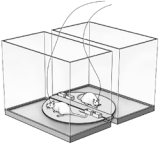 -The apparatus illustrated here is used to study
The comparative investigation of sleep has led to an important conclusion: It has suggested that
(Multiple Choice)
4.8/5 (73)
(73) The advantage of the carousel apparatus is that the __________ control procedure is an integral part of it.
(Short Answer)
5.0/5 (72)
(72) 
Filters
- Essay(0)
- Multiple Choice(0)
- Short Answer(0)
- True False(0)
- Matching(0)