



 Chat with AI
Exam 6: The Visual System

Exam 1: Biopsychology As a Neuroscience89 Questions
Exam 2: Evolution, Genetics, and Experience143 Questions
Exam 3: The Anatomy of the Nervous System153 Questions
Exam 4: Neural Conduction and Synaptic Transmission152 Questions
Exam 5: The Research Methods of Biopsychology161 Questions
Exam 6: The Visual System149 Questions
Exam 7: Mechanisms of Perception150 Questions
Exam 8: The Sensorimotor System119 Questions
Exam 9: Development of the Nervous System125 Questions
Exam 10: Brain Damage and Neuroplasticity185 Questions
Exam 11: Learning, Memory, and Amnesia147 Questions
Exam 12: Hunger, Eating, and Health145 Questions
Exam 13: Hormones and Sex157 Questions
Exam 14: Sleep, Dreaming, and Circadian Rhythms186 Questions
Exam 15: Drug Addiction and the Brains Reward Circuits153 Questions
Exam 16: Lateralization, Language, and the Split Brain170 Questions
Exam 17: Biopsychology of Emotion, Stress, and Health154 Questions
Exam 18: Biopsychology of Psychiatric Disorders137 Questions
Select questions type


Light passes through layers of the retina in which of the following sequences?

Free
(Multiple Choice)
4.9/5  (83)
(83) Correct Answer: Verified
D
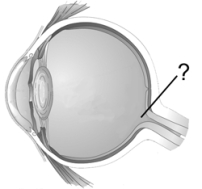 -Which retinal structure is indicated by the pointer line?
Free
(Multiple Choice)
4.9/5 (78)
(78) Correct Answer:Verified
VerifiedC
The parvocellular layers of the lateral geniculate nuclei get their name from the fact that the neurons in these layers are
Free
(Multiple Choice)
4.8/5 (74)
(74) Correct Answer:Verified
VerifiedB
Projections to the visual cortex from the lateral geniculate nuclei terminate in cortical layer
(Multiple Choice)
4.9/5 (81)
(81) The blind spot is the place where axons of __________ cells leave the eye.
(Short Answer)
4.9/5 (98)
(98) In general, neurons of the retina-geniculate-striate system respond weakly to
(Multiple Choice)
4.9/5 (81)
(81) In comparison to the photopic system, the scotopic system has more
(Multiple Choice)
4.9/5 (87)
(87) The amount of light reaching the retinas is controlled by two donut-shaped bands of contractile tissue called the
(Multiple Choice)
4.9/5 (86)
(86) Nonexistent stripes of lightness and darkness that accentuate the perception of edges are often called
(Multiple Choice)
4.9/5 (85)
(85) The opponent theory provides the best explanation of color coding at the
(Multiple Choice)
4.7/5 (87)
(87) The color and brightness of large unpatterned surfaces are not directly perceived; they are filled in or completed by a process called
(Multiple Choice)
4.8/5 (69)
(69) The component theory provides the best explanation of color coding at the
(Multiple Choice)
4.7/5 (75)
(75) The receptive fields of most retinal ganglion cells are roughly
(Multiple Choice)
4.7/5 (88)
(88) Many neuropsychological patients with scotomas are unaware of them because of
(Multiple Choice)
4.8/5 (81)
(81) 
Filters
- Essay(0)
- Multiple Choice(0)
- Short Answer(0)
- True False(0)
- Matching(0)