



 Chat with AI
Exam 14: The Urinary System

Exam 1: Introduction to Physiology and Homeostasis100 Questions
Exam 2: Cell Physiology100 Questions
Exam 3: The Plasma Membrane and Membrane Potential100 Questions
Exam 4: Principles of Neural and Hormonal Communication100 Questions
Exam 5: The Central Nervous System100 Questions
Exam 6: The Peripheral Nervous System - Afferent Division - Special Senses100 Questions
Exam 7: The Peripheral Nervous System - Efferent Division100 Questions
Exam 8: Muscle Physiology100 Questions
Exam 9: Cardiac Physiology100 Questions
Exam 10: The Blood Vessels and Blood Pressure100 Questions
Exam 11: The Blood100 Questions
Exam 12: Body Defenses100 Questions
Exam 13: The Respiratory System100 Questions
Exam 14: The Urinary System100 Questions
Exam 15: Fluid and Acid Base Balance100 Questions
Exam 16: The Digestive System100 Questions
Exam 17: Energy Balance and Temperature Regulation100 Questions
Exam 18: Principles of Endocrinology - the Central Endocrine Glands100 Questions
Exam 19: The Peripheral Endocrine Glands100 Questions
Exam 20: The Reproductive Systembrad100 Questions
Select questions type


The plasma clearance rate of what organic compound is used to measure renal plasma flow?
(Multiple Choice)
4.8/5  (81)
(81) On average,how many times do the kidneys filter the entire plasma volume each day?
(Multiple Choice)
4.9/5 (78)
(78) Figure 14-26
Use the figure above (Figure 14-26)to answer the corresponding questions.
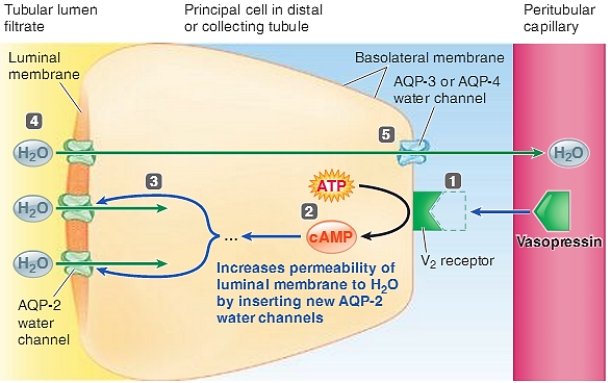 -Which number in the figure represents where water enters the tubular cell from the tubular lumen through the inserted water channels?
 (Multiple Choice)
4.8/5 (84)
(84) The properties of the glomerular membrane are collectively referred to as the:
(Multiple Choice)
4.8/5 (79)
(79) What is the tubular maximum reabsorption rate for glucose?
(Multiple Choice)
4.9/5 (74)
(74) The plasma clearance rate for a secreted substance is always less than the glomerular filtration rate.
(True/False)
5.0/5 (72)
(72) If too much H₂O is present relative to the solute load,the body fluids are __________,which means they are too dilute at an osmolarity less than 300 mOsm/L.
(Short Answer)
4.8/5 (77)
(77) The kidneys maintain proper __________ volume,which is important in the long-term regulation of arterial __________.
(Short Answer)
4.7/5 (79)
(79) Two mechanisms contribute to autoregulation of the GFR: a(n)__________mechanism and a tubuloglomerular __________ mechanism.
(Short Answer)
4.9/5 (101)
(101) Urea molecules,being the smallest of the waste products,are the only wastes passively reabsorbed.
(True/False)
4.9/5 (87)
(87) At normal fluid balance and solute concentration,the body fluids are:
(Multiple Choice)
4.7/5 (82)
(82) Chronic renal failure is insidious because up to __________% of the kidney tissue can be destroyed before the loss of kidney function is even noticeable.
(Short Answer)
4.8/5 (89)
(89) The selective movement of substances from inside the tubule (the tubular lumen)into the blood is called tubular __________.
(Short Answer)
4.8/5 (65)
(65) Figure 14-26
Use the figure above (Figure 14-26)to answer the corresponding questions.
-Which number in the figure represents water exiting the cell through different (always open)water channels permanently positioned at the basolateral border?
-Which number in the figure represents water exiting the cell through different (always open)water channels permanently positioned at the basolateral border? (Multiple Choice)
4.9/5 (68)
(68) What percentage of the blood each minute gets "cleaned" by the kidneys?
(Multiple Choice)
4.9/5 (80)
(80) Water diuresis involves increased excretion of both H₂O and solute caused by excess unreabsorbed solute in the tubular fluid,such as occurs in untreated diabetes mellitus.
(True/False)
4.9/5 (87)
(87) The concentrating mechanism accomplished by the loop of Henle is known as:
(Multiple Choice)
4.9/5 (85)
(85) 
Filters
- Essay(0)
- Multiple Choice(0)
- Short Answer(0)
- True False(0)
- Matching(0)