



 Chat with AI
Exam 23: Global Change in the Earth System

Exam 1: Cosmology and the Birth of Earth50 Questions
Exam 2: Journey to the Center of the Earth50 Questions
Exam 3: Drifting Continents and Spreading Seas51 Questions
Exam 4: The Way the Earth Works: Plate Tectonics64 Questions
Exam 5: Patterns in Nature: Minerals51 Questions
Exam 6: Up From the Inferno: Magma and Igneous Rock55 Questions
Exam 7: Pages of Earths Past: Sedimentary Rocks56 Questions
Exam 8: Metamorphism: A Process of Change53 Questions
Exam 9: The Wrath of Vulcan: Volcanic Eruptions50 Questions
Exam 10: A Violent Pulse: Earthquakes50 Questions
Exam 11: Cracks, crags, and Crumples: Crustal Deformation and Mountain Building50 Questions
Exam 12: Deep Time: How Old Is Old50 Questions
Exam 13: A Biography of Earth57 Questions
Exam 14: Squeezing Power From a Stone: Energy Resources50 Questions
Exam 15: Riches in Rock: Mineral Resources50 Questions
Exam 16: Unsafe Ground: Landslides and Other Mass Movements50 Questions
Exam 17: Streams and Floods: The Geology of Running Water45 Questions
Exam 18: Restless Realm: Oceans and Coasts48 Questions
Exam 19: A Hidden Reserve: Groundwater45 Questions
Exam 20: An Envelope of Gas: Earths Atmosphere and Climate40 Questions
Exam 21: Dry Settings: the Geology of Deserts30 Questions
Exam 22: Amazing Ice: Glaciers and Ice Ages30 Questions
Exam 23: Global Change in the Earth System50 Questions
Select questions type


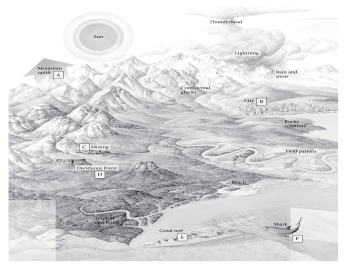
Which two features on the figure below are sources of CO₂ and hence probable contributors to global warming?
(Multiple Choice)
4.8/5  (73)
(73) The factors that affect Earth's long-term climate are different from those that affect climate on shorter time scales.
(True/False)
4.7/5 (79)
(79) The formation of oil shale deposits,coals,and limestones has what overall effect on CO₂ in the Earth's atmosphere?
(Multiple Choice)
4.8/5 (80)
(80) The hole in the ozone layer has been brought about by anthropogenic emissions of ____________.
(Multiple Choice)
4.7/5 (68)
(68) Oxygen-18 and oxygen-16 are useful in studying the geologic past,including gathering information about past climate,because ____________.
(Multiple Choice)
4.9/5 (93)
(93) In the last few decades,global warming has been most strongly affecting the climate and wildlife of ____________ regions.
(Multiple Choice)
4.9/5 (84)
(84) The last ice age ended approximately 16,000 years ago.The warmest global temperatures since then occurred in the ____________.
(Multiple Choice)
4.9/5 (82)
(82) Many cultures and religions refer to tremendous,ancient floods witnessed by early humans.Geologists believe which modern sea might have filled very rapidly with ocean water when global sea level (rising after the last ice age)overtopped a small "land bridge" or "natural dam," and provided the basis for many of the references to such tremendous floods?
(Multiple Choice)
4.9/5 (76)
(76) The presence of liquid water on Earth's surface is ____________.
(Multiple Choice)
4.8/5 (90)
(90) A blogger writes that global warming is not real,noting that his or her city had its coldest ever-recorded temperature last winter.Which statement(s)about his or her blog is/are correct?
(Multiple Choice)
4.8/5 (82)
(82) In this chapter,"sedimentary sequences" refers to variations ____________ within stratigraphic sequences.
(Multiple Choice)
4.9/5 (93)
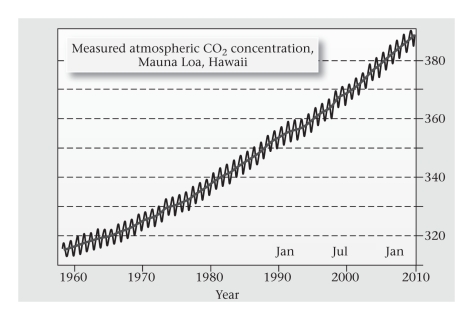
(93) How much has atmospheric CO₂ increased in approximately the last 50 years,according to the record for Hawaii's Mauna Loa observatory,in the figure below?
(Multiple Choice)
4.9/5 (74)
(74) A crater in Mexico's Yucatan peninsula is about the right age to be a result of an impact that brought about the extinction of numerous species at the end of the ____________ Period.
(Multiple Choice)
4.8/5 (83)
(83) How much CO₂ is pulled out of the atmosphere each year by various life forms?
(Multiple Choice)
4.8/5 (73)
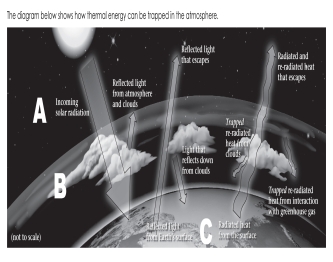
(73) The figure below shows the transmission,absorption,and reflection of radiation from various sources.In which layer (of the three layers labeled A,B,and C on the figure)do greenhouse gasses accumulate?
(Multiple Choice)
4.8/5 (87)
(87) Change within the Earth system is unidirectional and cannot be reversed.
(True/False)
5.0/5 (76)
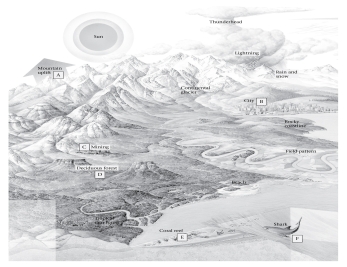
(76) Which three features on the figure below are best considered carbon (e.g. ,CO₂)sinks?
(Multiple Choice)
4.8/5 (86)
(86) Natural carbon "sinks" (processes that take CO₂ from the atmosphere,such as the chemical weathering of rocks,the growth of vegetation,and the solution of atmospheric CO₂ into the oceans)appear to have generally matched the production of CO₂ until ____________.
(Multiple Choice)
4.8/5 (93)
(93) Pollen species CANNOT be used to interpret ancient environments because most species inhabit all environments.
(True/False)
4.9/5 (72)
(72) How are bicarbonate and carbon dioxide related to one another?
(Multiple Choice)
4.8/5 (71)
(71) 
Filters
- Essay(0)
- Multiple Choice(0)
- Short Answer(0)
- True False(0)
- Matching(0)