



 Chat with AI
Exam 3: Drifting Continents and Spreading Seas

Exam 1: Cosmology and the Birth of Earth50 Questions
Exam 2: Journey to the Center of the Earth50 Questions
Exam 3: Drifting Continents and Spreading Seas51 Questions
Exam 4: The Way the Earth Works: Plate Tectonics64 Questions
Exam 5: Patterns in Nature: Minerals51 Questions
Exam 6: Up From the Inferno: Magma and Igneous Rock55 Questions
Exam 7: Pages of Earths Past: Sedimentary Rocks56 Questions
Exam 8: Metamorphism: A Process of Change53 Questions
Exam 9: The Wrath of Vulcan: Volcanic Eruptions50 Questions
Exam 10: A Violent Pulse: Earthquakes50 Questions
Exam 11: Cracks, crags, and Crumples: Crustal Deformation and Mountain Building50 Questions
Exam 12: Deep Time: How Old Is Old50 Questions
Exam 13: A Biography of Earth57 Questions
Exam 14: Squeezing Power From a Stone: Energy Resources50 Questions
Exam 15: Riches in Rock: Mineral Resources50 Questions
Exam 16: Unsafe Ground: Landslides and Other Mass Movements50 Questions
Exam 17: Streams and Floods: The Geology of Running Water45 Questions
Exam 18: Restless Realm: Oceans and Coasts48 Questions
Exam 19: A Hidden Reserve: Groundwater45 Questions
Exam 20: An Envelope of Gas: Earths Atmosphere and Climate40 Questions
Exam 21: Dry Settings: the Geology of Deserts30 Questions
Exam 22: Amazing Ice: Glaciers and Ice Ages30 Questions
Exam 23: Global Change in the Earth System50 Questions
Select questions type


Marine magnetic anomaly belts run parallel to ____________.
(Multiple Choice)
4.9/5  (76)
(76) Wegener's idea of continental drift was rejected by American geologists because ____________.
(Multiple Choice)
4.8/5 (85)
(85) Distinctive rock sequences on South America terminate at the Atlantic Ocean but reappear on the continent of ____________.
(Multiple Choice)
5.0/5 (76)
(76) Marine magnetic anomalies result from sea-floor spreading in conjunction with ____________.
(Multiple Choice)
4.8/5 (83)
(83) If you were using both a compass and a map marked with latitude and longitude to navigate,you might note the angle difference between your compass and what is marked on the map,called _____________.
(Multiple Choice)
4.8/5 (78)
(78) The magnetic field of Earth in the geologic past is ____________.
(Multiple Choice)
4.8/5 (93)
(93) The age of oceanic crust ____________ with increasing distance from a mid-ocean ridge.
(Multiple Choice)
4.7/5 (79)
(79) If a geologist discovered coal in a modern-day cold,snowy location,he or she could conclude that _____________.
(Multiple Choice)
4.9/5 (83)
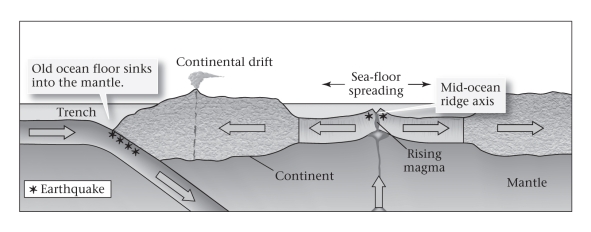
(83) The term and concept of sea-floor spreading (see figure below)was developed by _____________.
(Multiple Choice)
5.0/5 (92)
(92) The apparent tendency of the north (or south)magnetic pole to vary in position over time is termed ____________.
(Multiple Choice)
4.9/5 (62)
(62) The thickness of clay and planktonic microskeletons is greatest ____________.
(Multiple Choice)
4.8/5 (82)
(82) 
Filters
- Essay(0)
- Multiple Choice(0)
- Short Answer(0)
- True False(0)
- Matching(0)