



 Chat with AI
Exam 2: Journey to the Center of the Earth

Exam 1: Cosmology and the Birth of Earth50 Questions
Exam 2: Journey to the Center of the Earth50 Questions
Exam 3: Drifting Continents and Spreading Seas51 Questions
Exam 4: The Way the Earth Works: Plate Tectonics64 Questions
Exam 5: Patterns in Nature: Minerals51 Questions
Exam 6: Up From the Inferno: Magma and Igneous Rock55 Questions
Exam 7: Pages of Earths Past: Sedimentary Rocks56 Questions
Exam 8: Metamorphism: A Process of Change53 Questions
Exam 9: The Wrath of Vulcan: Volcanic Eruptions50 Questions
Exam 10: A Violent Pulse: Earthquakes50 Questions
Exam 11: Cracks, crags, and Crumples: Crustal Deformation and Mountain Building50 Questions
Exam 12: Deep Time: How Old Is Old50 Questions
Exam 13: A Biography of Earth57 Questions
Exam 14: Squeezing Power From a Stone: Energy Resources50 Questions
Exam 15: Riches in Rock: Mineral Resources50 Questions
Exam 16: Unsafe Ground: Landslides and Other Mass Movements50 Questions
Exam 17: Streams and Floods: The Geology of Running Water45 Questions
Exam 18: Restless Realm: Oceans and Coasts48 Questions
Exam 19: A Hidden Reserve: Groundwater45 Questions
Exam 20: An Envelope of Gas: Earths Atmosphere and Climate40 Questions
Exam 21: Dry Settings: the Geology of Deserts30 Questions
Exam 22: Amazing Ice: Glaciers and Ice Ages30 Questions
Exam 23: Global Change in the Earth System50 Questions
Select questions type


If one were to ride a hot air balloon up into the atmosphere,one would experience the concentration of gases ____________.
(Multiple Choice)
4.9/5  (79)
(79) The thickness of the Earth's crust varies from ____________.
(Multiple Choice)
4.9/5 (78)
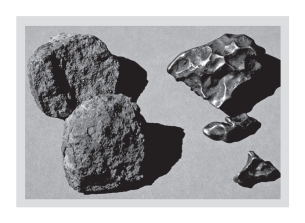
(78) 
When you are warmed by the Sun,you are experiencing _____________,as opposed to when you burn yourself touching a metal object whose other end is being heated you are experiencing ____________.
(Multiple Choice)
4.9/5 (85)
(85) In the whole Earth,the four most common elements are oxygen,silicon,magnesium,and ____________.
(Multiple Choice)
4.9/5 (71)
(71) Earth's geothermal gradient is the rate of temperature change incurred by ____________.
(Multiple Choice)
4.8/5 (98)
(98) A fracture in the crust,where rocks slide past one another,is termed a ____________.
(Multiple Choice)
4.7/5 (74)
(74) Of the three primary chemical layers of the Earth (crust,mantle,core),which is the thickest layer?
(Multiple Choice)
4.7/5 (78)
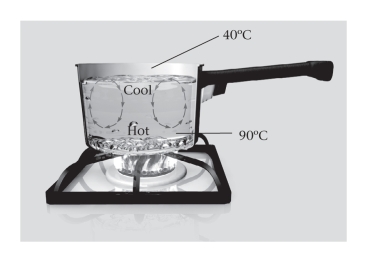
(78) Heat transfer that occurs through the movement of a fluid,driven by temperature differences among various points within the fluid,is termed ____________.
(Multiple Choice)
4.9/5 (81)
(81) Ophiolite sequences are important to geologists because they preserve ____________.
(Multiple Choice)
4.8/5 (78)
(78) In order to be defined as a mineral,a substance must ______________.
(Multiple Choice)
4.9/5 (90)
(90) As compared to the asthenosphere,the lithosphere is ____________.
(Multiple Choice)
4.8/5 (97)
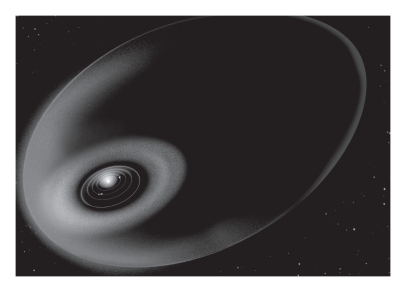
(97) The region of space that contains the material of our Solar System (shown below)is termed the ____________.
(Multiple Choice)
4.8/5 (78)
(78) Leftovers from the protoplanetery disk that formed our Solar System after the Big Bang can be found where?
(Multiple Choice)
4.8/5 (82)
(82) As seismic (earthquake-generated)waves travel downward and reach the Moho,they ____________.
(Multiple Choice)
4.9/5 (73)
(73) Glass is different from a mineral because it _____________.
(Multiple Choice)
4.9/5 (83)
(83) Hydrocarbons,such as petroleum and natural gas,are classified as ____________.
(Multiple Choice)
4.8/5 (71)
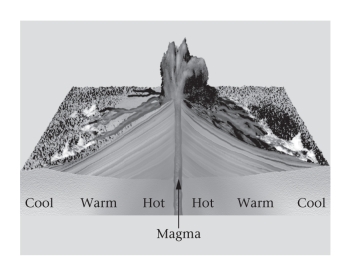
(71) The image below shows ___________,where a hot liquid rises into a cooler material,and heat then conducts from the hot liquid into the cooler material.
(Multiple Choice)
4.8/5 (83)
(83) Topographically,most of the ocean floor is made up of ____________.
(Multiple Choice)
4.8/5 (85)
(85) 
Filters
- Essay(0)
- Multiple Choice(0)
- Short Answer(0)
- True False(0)
- Matching(0)