



 Chat with AI
Exam 15: The Nature of the Solar System

Exam 1: Matter and Minerals60 Questions
Exam 2: Rocks: Materials of the Solid Earth63 Questions
Exam 3: Landscapes Fashioned by Water68 Questions
Exam 4: Glacial and Arid Landscapes64 Questions
Exam 5: Plate Tectonics: A Scientific Revolution Unfolds64 Questions
Exam 6: Restless Earth: Earthquakes, Geologic Structures, and Mountain Building67 Questions
Exam 7: Volcanoes and Other Igneous Activity64 Questions
Exam 8: Geologic Time70 Questions
Exam 9: Oceans: The Last Frontier65 Questions
Exam 10: The Restless Ocean65 Questions
Exam 11: Heating the Atmosphere66 Questions
Exam 12: Moisture, Clouds, and Precipitation66 Questions
Exam 13: The Atmosphere in Motion68 Questions
Exam 14: Weather Patterns and Severe Weather66 Questions
Exam 15: The Nature of the Solar System67 Questions
Exam 16: Beyond Our Solar System66 Questions
Select questions type


Three laws of planetary motion were discovered by ________.
(Multiple Choice)
5.0/5  (79)
(79) Of the terrestrial planets, Mercury exhibits the greatest variation in surface temperatures.
(True/False)
4.8/5 (77)
(77) The first modern astronomer to propose a Sun-centered universe was ________.
(Multiple Choice)
5.0/5 (84)
(84) Eruptive plumes and lava flows rich in sulfur have been photographed on Jupiter's moon, Io.
(True/False)
4.7/5 (85)
(85) Jupiter is the largest and most massive planet in the solar system.
(True/False)
4.9/5 (68)
(68) Galileo discovered that the Sun has "blemishes" which we call sunspots.
(True/False)
4.8/5 (65)
(65) Galileo made numerous contributions to the science of astronomy. Discuss two of them in detail.
(Essay)
4.9/5 (64)
(64) Most of the time, the planets appear to move eastward. However, the occasional apparent westward "drift" of the planets compared to the background stars is called ________.
(Multiple Choice)
4.9/5 (76)
(76) ________ is the only planet in the solar system whose axis of rotation lies close to the plane of the solar system.
(Short Answer)
4.8/5 (82)
(82) Lunar regolith contains crystalline rock fragments, glassy fragments, and a moderate amount of organic matter.
(True/False)
4.8/5 (75)
(75) 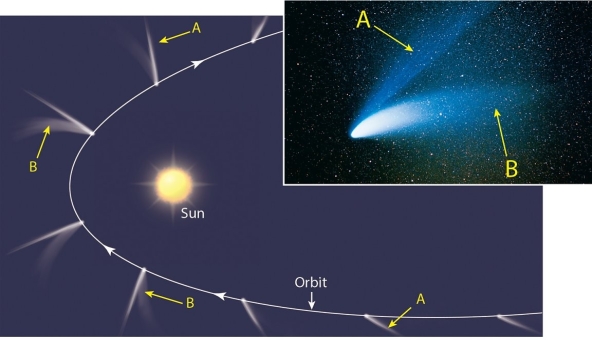 Examine the figure and identify which of the two tails, "A" or "B," is the ion tail and which is the dust tail. How does this relate to the composition of the comet? Explain the different characteristic(s)that allowed you to distinguish between the two tails, and how that relates to the way they form.
 (Essay)
4.8/5 (75)
(75) Vast, circular to elliptical dark-colored smooth areas of the Moon are known as ________.
(Multiple Choice)
4.7/5 (77)
(77) The "celestial sphere" is a feature of the Ptolemaic model of a geocentric universe.
(True/False)
5.0/5 (84)
(84) 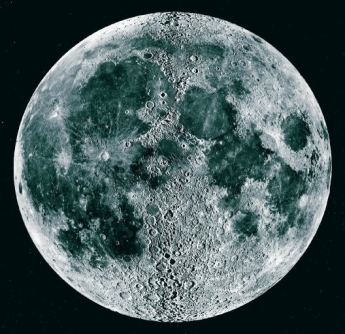 Briefly outline the formation of Earth's Moon, referring to the figure where appropriate.
 (Essay)
4.9/5 (81)
(81) The Martian polar caps are thought to be mainly frozen methane and ammonia.
(True/False)
4.7/5 (72)
(72) 
Filters
- Essay(0)
- Multiple Choice(0)
- Short Answer(0)
- True False(0)
- Matching(0)