



 Chat with AI
Exam 7: Volcanoes and Other Igneous Activity

Exam 1: Matter and Minerals60 Questions
Exam 2: Rocks: Materials of the Solid Earth63 Questions
Exam 3: Landscapes Fashioned by Water68 Questions
Exam 4: Glacial and Arid Landscapes64 Questions
Exam 5: Plate Tectonics: A Scientific Revolution Unfolds64 Questions
Exam 6: Restless Earth: Earthquakes, Geologic Structures, and Mountain Building67 Questions
Exam 7: Volcanoes and Other Igneous Activity64 Questions
Exam 8: Geologic Time70 Questions
Exam 9: Oceans: The Last Frontier65 Questions
Exam 10: The Restless Ocean65 Questions
Exam 11: Heating the Atmosphere66 Questions
Exam 12: Moisture, Clouds, and Precipitation66 Questions
Exam 13: The Atmosphere in Motion68 Questions
Exam 14: Weather Patterns and Severe Weather66 Questions
Exam 15: The Nature of the Solar System67 Questions
Exam 16: Beyond Our Solar System66 Questions
Select questions type


The Year Without A Summer (1816)was triggered by ________.

Free
(Essay)
4.9/5  (73)
(73) Correct Answer: Verified
the eruption of Tambora in 1815, and that volcano's explosive injection of sulfate particles into the stratosphere, screening out incoming sunlight
Which one of the following shows the correct order (from left to right)of decreasing magma viscosity? (remember that viscosity is resistance to flow, so you should pick the answer that has the most viscous lava type on the left, and the least viscous (most runny)on the right.
Free
(Multiple Choice)
4.8/5 (79)
(79) Correct Answer:Verified
VerifiedA
Match the descriptions and locations with one of the three principle kinds of volcanoes 
Correct Answer:Verified
VerifiedPremises:
Responses:
Free
(Matching)
4.8/5 (92)
(92) Correct Answer:Verified
VerifiedWhich type of basaltic lava flow has a fairly smooth, unfragmented, ropy surface?
(Multiple Choice)
4.8/5 (82)
(82) You are a field geologist, dropped off in a new area. You examine the rocks of this area and find rhyolite, welded tuff, and scattered pumice. All are very young. You begin mapping the area, and soon have a rough sense of the distribution of rock units, as shown here:
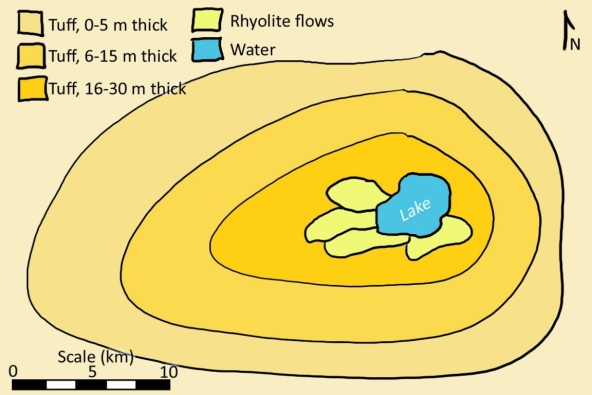 Note that the welded tuff varies systematically in its thickness, and that a lake is present near the center of your mapping area. How do you interpret this pattern?
 (Essay)
4.8/5 (74)
(74) Magma generation almost always involves partial melting, not complete melting of the source rock.
(True/False)
5.0/5 (74)
(74) The recent volcanic activity in Yellowstone National Park is caused by ________.
(Multiple Choice)
4.9/5 (75)
(75) Which of the following best describes Shiprock, a famous volcanic feature in New Mexico?
(Multiple Choice)
4.9/5 (69)
(69) Magma tends to rise toward Earth's surface principally because ________.
(Multiple Choice)
5.0/5 (60)
(60) Water vapor is the most abundant gaseous component dissolved in most magmas.
(True/False)
5.0/5 (93)
(93) When mantle peridotite partially melts beneath an oceanic ridge, ________ magma is produced.
(Short Answer)
4.8/5 (80)
(80) ________ tend to increase the explosive potential of a magma body beneath a volcano by the greatest amount.
(Multiple Choice)
4.8/5 (80)
(80) 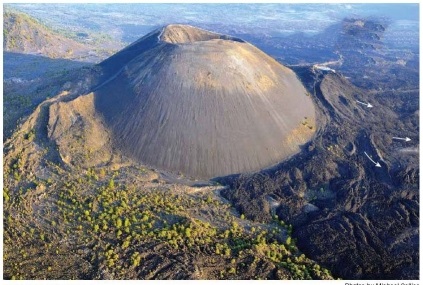 What kind of volcano is pictured here?
________ are pyroclastic materials that are larger than ash, but smaller than blocks or bombs.
(Short Answer)
4.8/5 (79)
(79) 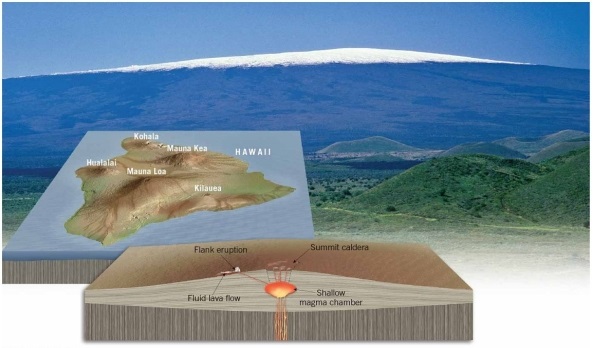 Mauna Loa, a volcano in Hawaii, is an excellent example of a ________.
 (Multiple Choice)
4.8/5 (83)
(83) A long-lived magma source located in the mantle is called a ________.
(Multiple Choice)
4.9/5 (76)
(76) Volcanoes are generally not preserved in the geologic rock record as they are eroded away. However, the various materials erupted from volcanoes are often found preserved in the rock record. How could you infer what type of volcano erupted in a given area based on the type of volcanic deposits now found as layers of rock? Give specific examples and briefly discuss if some materials may be linked to different types of volcanoes.
(Essay)
4.9/5 (80)
(80) 
Filters
- Essay(0)
- Multiple Choice(0)
- Short Answer(0)
- True False(0)
- Matching(0)