



 Chat with AI
Exam 7: Volcanoes and Other Igneous Activity

Exam 1: Matter and Minerals60 Questions
Exam 2: Rocks: Materials of the Solid Earth63 Questions
Exam 3: Landscapes Fashioned by Water68 Questions
Exam 4: Glacial and Arid Landscapes64 Questions
Exam 5: Plate Tectonics: A Scientific Revolution Unfolds64 Questions
Exam 6: Restless Earth: Earthquakes, Geologic Structures, and Mountain Building67 Questions
Exam 7: Volcanoes and Other Igneous Activity64 Questions
Exam 8: Geologic Time70 Questions
Exam 9: Oceans: The Last Frontier65 Questions
Exam 10: The Restless Ocean65 Questions
Exam 11: Heating the Atmosphere66 Questions
Exam 12: Moisture, Clouds, and Precipitation66 Questions
Exam 13: The Atmosphere in Motion68 Questions
Exam 14: Weather Patterns and Severe Weather66 Questions
Exam 15: The Nature of the Solar System67 Questions
Exam 16: Beyond Our Solar System66 Questions
Select questions type


A small, igneous rock body emplaced at shallow depths by uplift and arching of the overlying, older strata is a(n)________.
(Short Answer)
4.9/5  (72)
(72) 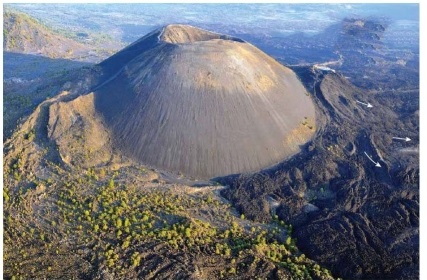 Parícutin is an example of a ________.
The most violent volcanic activity is associated with ________.
(Multiple Choice)
4.7/5 (77)
(77) ________ lava is the most abundant type erupted at oceanic spreading centers.
(Multiple Choice)
4.9/5 (62)
(62) 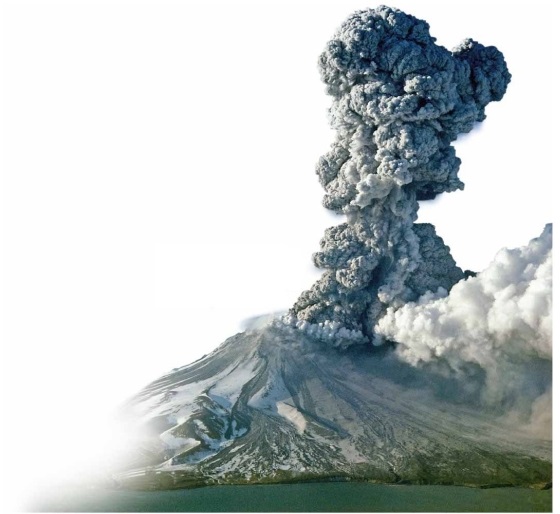 This is a photograph of Augustine volcano in Alaska. Judging by its shape, and the eruptive activity in the photo, what kind of volcano is it?
 (Multiple Choice)
4.9/5 (87)
(87) Three of the following statements about the May, 1980 eruption of Mount St. Helens are true. Which one is false?
(Multiple Choice)
4.7/5 (72)
(72) Repeated eruptions of relatively fluid lava from fissures can eventually cause an area to be covered by flood basalts.
(True/False)
4.8/5 (84)
(84) A(n)________ is a dangerous, fast moving, hot, turbulent cloud of volcanic gases and solid particles.
(Short Answer)
4.7/5 (80)
(80) The viscosity of magma increases with an increasing percentage of silica.
(True/False)
4.8/5 (82)
(82) The difference between lava and magma is lava is found ________ Earth's surface; whereas magma is ________ the surface.
(Short Answer)
4.9/5 (84)
(84) Which of the following best describes the bedrock in the Sierra Nevada Mountains in California?
(Multiple Choice)
4.7/5 (84)
(84) Discuss the six different tectonic settings in which volcanism can occur, and why magma is produced at each location.
(Essay)
4.8/5 (82)
(82) Crater Lake in Oregon actually occupies a caldera, not a crater.
(True/False)
4.8/5 (82)
(82) Shield volcanoes consist of many successive layers of ________ and lack significant amounts of pyroclastic debris.
(Short Answer)
4.7/5 (85)
(85) Lava tubes would be more likely to be form at a shield volcano like Kilauea than at a composite volcano like Mount St. Helens.
(True/False)
4.8/5 (79)
(79) Pick three of the following volcanic regions and assign it to one of the three types of volcanism (convergent plate boundaries, divergent plate boundaries, or intraplate volcanism):
a. Crater Lake
b. Hawaii's Kilauea
c. Mount St. Helens
d. East African Rift
e. Yellowstone
f. Vesuvius
g. Deccan Plateau
h. Iceland
Give a brief explanation of how the volcanoes formed at each of the three locations you select.
(Essay)
5.0/5 (65)
(65) 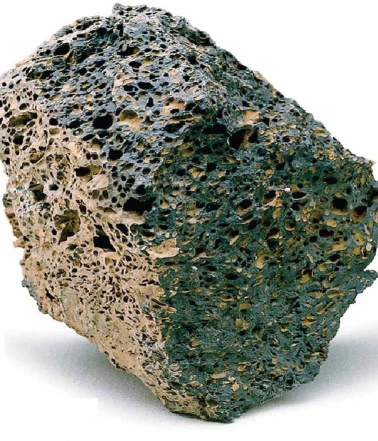 What caused the many small holes that are seen in this sample of scoria?
 (Multiple Choice)
4.9/5 (79)
(79) 
Filters
- Essay(0)
- Multiple Choice(0)
- Short Answer(0)
- True False(0)
- Matching(0)