



 Chat with AI
Exam 11: Heating the Atmosphere

Exam 1: Matter and Minerals60 Questions
Exam 2: Rocks: Materials of the Solid Earth63 Questions
Exam 3: Landscapes Fashioned by Water68 Questions
Exam 4: Glacial and Arid Landscapes64 Questions
Exam 5: Plate Tectonics: A Scientific Revolution Unfolds64 Questions
Exam 6: Restless Earth: Earthquakes, Geologic Structures, and Mountain Building67 Questions
Exam 7: Volcanoes and Other Igneous Activity64 Questions
Exam 8: Geologic Time70 Questions
Exam 9: Oceans: The Last Frontier65 Questions
Exam 10: The Restless Ocean65 Questions
Exam 11: Heating the Atmosphere66 Questions
Exam 12: Moisture, Clouds, and Precipitation66 Questions
Exam 13: The Atmosphere in Motion68 Questions
Exam 14: Weather Patterns and Severe Weather66 Questions
Exam 15: The Nature of the Solar System67 Questions
Exam 16: Beyond Our Solar System66 Questions
Select questions type


Reflected light bounces back from a surface at the same angle at which it strikes that surface and with the same ________.

Free
(Short Answer)
4.7/5  (67)
(67) Correct Answer: Verified
intensity (strength)
Climate data can predict the weather.
Free
(True/False)
4.8/5 (73)
(73) Correct Answer:Verified
VerifiedFalse
Even though ground-level ozone is a health hazard, the "ozone layer" in the stratosphere is a health benefit because ________.
Free
(Multiple Choice)
4.9/5 (77)
(77) Correct Answer:Verified
VerifiedC
Solar radiation is ________, as compared to the ________ emitted by Earth.
(Multiple Choice)
4.8/5 (78)
(78) 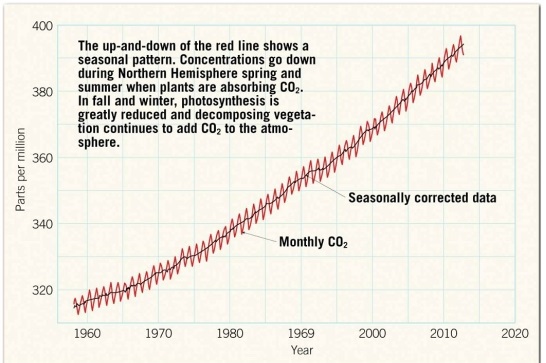 Examine the graph. Note that the explanatory label indicates that during the Northern Hemisphere summer, CO₂ concentrations decrease because plants consume that gas during photosynthesis. But when it is summer in the Northern Hemisphere, it is winter in the Southern Hemisphere. When it is winter in the Northern Hemisphere, it is summer in the Southern Hemisphere. Why doesn't the Southern Hemisphere summer show this same CO₂ drawdown?
 (Essay)
4.7/5 (85)
(85) 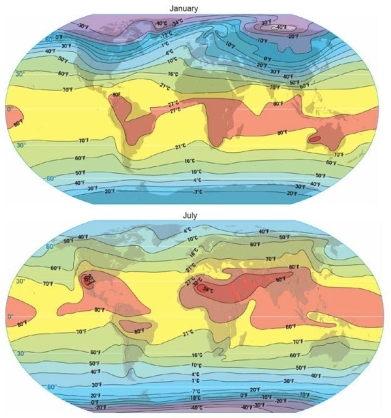 Compare and contrast the two maps showing the global distribution of temperatures in January and July. Explain the differences as fully as possible.
 (Essay)
4.7/5 (73)
(73) More solar energy is reflected back to space (30%)than is absorbed directly by the atmosphere (20%).
(True/False)
4.9/5 (75)
(75) Identify and label each of the layers and boundaries in Earth's atmosphere.
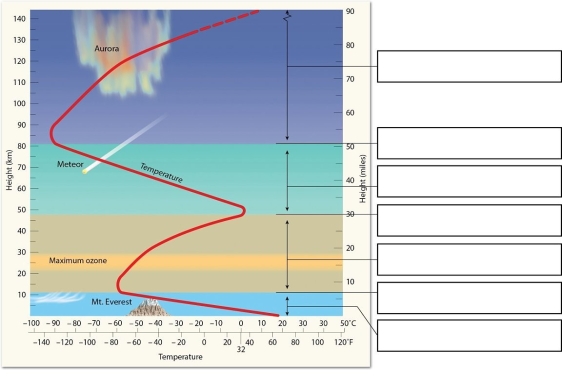
(Essay)
4.9/5 (77)
(77) Imagine you are hired by NASA to help plan for a new "rover" mission to Mars. Your supervisors learn that you have been trained in Earth science, and they ask you to consider solar panels as a source of energy for many of the rover's instruments while it is on the Martian surface. Using your knowledge of seasons and temperatures here on Earth as a model, briefly outline the factors what would influence solar radiation on the Martian surface.
(Essay)
4.9/5 (71)
(71) The seasonal shift of isotherms is greater over the continents than over the ocean.
(True/False)
4.9/5 (91)
(91) 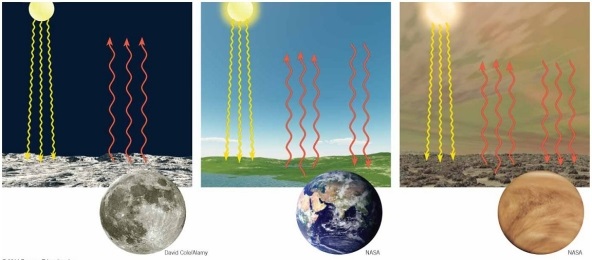 Examine the figure and use it as a basis for discussing the role the greenhouse effect plays in the atmospheres of (a)the Moon, (b)Earth, and (c)Venus.
 (Essay)
4.8/5 (73)
(73) The variation in distance between Earth and the Sun is the cause of the temperature variations that cause the seasons.
(True/False)
4.9/5 (75)
(75) Conduction is a form of heat transfer that involves the movement of a mass or substance.
(True/False)
4.8/5 (63)
(63) If it were December and you wanted to travel to "the land of the midnight Sun," where would you have to go?
(Multiple Choice)
4.8/5 (67)
(67) The most important elements of weather and climate (quantities or properties that are measured regularly)are (1)air temperature, (2)________, (3)type and amount of cloudiness, (4)type and amount of precipitation, (5)air ________, and (6)the speed and direction of the wind.
(Short Answer)
4.8/5 (86)
(86) 
Filters
- Essay(0)
- Multiple Choice(0)
- Short Answer(0)
- True False(0)
- Matching(0)