



 Chat with AI
Exam 11: Heating the Atmosphere

Exam 1: Matter and Minerals60 Questions
Exam 2: Rocks: Materials of the Solid Earth63 Questions
Exam 3: Landscapes Fashioned by Water68 Questions
Exam 4: Glacial and Arid Landscapes64 Questions
Exam 5: Plate Tectonics: A Scientific Revolution Unfolds64 Questions
Exam 6: Restless Earth: Earthquakes, Geologic Structures, and Mountain Building67 Questions
Exam 7: Volcanoes and Other Igneous Activity64 Questions
Exam 8: Geologic Time70 Questions
Exam 9: Oceans: The Last Frontier65 Questions
Exam 10: The Restless Ocean65 Questions
Exam 11: Heating the Atmosphere66 Questions
Exam 12: Moisture, Clouds, and Precipitation66 Questions
Exam 13: The Atmosphere in Motion68 Questions
Exam 14: Weather Patterns and Severe Weather66 Questions
Exam 15: The Nature of the Solar System67 Questions
Exam 16: Beyond Our Solar System66 Questions
Select questions type


By adding the daily maximum and minimum temperatures and then dividing by two, the daily range is calculated.
(True/False)
4.9/5  (83)
(83) Which of the following locations would have the lowest average air pressure?
(Multiple Choice)
4.9/5 (86)
(86) Because stratospheric ozone occurs at 10 to 50 kilometers elevation (6 to 31 miles above Earth's surface), it is not vulnerable to human influence.
(True/False)
4.7/5 (85)
(85) Which one of the following is the most abundant gas in the atmosphere?
(Multiple Choice)
4.8/5 (74)
(74) A field covered with several inches of freshly-fallen snow has a high albedo.
(True/False)
4.8/5 (86)
(86) As you increase in latitude, for example going from the equator to the Tropic of Cancer, you would expect annual temperature range to increase.
(True/False)
4.8/5 (73)
(73) Located adjacent to red on the electromagnetic spectrum, and having a longer wavelength, is ________ radiation, which we cannot see but which we can detect as heat. This is an important wavelength for the greenhouse effect, because its wavelength is blocked by greenhouse gases.
(Short Answer)
4.8/5 (73)
(73) Dust in the atmosphere is responsible for which of the following?
(Multiple Choice)
4.8/5 (74)
(74) 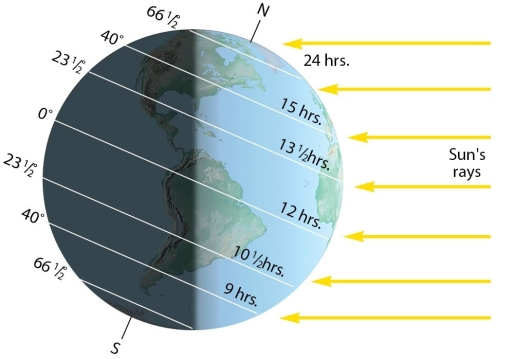 Examine the figure. What exact day of the year is depicted? Explain.
In total, Earth receives about 7% more energy from the Sun during ________ relative to ________.
(Multiple Choice)
4.9/5 (72)
(72) If it were not for the inclination of Earth's axis, there would be no well-defined seasons.
(True/False)
5.0/5 (74)
(74) A day of the year when the length of the night is equal to the length of the day is known as a(n)________.
(Short Answer)
4.8/5 (69)
(69) The storage of heat in the lower layer of the atmosphere due to certain gases absorbing heat is called ________.
(Multiple Choice)
4.8/5 (87)
(87) Climate scientists predict that an effect of human-caused climate change is ________.
(Multiple Choice)
4.8/5 (81)
(81) 
Filters
- Essay(0)
- Multiple Choice(0)
- Short Answer(0)
- True False(0)
- Matching(0)