



 Chat with AI
Exam 11: Heating the Atmosphere

Exam 1: Matter and Minerals60 Questions
Exam 2: Rocks: Materials of the Solid Earth63 Questions
Exam 3: Landscapes Fashioned by Water68 Questions
Exam 4: Glacial and Arid Landscapes64 Questions
Exam 5: Plate Tectonics: A Scientific Revolution Unfolds64 Questions
Exam 6: Restless Earth: Earthquakes, Geologic Structures, and Mountain Building67 Questions
Exam 7: Volcanoes and Other Igneous Activity64 Questions
Exam 8: Geologic Time70 Questions
Exam 9: Oceans: The Last Frontier65 Questions
Exam 10: The Restless Ocean65 Questions
Exam 11: Heating the Atmosphere66 Questions
Exam 12: Moisture, Clouds, and Precipitation66 Questions
Exam 13: The Atmosphere in Motion68 Questions
Exam 14: Weather Patterns and Severe Weather66 Questions
Exam 15: The Nature of the Solar System67 Questions
Exam 16: Beyond Our Solar System66 Questions
Select questions type


Match the items with the correct descriptions.
Correct Answer: Verified
Premises:
Responses:
(Matching)
4.8/5  (91)
(91) Sea salts from breaking waves, fine soil blown into the air, smoke and soot from wildfires, pollen and microorganisms lifted by the wind, and ash from volcanic eruptions are all examples of ________.
(Multiple Choice)
5.0/5 (85)
(85) Solar radiation may be absorbed, transmitted, or redirected (reflected or scattered)by the atmosphere.
(True/False)
4.7/5 (76)
(76) 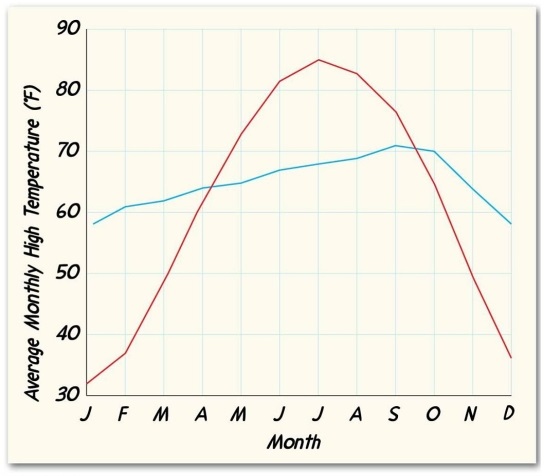 On this graph, one of the monthly mean temperature lines (red or blue)represents the coastal city of San Francisco, California. The other represents Urbana, Illinois, a city on the same latitude as San Francisco, but located deep in the interior of the North American continent. The red line therefore most likely represents ________.
 (Short Answer)
4.7/5 (69)
(69) Carbon dioxide and ________ are the most important heat absorbing gases in the lower atmosphere.
(Short Answer)
4.9/5 (85)
(85) Explain the discrepancy between someone who looks at the Sun at noon and goes blind as a result, and another person in the same spot, who watches the sunset a few hours later with satisfaction and a sense of relaxation, and no ill effects whatsoever.
(Essay)
5.0/5 (66)
(66) The tops of tall mountains are much colder than surrounding lowlands. This is evidence of ________.
(Multiple Choice)
4.9/5 (76)
(76) On a map, lines connecting points of equal temperature are ________.
(Short Answer)
4.9/5 (76)
(76) Visible light makes up about one-half of the electromagnetic spectrum.
(True/False)
4.8/5 (81)
(81) 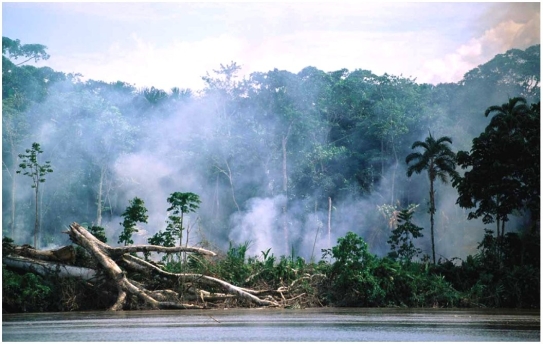 Explain how the events/processes depicted in this photo might influence climate.
 (Essay)
4.9/5 (78)
(78) 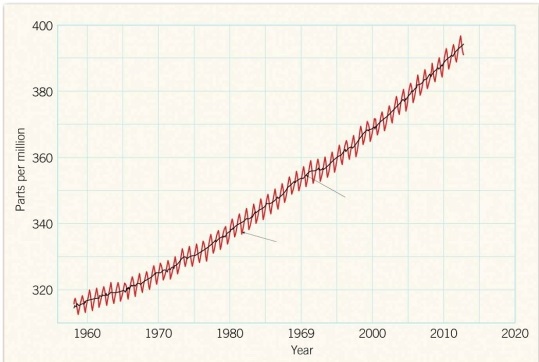 The concentration of the atmospheric gas ________ is shown in this graph.
 (Short Answer)
4.9/5 (85)
(85) Approximately how many kilometers (miles)above Earth's surface does the atmosphere end and outer space begin?
(Multiple Choice)
4.9/5 (72)
(72) The monthly ________ temperature is calculated by adding together the daily means for each day of the month and dividing by the number of days in the month.
(Short Answer)
4.9/5 (78)
(78) The form of oxygen that combines three atoms of oxygen into each molecule is ________.
(Short Answer)
4.9/5 (83)
(83) Imagine you are in a flying aircraft. You note the presence of clouds and storms at your same altitude. What layer of the atmosphere must the aircraft be traveling through?
(Multiple Choice)
4.7/5 (76)
(76) Match the items in the first column with the correct descriptions in the second column.
A)electromagnetic energy that has been scattered by the atmosphere
B)a package of instruments attached to a balloon
C)a generalization of the weather conditions that are typical of a place
D)the state of the atmosphere at a particular time and place
E)liquid droplets or solid particles in the atmosphere
F)a mixture of many discrete gases, including water vapor, as well as variable components like dust and small liquid droplets
G)the form of energy re-radiated by Earth's surface, after being absorbed as visible light from the Sun
H)the change in temperature over changes in altitude in the atmosphere
-1)air
2)environmental lapse rate
3)weather
4)diffused light
5)radiosonde
6)aerosols
7)infrared radiation
8)climate
(Short Answer)
4.7/5 (81)
(81) The fraction of the total radiation that is reflected by a surface is ________.
(Multiple Choice)
4.8/5 (86)
(86) All places at the same ________ have identical Sun angles and lengths of daylight.
(Short Answer)
4.8/5 (66)
(66) 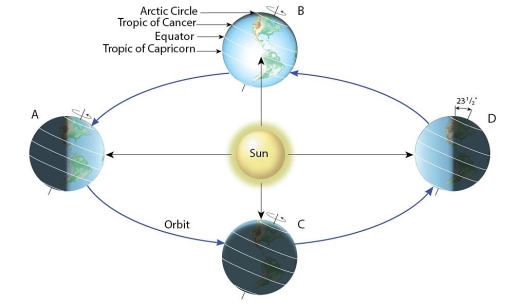 Examine the figure. Which of the four lettered positions depicts the Northern Hemisphere winter solstice?
 (Multiple Choice)
4.8/5 (85)
(85) 
Filters
- Essay(0)
- Multiple Choice(0)
- Short Answer(0)
- True False(0)
- Matching(0)