



 Chat with AI
Exam 15: The Nature of the Solar System

Exam 1: Matter and Minerals60 Questions
Exam 2: Rocks: Materials of the Solid Earth63 Questions
Exam 3: Landscapes Fashioned by Water68 Questions
Exam 4: Glacial and Arid Landscapes64 Questions
Exam 5: Plate Tectonics: A Scientific Revolution Unfolds64 Questions
Exam 6: Restless Earth: Earthquakes, Geologic Structures, and Mountain Building67 Questions
Exam 7: Volcanoes and Other Igneous Activity64 Questions
Exam 8: Geologic Time70 Questions
Exam 9: Oceans: The Last Frontier65 Questions
Exam 10: The Restless Ocean65 Questions
Exam 11: Heating the Atmosphere66 Questions
Exam 12: Moisture, Clouds, and Precipitation66 Questions
Exam 13: The Atmosphere in Motion68 Questions
Exam 14: Weather Patterns and Severe Weather66 Questions
Exam 15: The Nature of the Solar System67 Questions
Exam 16: Beyond Our Solar System66 Questions
Select questions type


Jupiter is the largest planet. This means it has a large amount of gravity. This gravity is compressing the planet into a smaller and smaller volume, releasing heat that ________.
(Multiple Choice)
4.8/5  (90)
(90) Why does Venus show fewer impact craters as compared to Mercury or Mars?
(Multiple Choice)
4.9/5 (79)
(79) 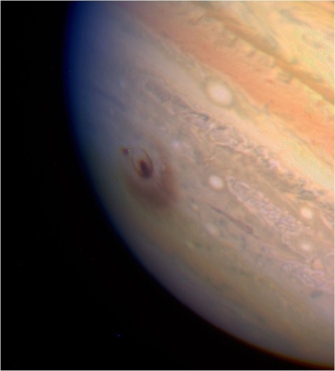 Examine the photo taken in 1994 when Comet Shoemaker-Levy collided with the planet Jupiter. This collision is thought to be similar to the collisions that occurred early in our solar system's history, according to the nebular theory. What happened to the (A)number of objects in the solar system and (B)mass of Jupiter as a result of this collision?
 (Multiple Choice)
4.9/5 (90)
(90) ________ solar system bodies are more likely to lose their atmospheres.
(Multiple Choice)
4.8/5 (83)
(83) ________ gave Galileo a huge advantage over his astronomical predecessors.
(Multiple Choice)
4.9/5 (80)
(80) In the Ptolemaic system, planets orbited in small circles called ________ while revolving along large circles called ________.
(Short Answer)
4.9/5 (76)
(76) Saturn's E ring is thought to be continually replenished by ________.
(Multiple Choice)
4.7/5 (94)
(94) It has been estimated that Halley's Comet, which has an orbital period of 76 years, has a mass of 100 billion tons. Furthermore, it is estimated to lose about 100 million tons of material when its orbit brings it close to the Sun. The maximum remaining life span of Halley's Comet is ________.
(Short Answer)
4.9/5 (72)
(72) Match the scientist in the second column with their major astronomical discoveries in the first column. Some scientists will have more than one discovery to their name!
A)Nicolaus Copernicus
B)Johannes Kepler
C)Sir Isaac Newton
D)Galileo Galilei
E)Tycho Brahe
-1)Planets are circular disks rather than just points of light
2)Stellar parallax should show if Earth shifts position over time.
3)Every body in the universe attracts every other body with a force that is directly proportional to their masses and inversely proportional to the square of the distance between them: the first formulation of the law of universal gravitation.
4)The Sun is at the center of the solar system, and Earth is just another planet.
5)The orbits of the planets are elliptical, and the speed of motion changes when the planets are closer to the Sun (faster)or further away (slower).
6)Jupiter has at least four satellites.
7)Venus exhibits phases just like the Moon does. Furthermore, Venus appears smallest when it is in full phase and thus is farthest from Earth.
8)The Moon's surface is not a smooth glass sphere.
9)The Sun has sunspots; dark regions caused by slightly lower temperatures.
10)The first law of motion is inertia, the natural tendency for a moving object that is unaffected by an outside force is to continue moving at a uniform speed and in a straight line.
(Short Answer)
4.7/5 (78)
(78) 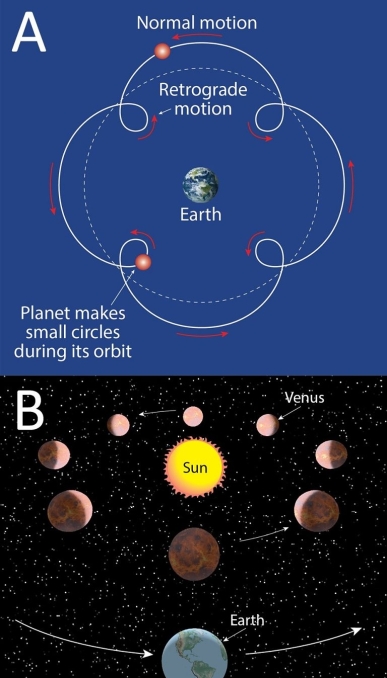 Compare part "A" of the figure to part "B." Decide whether "A" and "B" represent heliocentric or geocentric solar systems. Which of the following statements best describes the two images?
 (Multiple Choice)
4.9/5 (83)
(83) 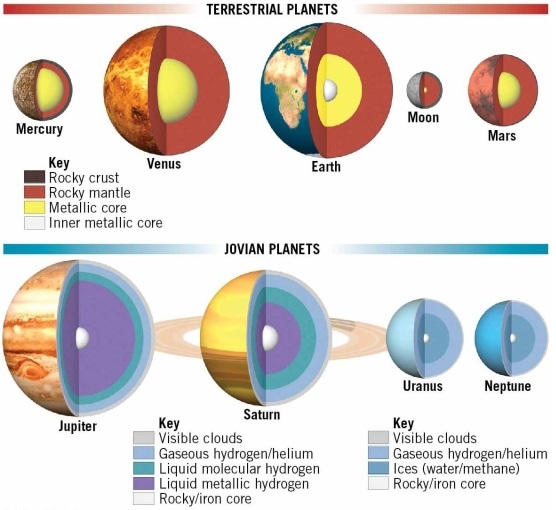 Examine the figure. Explain the origin of the layers inferred to exist within our Solar System's planets. Compare the terrestrial planets to the Jovian planets, and explain the origin of their differences.
 (Essay)
4.9/5 (72)
(72) 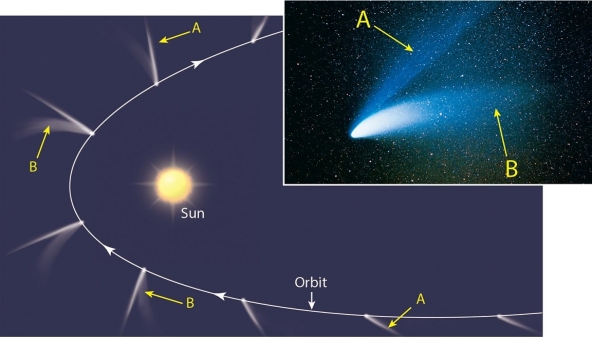 Examine the figure and evaluate the truth of the following statement: The tail labeled "A" is the ion tail of the comet.
 (True/False)
4.9/5 (74)
(74) Approximately how much further away from the Sun is Neptune, as compared to Earth?
(Multiple Choice)
4.9/5 (83)
(83) 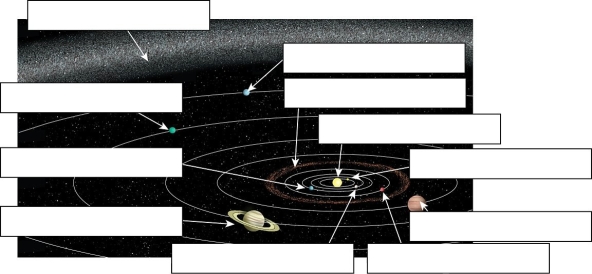
The Cassini gap refers to the planetless belt of asteroids between Mars and Earth.
(True/False)
4.8/5 (66)
(66) ________ is the apparent shift in the position of a nearby star when viewed from extreme points in Earth's orbit six months apart.
(Short Answer)
4.8/5 (85)
(85) 
Filters
- Essay(0)
- Multiple Choice(0)
- Short Answer(0)
- True False(0)
- Matching(0)